

As the salty scent of the sea gradually recedes, giving way to the aroma of red basalt soil and the breath of the vast forest, we know we are stepping into a different space, deeper, slower, and with more layers of emotion.
My morning began in eastern Dak Lak , where the sunrise touched Mui Dien (Cape Dien). At the foot of Ganh Da Dia (Disk Rock Beach), the waves lapped gently, without noise or haste. The Tuy Hoa sea appeared calm, clear blue, sometimes a deep emerald green, reflecting the swaying coconut trees in the early morning sun. The scent of the sea was very real: the smell of fresh fish just arrived, the salty taste clinging to the traveler's hair, even permeating the rice fields being sown in the Tuy Hoa plain.
Standing in Nghinh Phong Square, the sea breeze blows strongly. This breeze carries a unique and pleasant feeling, enough to let go of everyday weariness, to lighten the heart, like a bird gliding across the water.
Leaving the sea, I headed west. The roads began to wind, the sun softened, and the air became cooler. The red basalt soil appeared, deep and tranquil, like a familiar greeting from the plateau. The breath of the forest didn't rush in, but seeped in gradually, enough to make one slow down.
 |
| Dan Phuoc fishing port (Song Cau ward) in the early days of the new year. Photo: V. Tai |
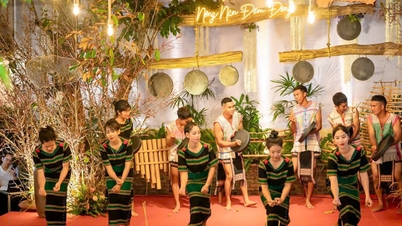
Western Dak Lak welcomed me with the scent of blooming white coffee flowers and the sound of gongs echoing from somewhere in a distant village. If the sea offered the gentle embrace of waves, this place held the tranquil rhythm of the mountains and forests—unpretentious, quiet, yet with a lasting resonance in the heart.
One afternoon, following a friend, I went to Lake Lak. The water was as calm as a mirror, reflecting the changing colors of the highland sky. Sitting by the lake's edge, I suddenly remembered O Loan Lagoon. Two bodies of water, one near the sea, the other in the middle of the highlands, separated by several hundred kilometers, yet both possess a tranquility that makes one feel melancholic.
Dak Lak today is a strange meeting of two regions. On one side, there's the sweetness of lobster and tuna; on the other, the gentle bitterness of a cup of Buon Ma Thuot coffee. On one side, there's the strong aroma of rice wine from seaside restaurants; on the other, the earthenware pot of rice wine by the village fire. These seemingly contrasting flavors blend together naturally, as if they've been familiar for a long time.
Night falls over the mountain town, a chill seeping through every small street. In that breeze, I can still feel the breath of the East Sea, crossing the Ca Pass and the Phuong Hoang Pass, then dissolving into the vast forest. The sea breeze doesn't disappear, it only changes its way of being present, lighter, deeper.
Traveling through the sea and the forest, through the sun, wind, and red soil, one realizes that Dak Lak possesses two distinct yet inseparable beauties. Just a few hundred kilometers, and you step into a different world , yet still feel a sense of familiarity. Perhaps it's because everywhere on this land, whether amidst crashing waves or swirling winds, people can still find a feeling of homecoming.
Source: https://baodaklak.vn/xa-hoi/202601/song-bien-va-gio-ngan-5e912e7/


![[Image] "Journey of Hope" promotes the organ and tissue donation movement in Vietnam.](https://vphoto.vietnam.vn/thumb/1200x675/vietnam/resource/IMAGE/2026/05/20/1779294400833_1-8910-jpg.webp)
![[Photo] National Assembly Chairman Tran Thanh Man working with the Standing Committee of the National Assembly's Ethnic Council](https://vphoto.vietnam.vn/thumb/1200x675/vietnam/resource/IMAGE/2026/05/21/1779337435930_ndo_br_1-jpg.webp)





![[E-Magazine]: And tomorrow, the sun will rise.](https://vphoto.vietnam.vn/thumb/402x226/vietnam/resource/IMAGE/2026/02/27/1772199533891_e-magazine-roi-w1200t0-di2608d199d5160636t11920l1-mtg-013.webp)





















































































Comment (0)