

In this last surviving Tantric Buddhist kingdom, despite welcoming countless tourists and pilgrims every day, it is a place where the people entrust every aspect of their lives. Children follow their parents around the stupas, the elderly lean on their canes and turn prayer wheels, and young people pause to respectfully bow before the Buddha statues. There is no urging, no impatient gaze. Every gesture is slow, yet not sluggish. They are like a gentle stream, quietly seeping in. For them, worship is as natural and essential as breathing to live.
Therefore, it's no surprise that temples and monasteries are built throughout the kingdom. Just a 10-15 minute stroll through the central cities and towns will easily lead you to temples or monasteries with rows of people silently or softly chanting Om mani padme hum while waiting for their turn to push the prayer wheel. Because of this, visitors often immediately sense the difference when entering these temples. Sometimes it's the sound of the wind rustling through the wooden pillars, other times it's the gentle tinkling of small bells in rhythm with the prayers.
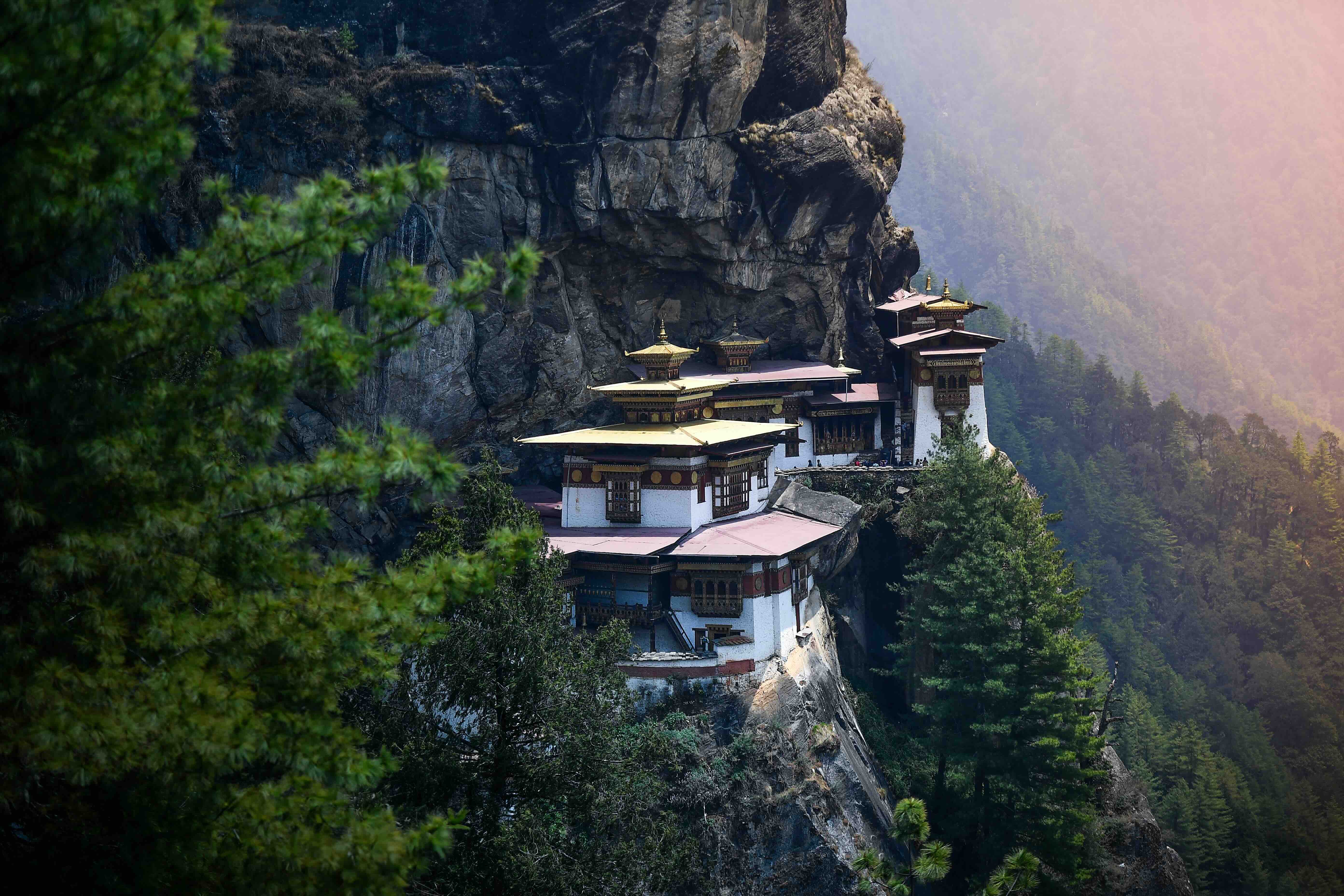
Taktsang Temple is perched precariously on a cliff.
Taktsang – Tiger's Nest
Bhutan's most famous temple, perched precariously on a cliff over 3,000 meters high, is known by the legendary name Taktsang, also called Tiger's Nest. Locals believe that Guru Rinpoche – the master who brought Buddhism to this land – once rode a flying tiger to this place and meditated in a cave. From this belief, the temple was built, becoming a symbol of steadfastness and spiritual strength. The path to Taktsang is not easy: steep stone steps, winding bends, and the breathless gasps at the dizzying altitude. But this also conveys a meaningful message: only through hardship can we truly appreciate moments of peace. Sitting before Taktsang, listening to the lingering sound of wind chimes, one understands that "slow living" is not about stopping, but about patiently taking each step, so that the journey becomes a reward.

The fortress of light, Rinpung Dzong, blazes with the Paro sunset.
Rinpung Dzong – “Fortress of Light”
In the Paro Valley, Rinpung Dzong stands majestically with its sprawling white walls and intricately carved wooden roof. Locals believe it to be a “fortress of light,” a place that maintains the balance between good and evil, between light and darkness within each person. The Dzong is not only a temple but also the administrative and religious center of the region. Every spring, the Paro Tsechu festival takes place here, attracting thousands of locals and tourists to watch the traditional mask dances. In the graceful dances and resounding drumbeats, people hope to find a connection with their ancestors and the universe. What makes Rinpung Dzong evoke the philosophy of slow living is the way the locals spend their days simply strolling around the courtyard, touching the cool stone walls, and listening to a long, melodious tune. For them, happiness is not about quickly completing a task, but about savoring each moment.

The monks walk leisurely at Punakha Dzong.
Punakha Dzong – A place where blessings and prosperity converge.
If Taktsang symbolizes steadfastness, Rinpung Dzong symbolizes light and darkness, then Punakha Dzong is considered a place where love and prosperity converge. Situated between the Pho Chhu (Father River) and Mo Chhu (Mother River), the temple holds sacred significance: the harmony of yin and yang, of nature and humanity. The Bhutanese believe that this dual flow brings blessings, balance, and fertility to the nation. It is no coincidence that Punakha Dzong was once the center of political power, where many of the country's most important ceremonies were held. Walking on the wooden bridge leading to the temple, listening to the sound of the flowing river, I realized that the people here are not detached from nature. They live slowly, in harmony with the earth and sky. And it is this harmony that creates a rare sense of peace.

The ancient Kyichu Lhakhang temple
Kyichu Lhakhang – The Heart of Bhutanese Buddhism
One of Bhutan's oldest temples is Kyichu Lhakhang, built in the 7th century. Locals believe it is the "heart" of Buddhism here, laying the foundation for a belief that has lasted for thousands of years. People often bring their children to the temple to pray for blessings, believing it contains the purest, most primordial energy. Walking around the stupa, I encountered the bright eyes of elderly people, their hands trembling but persistently counting their prayer beads.
Four temples – four stories – gave me a complete picture of Bhutan: steadfastness, balance, harmony, and faith. Each temple is not just a destination, but also a mirror reflecting the slow-paced philosophy of life of the entire nation.
What's special is that the Bhutanese don't consider slow living a skill to be learned, but rather a natural part of life. They don't need to manage time, because for them, time isn't something to control, but something to live with. They don't focus on "seizing opportunities," believing that happiness isn't a future reward, but something to cherish in the present.
Standing silently before the gate of a temple, I once watched a prayer wheel spin in the wind. Those spinning wheels seemed to whisper to me: Happiness is not in our speed, but in the tranquility of our mind. Perhaps the secret of the Kingdom of Happiness lies in this simple thing: they don't race to seize the future, but walk slowly to preserve the present.
And who knows, in a moment when we dare to slow down, we might find the most peaceful version of ourselves.
Source: https://heritagevietnamairlines.com/song-cham-o-bhutan/















![[Photo] A vibrant celebration of generations of Nhan Dan Newspaper staff](https://vphoto.vietnam.vn/thumb/1200x675/vietnam/resource/IMAGE/2026/03/11/1773228432744_cb-75-nam-7-7034-jpg.webp)










































Comment (0)