

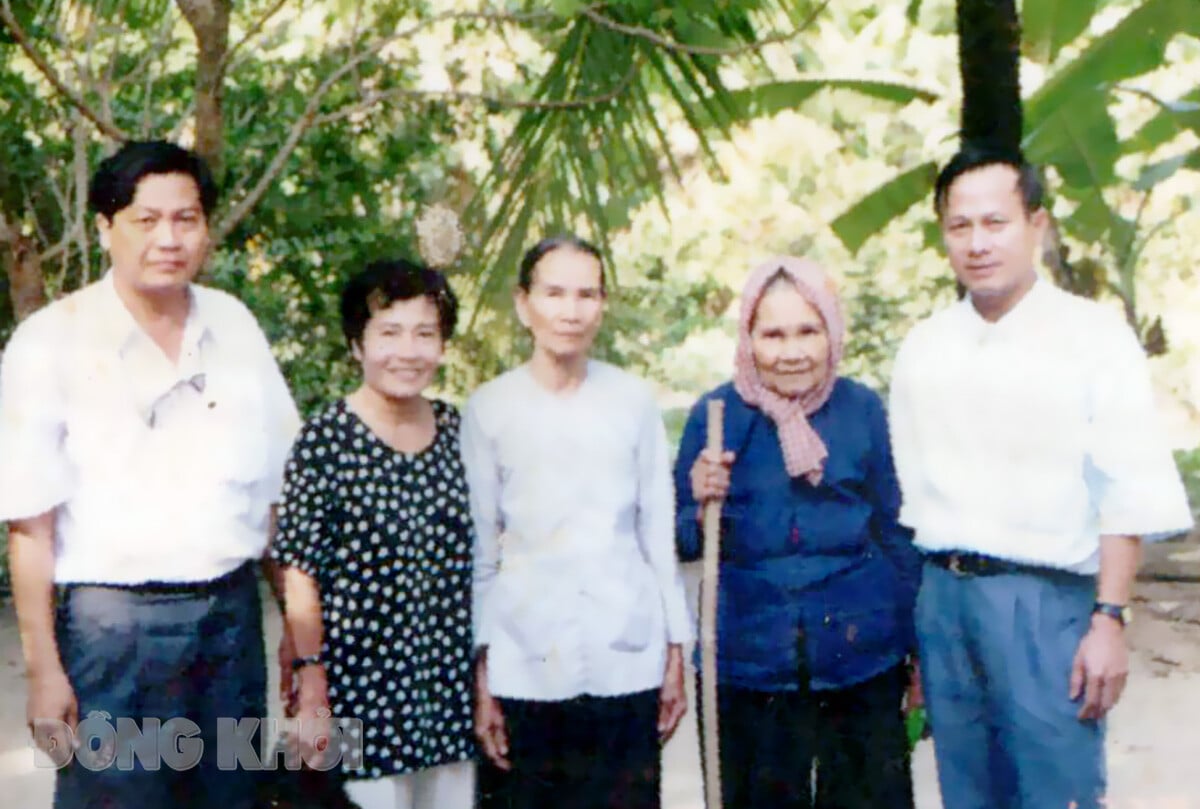
Comrades from the Press and Information Subcommittee visited Mrs. Ba Hanh and Mrs. Pham Thi Hoa (second and third from the right), who sheltered and protected them when the agency was located in Tan Loi Thanh commune from 1967 to 1969. (Archival photo)
The bond of love and loyalty to the people is profound.
In the writings of journalist Huynh Nam Thong - former Editor-in-Chief of Chien Thang Newspaper (later Dong Khoi Newspaper) - he likened the years of resistance to a period when journalists lived in a "vast ocean of the people" and a "love as vast as the ocean," meaning they were protected by the people so that revolutionary journalism could fulfill the political tasks assigned by the Party. This is a precious thing that no journalist can ever forget.
He wrote: “What cannot be forgotten are the families in the ‘vast ocean of the people’ of the ‘oceanic love’ who once sheltered, protected, and nurtured those who worked for the Victory Newspaper. It is impossible to recount them all, yet one cannot help but feel a pang of regret and remorse. Because there was no place the editorial office did not set foot in. From remote areas, on the outskirts, in coconut groves, in open fields, on barren hills or at the edge of forests… everywhere left the mark of sacredness – sacred because it was the sincere heart – a kind of direct, profound, and overflowing love of the people for the newspaper – or more accurately, for the Party, for the revolutionary cause. It is impossible not to utter in words the sacred gratitude that was once deeply etched in the hearts of those who had the honor of working for the Victory Newspaper during the anti-American war.”
The editorial staff of Chien Thang Newspaper has visited countless families during its journey of more than two decades. Journalist Huynh Nam Thong recounted: “After liberating the vulnerable area in Cho Lach following the Tet Offensive, we even ventured up to Vinh Thanh (Cai Mon), a Catholic area, and the editorial staff was assigned to stay with a wealthy family. We were given the upper part of the house, 'with high walls and gates.' The host took care of the meals, claiming his daughter would handle them. We were always treated like honored guests, with huge plates constantly filled with rambutan, mangosteen, durian, and longan. We were very embarrassed, but the host was always open and welcoming.”
Or another family in Long My where the editorial office once stayed had only Mr. Tu as the homeowner. His wife died when their daughter was still an infant. “When we withdrew, she volunteered to join the army and was killed in action. Later, when we had the chance to visit, Mr. Tu had aged considerably due to loneliness. We were worried he might blame the Victory Newspaper for ‘luring’ his daughter to the battlefield, leaving him to live alone from then on. But he wasn’t angry; instead, he begged us to visit him when we had time, and from the bottom of his heart, he said: The newspaper had shown us a worthy path to sacrifice.”
Once, the editorial team stayed at a well-off house in Binh Khanh, Mo Cay. The homeowner was known for his meticulousness. Every day, he used a pointed stick to gather up fallen leaves and burn them. He dedicated three rooms upstairs to us for work, furnished with polished rosewood and ebony tables and chairs, and a mother-of-pearl inlaid long bench where we could comfortably stretch our legs when writing, a truly delightful experience. Every lunchtime, his wife would bring us plates of sweet potatoes, cassava, or sometimes fruit. Both he and his wife had grown-up children and grandchildren living nearby; no one wanted to live with them because they were afraid of his difficult nature. But for the revolution, he readily set aside his difficulties and granted us every privilege,” wrote Mr. Nam Thong.
Portrait of our compatriots
Everywhere, the people were a "forest of people, a forest of love," bound to the revolution like a "heavenly net" enveloping journalists, leaving behind indelible memories of profound gratitude and unforgettable kindness. And through the pens of journalists, the beautiful portraits of the people in the resistance zones were recorded. There was the frail mother from An Khánh who stayed amidst the bombs and bullets to gather rice to cook meals for the soldiers, preventing hunger in the trenches, as journalist Thanh Nhân recounted in his report "The Old Mother on the Front Line": "The mother moved back and forth like a shuttle on the front line. At night, she voluntarily took up arms, accepting the sacrifice to open a path for the soldiers to escape the enemy's encirclement, crossing Highway 6 to reach the liberated zone safely."
It was Nhi's parents in Cau Dinh, Binh Khanh, who dedicated all their love to the revolution, to the propaganda cadres, and to the Chien Thang (Victory) Newspaper. Journalist Thanh Nhan wrote: "Later, I learned that Nhi's mother was always in debt because she raised her children, but she never let them know. Whenever a child came home, whether early in the morning or in the middle of the night, she loved and cared for them as if they were her own. If a child needed a family, even amidst bombs and bullets, she would go to great lengths to find and bring them home. Nhi's father, though old and frail, built hundreds of secret bunker covers for the provincial propaganda cadres."
Turning the pages of the province's journalistic history, in almost every section, including memoirs and portraits of resistance journalists, the image of the people is never absent. Journalism resided in the hearts of the people, journalism fought alongside the people against the enemy, and its existence depended on the people. Journalist Huynh Nam Thong affirmed: "No amount of paper and ink can record all the heartfelt sentiments, no amount of memory can preserve all the feelings and memories of a time of resistance, transforming our narrow, private feelings into the greater cause, into the revolutionary cause. Later, no matter what we accomplished, big or small, we considered ourselves merely grains of sand in the vastness of our success and growth, thanks to the people's kindness."
Thanh Dong (excerpt)
Source: https://baodongkhoi.vn/song-trong-moi-tinh-dai-duong--16042025-a145241.html

























































Comment (0)