

SpaceX officials said the launch of the giant rocket was delayed just minutes before its scheduled launch time. SpaceX boss, billionaire Elon Musk, said a pressure valve appeared to have frozen, forcing a delay to the launch, which was planned for 8:20 a.m. local time Monday at SpaceX's spaceport in Boca Chica, Texas.
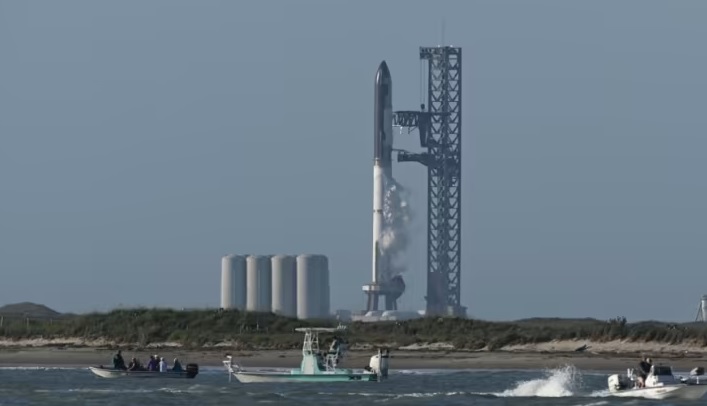
The SpaceX Starship rocket on the launch pad at SpaceX's Starbase in Boca Chica, Texas, on April 17, 2023. Photo: AFP
"I learned a lot today, now offloading fuel, will try again in a few days," Musk wrote on Twitter. SpaceX said the launch would be delayed by at least 48 hours.
The US space agency NASA has selected the Starship spacecraft to take astronauts to the Moon by the end of 2025 – a mission called Artemis III – which will be the first time humans have returned to the Moon since the Apollo program ended in 1972.
Starship consists of a 50-meter-tall spacecraft designed to carry crew and cargo, atop a "super" Starship booster rocket. Musk warned before the test that delays were possible.
"It's a very dangerous flight. This is the first launch of a huge, very complex rocket," he said. "There are a million ways this rocket could fail. We're going to be very careful, and if we see anything that worries us, we'll postpone it."
NASA will send astronauts into lunar orbit in November 2024 on the Artemis mission using its own heavy-lift rocket called the Space Launch System (SLS), which has been under development for more than a decade.
However, they will need Starship for the Artemis III mission because it is both larger and more powerful than the SLS. It generates 17 million pounds of thrust, more than double that of the Saturn V rocket used to launch the Apollo astronauts to the moon half a century ago.
SpaceX plans to launch one Starship into orbit, then refuel it with another Starship so it can continue its journey to Mars or beyond.
Musk said the goal is to make Starship reusable and reduce the cost to a few million dollars per flight. "In the long term—meaning in the long term, I don't know, two or three years—we should achieve full and rapid reusability," he said.
The ultimate goal of the Artemis program is to establish bases on the Moon and Mars and put humanity on "the path to becoming a multi-planetary civilization," billionaire Musk expressed his ambition.
Huy Hoang (according to NASA, CNN, AFP)
Source


![[Image] National Assembly discusses the implementation of the socio-economic development plan.](https://vphoto.vietnam.vn/thumb/1200x675/vietnam/resource/IMAGE/2026/04/20/1776696707422_ndo_br_img-20260420-185419-jpg.webp)

![[Photo] General Secretary and President To Lam meets with National Assembly delegates from ethnic minorities.](https://vphoto.vietnam.vn/thumb/1200x675/vietnam/resource/IMAGE/2026/04/20/1776696701056_a1-bnd-8331-3342-jpg.webp)

























































































Comment (0)