Unlocking land resources will make a significant contribution to economic growth.
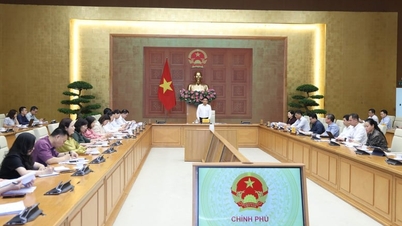
The Politburo has just issued Notice No. 04-TB/TW on the National Land Use Planning Adjustment Project for the period 2021-2030, with a vision to 2050.
The Politburo assigned the Party Committee of the Government to direct the Party Committee of the Ministry of Agriculture and Environment to coordinate with relevant agencies to urgently conduct a preliminary review of the implementation of Resolution No. 18 of 2022 of the Central Committee in order to propose fundamental amendments to land policies, and submit them to the 3rd Central Committee Conference for consideration and comments.
Based on that, a proposal to amend the Land Law is submitted to the National Assembly for consideration and decision.
In an interview with Tuoi Tre newspaper, Associate Professor Dr. Nguyen Quang Tuyen, Vice Chairman of the Board of Directors of Hanoi Law University, analyzed the situation and offered several recommendations.
Aiming for double-digit growth.
* In your opinion, why do we need to amend the Land Law after more than a year of implementation? Does this mean the current law is not fully utilizing this resource for development?

Assoc. Prof. Dr. Nguyen Quang Tuyen, Vice Chairman of the Council of Hanoi Law University
- The current amendment to the Land Law primarily aims for double-digit growth, while also adjusting regulations to suit the context of a two-tiered local government system and the application of technology in land management.
In reality, businesses still face difficulties in accessing land, so the procedures for land allocation and leasing must be streamlined and simplified through the application of artificial intelligence (AI) technology to handle procedures instead of the current manual methods.
Secondly, it is necessary to quickly complete and standardize land database information in a way that is complete, clean, and up-to-date. When land management agencies do not have standardized information and data, and each agency has different data, integration and interoperability will be impossible, making unified management very difficult.
For example, while local authorities can compile administrative land management data, data on how many plots of land an individual owns, and in which localities, has not yet been integrated.
There are still no records of cases where land owned by one person is registered under another's name to "circumvent" regulations. The cadastral map system and land parcel diagrams have not been synchronized until now.
Thirdly, it is necessary to determine land use fees and land-related financial obligations at appropriate levels, supporting businesses in accessing land for production.
* Is land reclamation also a hot issue that needs clearer regulations?
- Regarding land acquisition, it must be clearly defined that land acquisition serves socio-economic development, brings common benefits, and creates a ripple effect of development throughout the region. In such cases, the State must use administrative mechanisms to implement it.



However, in cases where a business reclaims land to serve its own projects, this process should be carried out under civil law mechanisms.
Regardless of how we amend the Land Law, compensation must be calculated in a way that allows people to secure housing, so they will be happy to move to their new homes. Otherwise, the State should establish a resettlement housing fund so they can confidently leave their old homes.

Revenue from land (through land auctions) has increased in recent years - Photo: NAM TRAN
There are still many land issues and large projects that need to be resolved.
* Besides improving institutions, what else do we need to do to ensure that land truly becomes a driving force for growth?
According to the Ministry of Agriculture and Environment, as of March 30, 2025, the whole country recorded 4,489 projects and land issues facing difficulties and obstacles, corresponding to approximately 198,428 hectares of land and a total investment capital of about 3.3 million billion VND. This figure is three times the total public investment capital in 2026.
To date, ministries, central and local agencies have resolved 1,151 projects within their jurisdiction, with a total land area of approximately 52,790 hectares and a total investment capital of approximately 804,953 billion VND.
To address this, the National Assembly recently passed Resolution No. 29 of 2026. This mechanism needs to be added to the amended law for consistent implementation.
Furthermore, the amendment to the law needs to include provisions on handling surplus office buildings of state agencies after the merger of provinces, communes, and two-tiered local government organizations, in order to free up resources and prevent loss and waste.
Finally, amendments to the Land Law must address the imbalance between housing supply and demand in the real estate market. This is a social welfare issue aimed at providing housing for the majority of middle- and low-income workers. The law needs to provide solutions for land use planning to develop various types of housing in order to balance market supply and demand.
3,338
These are the outstanding land-related projects with unresolved issues, covering an area of approximately 145,638 hectares and a total investment of over 2.5 trillion VND. Of these, 1,814 projects fall under the jurisdiction of local authorities and 1,524 projects fall under the jurisdiction of the National Assembly.
* Mr. Pham Duc Toan (General Director of EZ Real Estate Investment and Development Joint Stock Company):
Collect land use fees, but don't let businesses be caught off guard.
The most pressing issue for businesses is land allocation and land use fee calculation. Regarding land allocation, the question remains: what form should it take? For example, leasing land with a lump-sum payment, annual payments, or land allocation with a lump-sum land use fee – these are still unresolved issues. Calculating land use fees is also complex; although a coefficient K exists, some localities still add it based on local practices and market information, often resulting in losses for businesses.
In calculating land use fees, some localities recalculate the fees repeatedly. In some cases, a locality has already determined the land use fee for a project, but when inspection or auditing agencies come in, they add additional land use fees.
There was a business that completed a project in Hung Yen nearly a decade ago. They had already paid land use fees to the local authorities, received land ownership certificates, and people had built houses and moved in. However, after an inspection, the land use fees for the project were recalculated, resulting in an additional cost of hundreds of billions of dong.
This revision of the law needs to address the obstacles in land allocation and land use fee calculation to facilitate citizens and businesses, and maximize the efficiency of land use. At the same time, there needs to be a mechanism to support appropriate land allocation instead of leaving businesses to negotiate on their own.



* Dr. Pham Viet Thuan (Director of the Institute of Resource and Environmental Economics, Ho Chi Minh City):
Avoid letting land prices become a burden.
According to current regulations, the coefficient K multiplied by the land price table is applied to calculate land use fees in cases of land compensation and land prices for calculating land use fees at resettlement sites; calculating land use fees and land rent when allocating or leasing land...
Adding the coefficient K benefits people whose land is confiscated by the State, but it will increase land prices for many other land users. Specifically, the land price used for calculating taxes and fees will increase sharply, directly leading to heavy financial pressure on people when going through procedures to change land use purposes, and causing input costs for real estate businesses to skyrocket, driving up housing prices.
For households and individuals, land use fees, personal income tax, and registration fees when transferring ownership, changing land use purposes, or issuing new land use certificates will increase sharply. Many households, especially in urban or suburban areas, lack the financial means to pay land use fees, and those in rural areas also face difficulties.
From the perspective of businesses and the economy, real estate projects will face increased costs. Applying a high K coefficient will significantly increase land acquisition costs and land use fees that investors must pay to the State. Investors will then pass these costs on to the selling price of houses, causing housing prices to remain far beyond affordability, increasing social inequality, and making housing more difficult for workers to access.
In addition, increased costs for renting production space, land in industrial clusters and zones, or business premises will push up the prices of products and services, creating inflationary pressure and reducing the competitiveness of the economy.
To prevent land prices from becoming a burden and to ensure the stimulation of production and economic growth, it is essential to amend and improve the Land Law by stipulating a flexible method for applying the K coefficient. The amended Land Law should transform the K coefficient into an effective tool for regulating land prices, thereby regulating and stimulating growth in accordance with the practical realities of each time period and locality.
Source: https://tuoitre.vn/sua-luat-dat-dai-thuc-day-tang-truong-10026062123591461.htm


![[Photo] "Hanoi Lotus Festival" honors the lotus flower that has been associated with Vietnam for thousands of years.](https://vphoto.vietnam.vn/thumb/1200x675/vietnam/resource/IMAGE/2026/06/27/1782516943048_sen-ha-noi-2026-minh-duy-1-jpg.webp)