

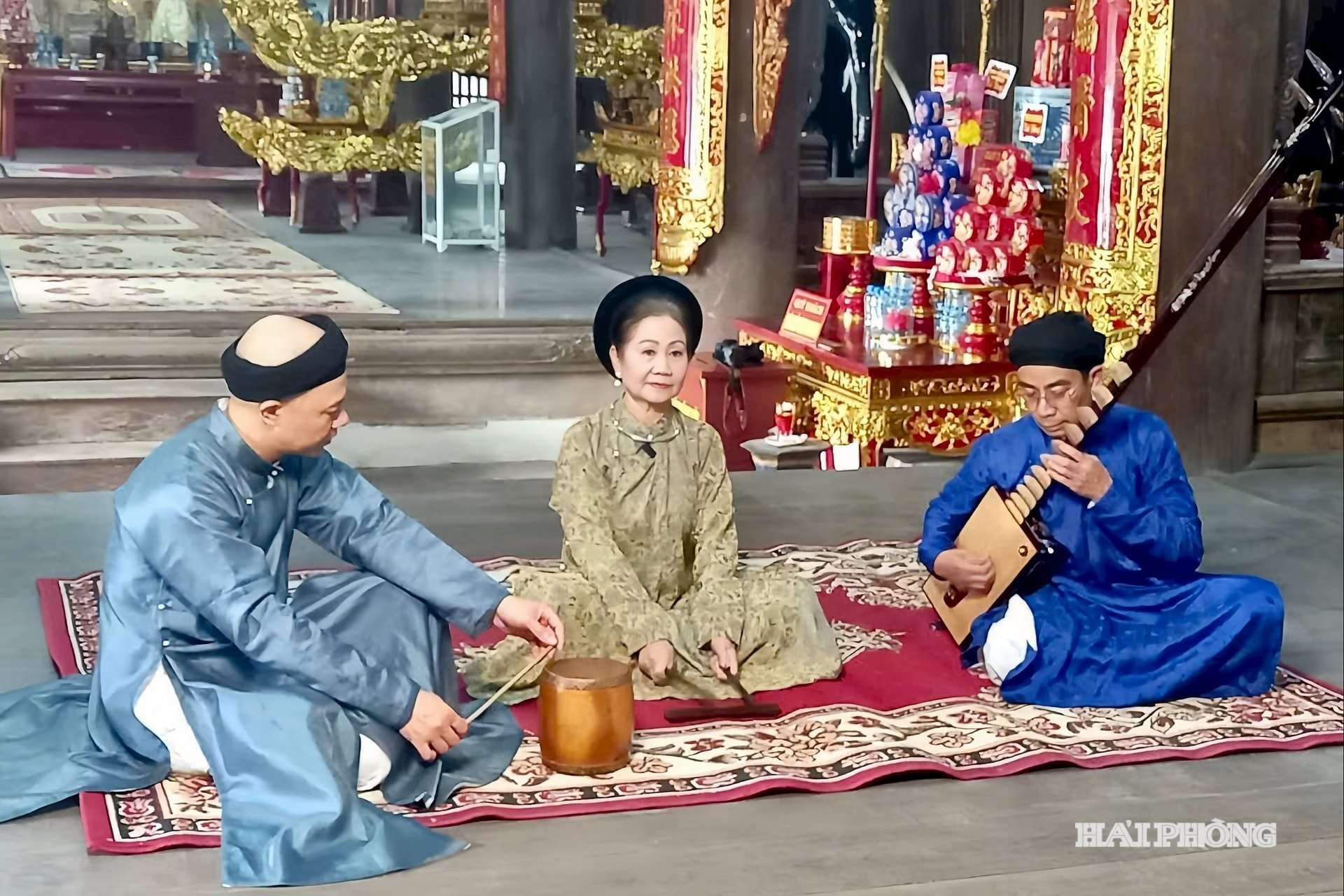
Meritorious Artist Do Quyen performs Ca Tru (traditional Vietnamese singing) at Kenh communal house.
Echoes of ancient songs
On the last Saturday of each month, in the ancient setting of Kênh Temple, the performers of the Hai Phong Ca Tru singing troupe sing and beat their percussion instruments rhythmically before a large crowd of locals and tourists. This activity has been regularly maintained since 2007.
The Hai Phong Ca Tru guild currently has over 30 members, the youngest being only 12 years old but already capable of assuming the role of a court official. The person who laid the foundation for the Hai Phong Ca Tru movement is the Meritorious Artist Do Quyen, who is nearly 80 years old this year.
Ms. Quyen previously worked at the Hai Phong Cheo Troupe, then transferred to the Department of Culture and Information (now the Department of Culture, Sports and Tourism). She recounted her journey into ca trù (traditional Vietnamese singing): “Back then, I often heard veteran artists perform ca trù, and I became captivated without even realizing it. In 1993, I started studying ca trù and became the first member of the Hai Phong Ca Tru Club (now the Hai Phong Ca Tru Guild), and I've been involved with it for over three decades.”
Since 2014, the Hai Phong Department of Culture, Sports and Tourism has provided annual funding (20-30 million VND/year) to support the preservation, teaching, and promotion of Ca Tru (traditional Vietnamese singing). For many years, the Hai Phong Ca Tru Guild has consistently won high awards at national Ca Tru festivals. From 2015 to the present, the Hai Phong Ca Tru Guild has collaborated with Nguyen Cong Tru Primary School to open six training courses, attracting nearly 100 students, of whom more than 10 have become regular members of Ca Tru clubs.
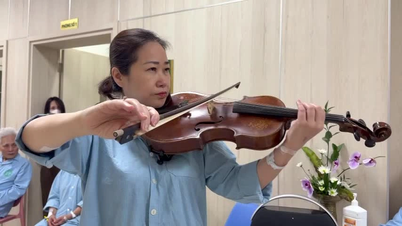
Moreover, the model of teaching Ca Tru (a traditional Vietnamese musical genre) in schools is spreading to many localities. Every Tuesday afternoon, the traditional room of Dan Chu Primary School (Tan Ky commune) resonates with the rhythmic clappers, the sounds of the Dan Day (a type of lute), and the voices of young singers. This special class has been running for over 10 years, taught directly by singer Truong Thi Chiem (granddaughter of People's Artist Nguyen Phu De, who is known as the "foremost master" of Ca Tru).
Each year, around 40-60 students enroll, divided into several groups. "I didn't study pedagogy, but I always try to find suitable teaching methods to keep the children interested. Older students who sing well will mentor the newcomers," Ms. Chiêm shared. Outstanding students are selected to perform in school and local cultural and artistic activities.
In the classroom, all musical instruments such as clappers, zithers, drums, mats, etc., are provided. Students begin by tapping the clappers, singing lullabies, and singing short folk songs, before moving on to spoken singing – a popular style in Ca Tru, requiring techniques such as vibrato, vocal embellishments, breath control, and vocal trills. Thanks to this systematic teaching method, many young children have nurtured a lasting love for this heritage.
Many schools in Hai Phong also regularly include ca trù in their curriculum, gradually "rejuvenating" the next generation of this traditional art form that appeals to a niche audience.
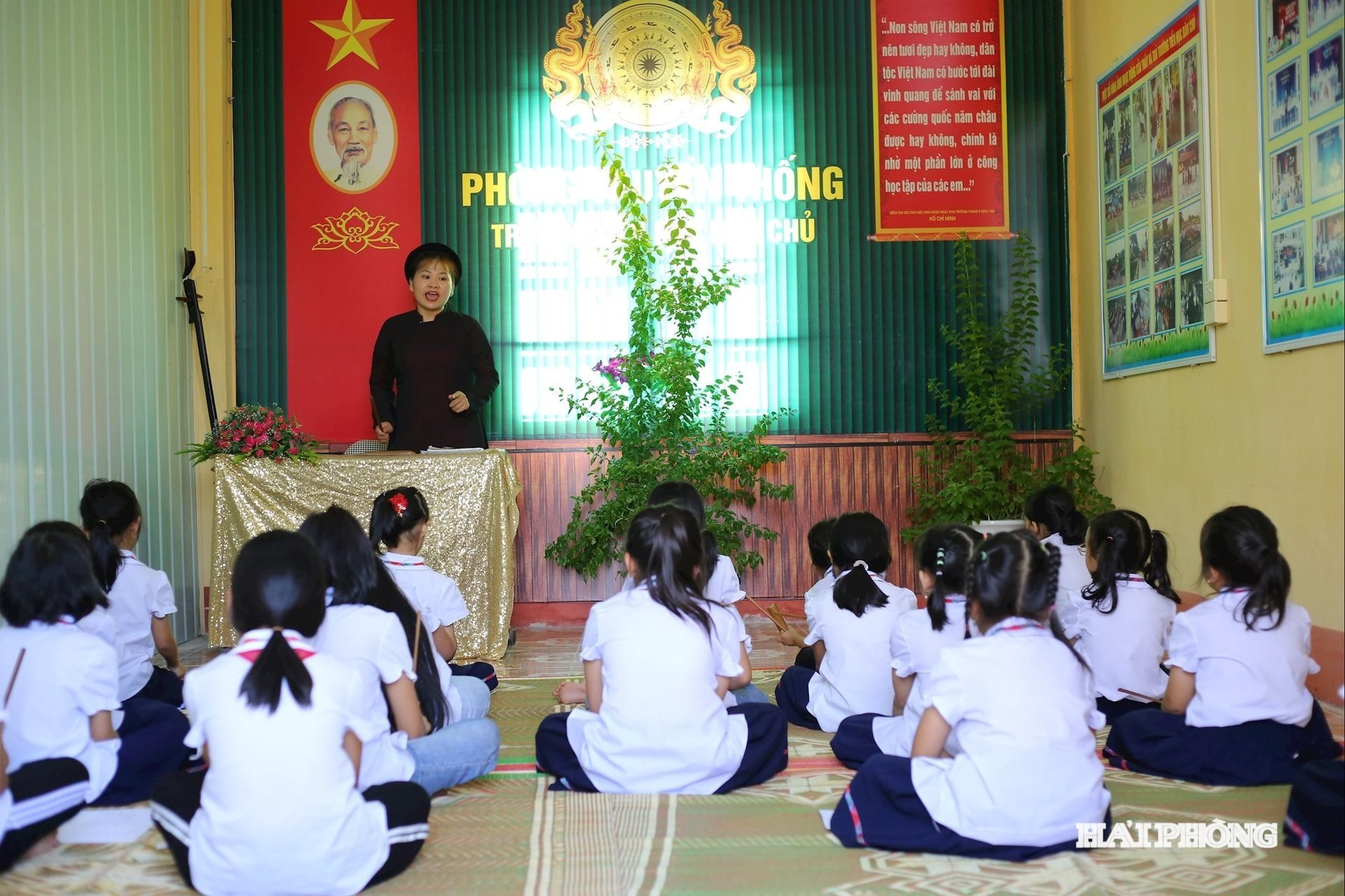
A traditional Vietnamese folk singing class is being held in the traditional hall of Dan Chu Primary School (Tan Ky commune).
To make Ca Tru (traditional Vietnamese singing) no longer "for a select audience".
In a small house in Phu Da village (Binh Giang commune), the song "Dao Hong Dao Tuyet" (Pink Peach Blossoms, Snow Peach Blossoms) resonates, blending with the deep, resonant sound of the zither, the rhythmic clappers, and the lively beat of the drums. Sisters Tran Thi Thanh Truc and Tran Thi Bach Duong enthusiastically practice under the guidance of their grandfather, Tran Van Tha.
Mr. Thả used to play many traditional musical instruments and was skilled at singing Chèo (traditional Vietnamese opera). In 2017, he began learning Ca Trù (a traditional Vietnamese musical genre) and passed the passion on to his grandchildren. Every summer, he would take Trúc and Dương to Ca Trù art training classes organized by the Hai Duong (formerly) Provincial Cultural and Arts Center. “He played the instrument, the youngest played the clappers and sang the main part, and the older sister played the drums and sang backing vocals. The three of us performed together at many festivals,” Mr. Thả recounted.
The two sisters, Truc and Duong, also expressed their desire to be involved with ca trù (traditional Vietnamese singing) for the long term. On evenings when they don't have school schedules, the three of them practice together.
Despite positive signs, experts still recognize that the path to preserving Ca Tru (a traditional Vietnamese musical genre) remains fraught with challenges. Folk culture researcher Nguyen Dinh Chinh, Chairman of the Hai Phong Folk Arts Association, stated: “The Association is very interested in Ca Tru. Folk arts workshops encourage the writing of new lyrics for Ca Tru and prioritize performance opportunities. However, in reality, Ca Tru remains a genre that appeals to a select audience, especially young people, so further efforts are needed to preserve and promote it.”
Mr. Chinh also emphasized that, in addition to the efforts of artisans and clubs, there needs to be stronger support mechanisms in terms of funding and media to bring Ca Tru closer to the public, especially the younger generation. Because only when there are listeners and lovers can Ca Tru truly thrive in contemporary life.
LINH ANH
Source: https://baohaiphong.vn/suc-song-ca-tru-521186.html
![[Photo] General Secretary and President To Lam meets with National Assembly delegates from ethnic minorities.](https://vphoto.vietnam.vn/thumb/1200x675/vietnam/resource/IMAGE/2026/04/20/1776696701056_a1-bnd-8331-3342-jpg.webp)




![[Image] National Assembly discusses the implementation of the socio-economic development plan.](https://vphoto.vietnam.vn/thumb/1200x675/vietnam/resource/IMAGE/2026/04/20/1776696707422_ndo_br_img-20260420-185419-jpg.webp)







































































Comment (0)