

In the early stages of North Korea's ballistic missile program, the country primarily adopted Soviet missile technologies. Examples include the short-range Hwasong-5, 6, and 9 missiles, which use liquid fuel and are based on the designs of the Scud B and C missiles; and the KN-02 and medium-range Rodong-1 missiles, which use solid fuel and are similar to the OTR-21 Tochka missile.
Most of these missiles are derived directly from earlier Soviet designs, with the exception of the Hwasong-9, which is an improved version of the Scud with a longer range, higher accuracy, and greater maneuverability during flight.
Once deployed, the Hwasong-9 placed US bases across Japan within range. These North Korean missiles were subsequently exported to several partners, including Pakistan, Syria, and Iran.
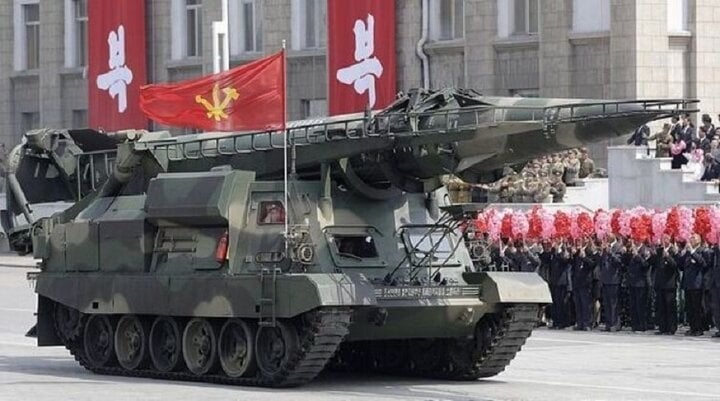
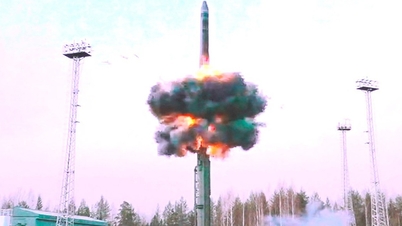
The Hwasong-9 ballistic missile on a mobile launch platform.
Taepodong 2 Program
Throughout the 2000s, Western analysts almost unanimously reported that North Korea had a relatively basic level of technology and was developing an intercontinental ballistic missile based on Soviet Scud technology. The West later named this intercontinental ballistic missile Taepodong 2.
In the United States, the Director of the Central Intelligence Agency, George Tenet, testified before the Senate Armed Services Committee in the late 1990s that North Korea was on track to develop an intercontinental ballistic missile capable of striking U.S. territory.
At the time, George Tenet observed that North Korea's defense industry had made technological advances and could address some critical technical issues in developing long-range missiles capable of reaching areas of the United States, although accuracy was still lacking.
Referring directly to the Taepodong 2, he stated that the two-stage liquid-fueled rocket could carry a larger payload, sufficient to reach the Alaskan and Hawaiian Islands. Tenet further predicted that this rocket could be developed into a three-stage variant, capable of covering the rest of the United States.
George Tenet also stated, " The United States is deeply concerned about North Korea's secret nuclear weapons program and considers North Korea's secret underground facilities a primary target for U.S. monitoring ."
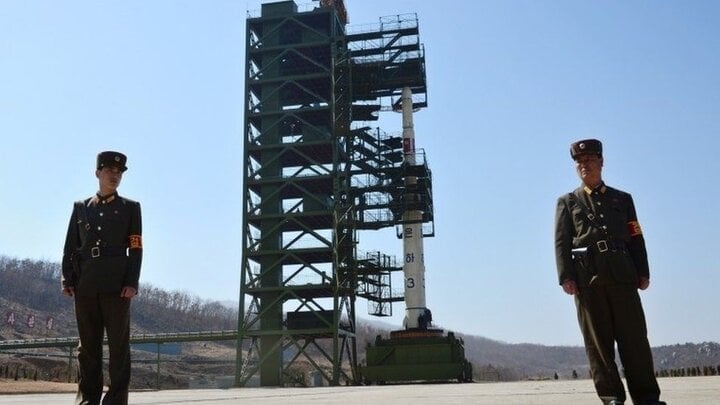
North Korean soldiers stand next to the Unha-3 satellite launch vehicle.
Years later, U.S. Ambassador to the United Nations Samantha Power directly mentioned the Taepodong 2 when confronting North Korean diplomats . Power accused North Korea of developing ICBM technology. Japanese media also reported in August 2003 that the Taepodong 2 was not only a threat to Tokyo, but that the missile was being transferred to Iran, where North Korea was preparing to transfer a manufacturing plant to assist Iran in producing ICBMs under license.
Although North Korea has long touted its missile capabilities as a symbol of power, Pyongyang has never unveiled the Taepodong 2 or any missile as described by the West. Military experts analyzing the Taepodong 2 program have found that such a missile never existed, the accusations against North Korea are fabricated, and it wasn't until 2017 that North Korea deployed its first ICBM.
Taepodong 2 is believed to be North Korea's Unha-2 and Unha-3 satellite launch vehicles, used to deploy weather observation satellites into space, with Kwangmyongsong-2, 3, and 4 variants. The launch vehicles are believed to use engines similar to those of the Rodong rocket, but they are not designed for combat use.
The truth about Taepodong 2
Unha missiles carry a modest payload for their size and require days to assemble using extensive scaffolding structures, making them extremely vulnerable to enemy attack due to their slow deployment time.
Meanwhile, North Korea's ballistic missiles are generally highly regarded for their survivability and deployment from mobile launchers, with launch times as short as minutes. This capability encompasses all types of ballistic missiles, from older-generation tactical missiles like the Hwasong-5 to newer, larger ICBMs like the Hwasong-17.
Regarding the inability of the Unha launchers to be used in combat, aerospace expert and North Korea missile program analyst John Schilling asserted: " An intercontinental ballistic missile (ICBM) using the Unha design is not in Pyongyang's plans . "
Initially, we mistook that missile (from satellite images) for an ICBM and gave it the intriguing name Taepodong-2. But the Unha was clearly not optimized for military purposes; it was too large and cumbersome.
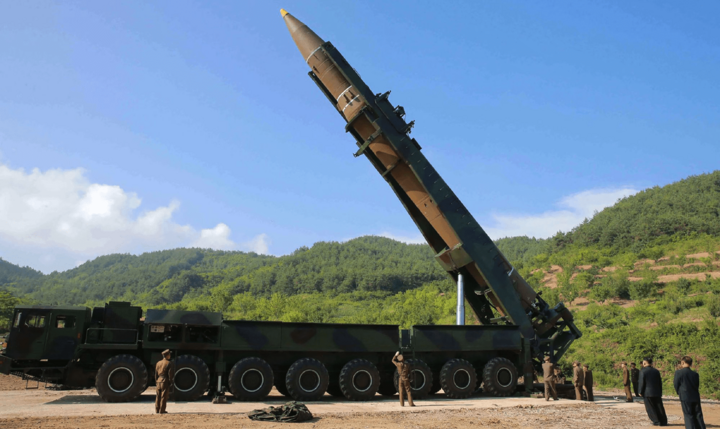
ICBM Hwasong-14 on its transport launch platform.
However, allegations that North Korea is testing ICBMs, rather than peacefully pursuing its space program, provide a valuable pretext for Western powers to push for further economic sanctions to weaken the country.
It wasn't until the late 2010s that the US Department of Defense reported that Taepodong-2 had never been deployed as a missile, and Western analysts also reported that the Unha space launch vehicle had in fact never been used for military purposes.
North Korea is often referred to by Western intelligence as an "intelligence black hole," so Taepodong 2 is just one of countless sensational stories in US foreign policy toward the country.
Le Hung (Source: Military Watch)
Source


![[Photo] Prime Minister Pham Minh Chinh presides over a meeting on private sector economic development.](/_next/image?url=https%3A%2F%2Fvphoto.vietnam.vn%2Fthumb%2F1200x675%2Fvietnam%2Fresource%2FIMAGE%2F2025%2F12%2F20%2F1766237501876_thiet-ke-chua-co-ten-40-png.webp&w=3840&q=75)












































































Comment (0)