

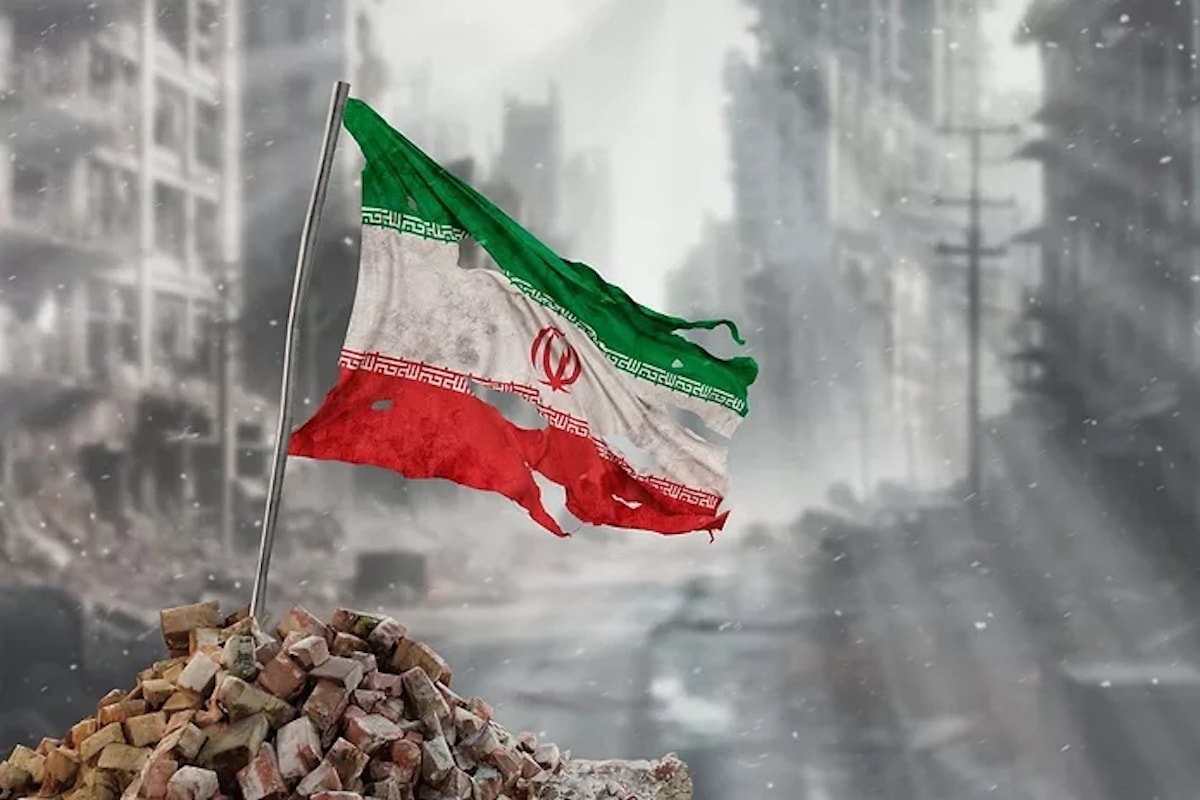
Look at the examples of history.
There is a moment in every major geopolitical confrontation when the outcome of the conflict becomes clear and almost irreversible before either side is willing to publicly acknowledge it.
Firepower decides battles, but willpower determines the entire war—a lesson that America, despite having learned many lessons in the past, still refuses to acknowledge.
Ancient Rome understood this very well, as the Germanic tribes refused to yield to the Roman Empire. The United Kingdom also understood this in 1947, when they stood empty-handed in the colonial territory of New Delhi after the decline of the empire...
We are living in such a moment, and almost no one in the decision-making rooms is willing to admit it – Iran has won. Not necessarily on the battlefield, but strategically. And the proof lies not in the number of missiles or the number of casualties, but in one undeniable fact: both Washington and Tel Aviv fear what Tehran will do next more than anything Iran has done so far.
That fear is well-founded. To understand why, we need to set aside the familiar stage of press conferences and congressional hearings and look at what has actually been built over the past four decades.
The architecture of patience
The Iranian Revolutionary Guard Corps (IRGC) didn't spend 20 years building an army. They built an architecture of dispersed and self-replicating proxy forces, tunnel systems, drone factories, missile stockpiles, and an intelligence network stretching from Beirut (Lebanon) to Sanaa (Yemen). And that structure wasn't built by improvisation, but by deliberate design.
Game theorists call this the “latecomer advantage.” Much of traditional military thinking holds that a preemptive strike—the shock, the overwhelming impact, and the psychological effect of the “first strike” strategy—will give them an advantage and victory. The US perfected this doctrine through “shock and awe” campaigns, using precision bombing and raids targeting leadership. It is an effective war manual if the opponent also plays by the same rules.
However, Iran never accepted that code of conduct. Instead, they pondered the lessons that Vietnam, Iraq, and Afghanistan had warned anyone who would listen: America wins battles but loses the war.
Firepower decides battles, but willpower determines victory. A nation fighting for survival creates a depth of will that a nation fighting simply to protect its prestige can never match. This asymmetry—quiet, structural, and almost invisible in the daily news cycle—is the driving force behind everything in the Iran war.
The collapse of Israel's deterrence capability.
Let's consider the foundation upon which Israel's deterrence is actually based. For decades, that structure has been quite simple yet effective: if someone attacks us, the cost will outweigh any potential gains.

It worked very effectively against Egypt in 1973 – conventional adversaries had fixed addresses and governments had to keep their fragile economies from collapsing. Deterrence is a kind of deal. It requires the adversary to have something they absolutely fear losing.
But who can Israel deter if its adversaries are forces with "nothing to lose"? When Hezbollah loses a commander, the command structure is immediately dispersed. When Hamas loses one tunnel, three more are immediately dug. When Iranian assets in Syria are attacked, they are moved elsewhere. Israel has bombed those same supply lines for 15 years, yet they remain operational. This is not simply a military failure, but a conceptual failure.
The "brinkmanship" theory
And then there's the nuclear issue, which Western media frequently simplifies into two binary questions: Does Iran have a nuclear bomb, while the strategic reality is far more complex.
Iran doesn't need atomic bombs; they need a safe threshold. North Korea understands this. Pakistan understands it too. Israel has been quietly preparing for this for 50 years without ever officially declaring its arsenal.
This doctrine is known as maintaining “strategic ambiguity” regarding nuclear capability, and its logic is ruthless in its simplicity: a nation that may possess nuclear capabilities is more strategically crippling than a nation that certainly possesses nuclear weapons.
In reality, when a country openly crosses the threshold, the deterrent effect is applied, and everyone understands the rules of the game. But a country maintaining its nuclear capability at 90% will cause serious confusion in its adversaries – making them wonder whether to attack, whether it's too late, or whether confrontation itself could lead to the outcome they fear. The confusion of adversaries is Iran's most powerful weapon, because maintaining it costs nothing, but countering it costs a great deal.
That's why regime change in Iran remains essentially out of reach, though no U.S. official dares to say it outright. What the U.S. did with Saddam Hussein's Iraq is not easily replicated with a nation on the verge of nuclear weapons. The Libyan model that removed leader Muammar Gaddafi also cannot be copied under similar circumstances.
In the history of modern warfare, there has never been a successful regime change achieved solely through airstrikes—never. The only path has always been through ground troops. And the prospect of deploying ground troops to a nation just weeks away from nuclear capability created a feeling in Washington's war rooms that was akin to campaign terror.
Hormuz Leverage
The Strait of Hormuz deserves far more serious consideration than it is often portrayed. 20% of the world's oil supply passes through this waterway, where its narrowest point is only 39 kilometers wide. Iran doesn't need to blockade the strait. Closing it would be seen as an act of war, triggering an immediate and unified international response.
Instead, Iran could simply make the route unreliable, driving up insurance premiums to the point where commercial shipping becomes unfeasible.
An oil tanker attacked every few weeks is enough to create the desired effect: silent, difficult to directly assign responsibility for, but causing serious economic damage – and precisely calculated to disrupt the seemingly united alliance against Tehran.
From the Gulf states to Japan, South Korea, and Germany, their opposition to Iran vanished the moment economic pain directly impacted people's wallets. Iran had calculated this carefully and understood the numbers better than Washington's strategists.

Limits of power
History has shown what happens when empires reach the limits of their true power. They don't accept a stalemate—a stalemate is psychologically and politically unbearable for the ruling class, whose entire identity has been built on dominance. Instead, they escalate by resorting to the next instrument of force, not because escalation is a strategy, but because it delays the moment of facing reality.
Each additional airstrike, each new sanction, each assassination attempt that fails to force the opponent to surrender not only fails to exert pressure but becomes a catalyst for hardening Iran's resolve, increasing its legitimacy in the eyes of the public, and recruiting the next generation of fighters through resentment towards their external aggressors.
Iran has survived 45 years of sanctions, isolation, assassinations, and bombings, and the regime remains in power. That fact alone contains more strategic information than 1,000 intelligence reports combined.
In Persian strategic culture, patience was not merely a virtue but a doctrine. And history—truly, consistently, and without exception—always favors the side that understands the meaning of "patience."
Source: https://daibieunhandan.vn/tai-sao-noi-iran-da-chien-thang-10419232.html
















































![[Video] Sunset at Lap An Lagoon – Where the sun sets over the fishing nets](https://vphoto.vietnam.vn/thumb/1200x675/vietnam/resource/IMAGE/2026/05/31/1780192137701_beach-landscape-sea-water-nature-grass-745871-pxhere-com.jpeg)





































Comment (0)