

Despite global instability, slowing production and consumption, rising inflation, escalating geopolitical tensions in many regions, and the impact of the Russia-Ukraine and Israel-Hamas conflicts, Singapore maintained its position as a leading cargo hub in the region, recording a record number of ship arrivals in 2023.
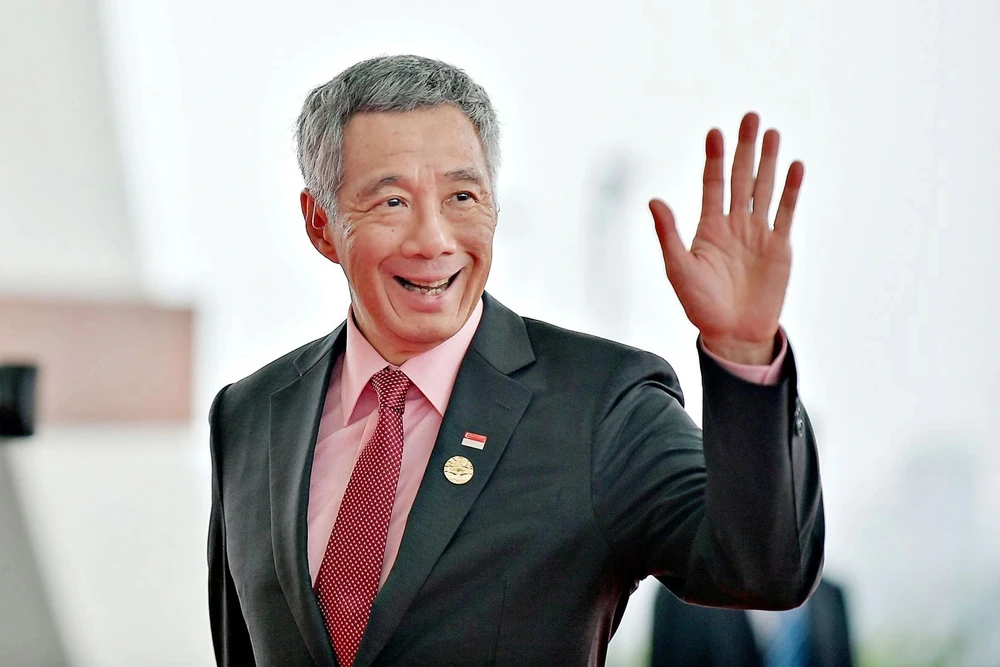
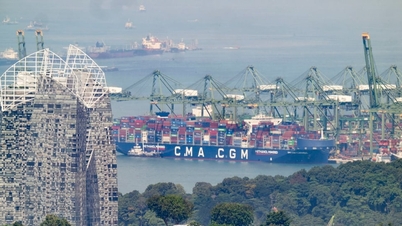
According to an official announcement from the Maritime and Port Authority of Singapore (MPA), the annual gross tonnage of ships calling at the Port of Singapore reached a record high of 3 billion GT (Gross tonnage) on December 25, 2023, up from 2.83 billion GT in 2022. This 3 billion GT breakthrough in Singapore's shipping industry is a crucial milestone amidst the global maritime downturn since 2016 and supply chain disruptions during the Covid-19 pandemic.
Significant investment in hardware, infrastructure, technology, and operating systems has helped Singapore achieve these results, but more importantly, it is due to close cooperation between trade unions, the maritime industry, and the government . According to Teo Eng Dih, CEO of the MPA, Singapore needs to continue improving port efficiency and safety. For example, expanding the Just-in-Time (JIT) scheduling and coordination platform for vessels calling at PSA and Jurong Port, to accommodate oil tankers and all vessels in berths and provide schedule information, thereby reducing waiting times and fuel consumption, saving costs, and reducing emissions.
In addition, the Pasir Panjang port is equipped with an 18-meter deep-water crane system with a reach of over 24 rows of containers and a fully automated electric yard crane system designed to serve the world's largest container ships. Singapore is also continuing to build the new large-scale Tuas Port facility, increasing container capacity by more than two-thirds and continuing to lead the world as a transshipment port with nearly 80% of cargo moving across Asia...
Another initiative by Singapore is the “Forward Singapore” dialogue, launched in June 2023, chaired by Deputy Prime Minister Lawrence Wong and other fourth-generation (4G) political leaders. In his New Year's message, Prime Minister Lee Hsien Loong described it as an “ambitious” roadmap, especially “in an era of rapid change both externally and internally.” He said: “Many larger societies have become divided and weakened because difficult issues are not addressed directly and effectively, rival interests jostle each other, and leaders put their own interests above the national interest.” As a small island nation, Singapore cannot afford to make the same mistakes and suffer the same consequences, and must strive harder than ever to keep society united and strengthen its sense of identity and national spirit.
Forward Singapore took place over 16 months, bringing together more than 200,000 Singaporeans through direct and indirect dialogues, surveys, traveling performances, and digital platforms. The Forward Singapore report, personally released by Deputy Prime Minister Lawrence Wong at the end of October 2023, summarized the aspirations of the people for a future society.
The report also outlines how the government will work with citizens to innovate the social contract. Key recommendations and policy changes are built upon suggestions from Singaporeans and stakeholders. However, the government's commitments to the people were actually made from the very beginning of Forwad Singapore. Singapore's socio-economic development roadmap is structured into six pillars, each personally overseen by 4G leaders. For example, the "Empowerment" pillar is overseen and directed by three ministers: the Minister of Manpower, the Secretary-General of the Trade Unions, and the Minister for Sustainability and Environment.
In 2023, Singapore's economy grew by only 1.2% and fortunately avoided recession amidst continuing geopolitical uncertainties weighing on the global economy. In his New Year's message, Prime Minister Lee Hsien Loong stated that GDP growth in 2024 would be 1-3%, but this is highly dependent on the external environment. Tensions and risks related to security in the region's seas will impact growth. Furthermore, climate change will also affect the economy. Singapore needs to adapt and prepare for rising temperatures and sea levels, while simultaneously transitioning its economy to zero carbon emissions, which entails significant costs.
However, despite these headwinds, Singapore has reason to be hopeful and confident because rapid technological advancements, particularly in artificial intelligence and robotics, hold great promise for businesses and citizens. The Prime Minister stated that the government will work closely with businesses to upgrade and transform operations, while also helping citizens improve and retrain their skills to remain employable and competitive.
Time will tell whether the Singaporean government's solutions to an uncertain future are feasible, but Singapore is doomed to fail without visionary technocratic leaders who are wholeheartedly committed to the country. This is also why Prime Minister Lee Hsien Loong is urging public support for the leadership transition process as he plans to step down in November 2025.
LE HUU HUY, Director of Vietnam Global Network Consulting Company, Singapore
Source
![[Photo] General Secretary and President To Lam meets with National Assembly delegates from ethnic minorities.](https://vphoto.vietnam.vn/thumb/1200x675/vietnam/resource/IMAGE/2026/04/20/1776696701056_a1-bnd-8331-3342-jpg.webp)

![[Image] National Assembly discusses the implementation of the socio-economic development plan.](https://vphoto.vietnam.vn/thumb/1200x675/vietnam/resource/IMAGE/2026/04/20/1776696707422_ndo_br_img-20260420-185419-jpg.webp)










































































Comment (0)