

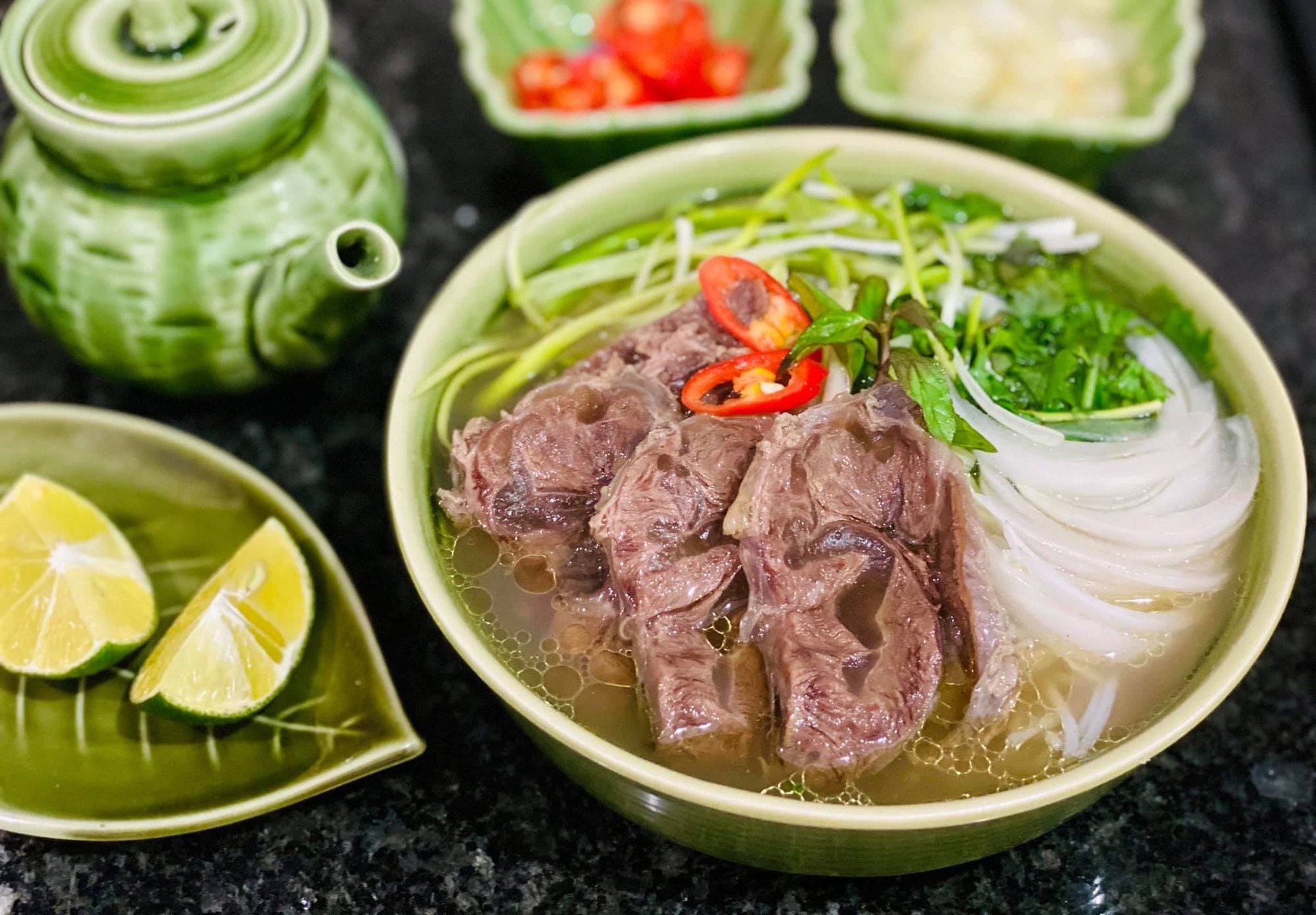
My mom is clumsy at cooking, so she keeps it simple, but the kids are still thrilled. My kids love pho with thick, sliced noodles, but the ones sold at the market are all thinly sliced. So I bought pho wrappers and sliced them myself, about a centimeter thick. The noodle vendor said it was too much trouble to slice them. But my kids love it. When they get home and bring out a bowl of pho, they cheer because the noodles are thick. I'm not entirely sure, but thick noodles seem more rustic and traditional, and they seem to be more satisfying to bite into.
I'm from Nam Dinh, but I didn't know the difference between Nam Dinh pho and Hanoi pho. Once, while traveling in Nam Dinh, I stopped at a pho restaurant and found it so delicious that I asked the owner where he got his beef. He probably thought I was from Hanoi and preferred the city style, so he said he sourced the beef from Hanoi. Oh no!
But Nam Dinh pho, on those nights at Vieng Market, with the cool spring air, the pho stalls bustling with activity, stopping for a bowl of pho, the broth steaming, the tender slices of meat clinging with layers of lean, tendon, and golden-yellow fat, the pot of pho simmered with beef bones emitting a fragrant aroma—it fills the entire Vieng Market, warming both the hands holding the bowl of pho and the half-full stomach, the lingering feeling of something on that spring night.
I've tried Vietnamese pho in Japan, the US, and Germany – the first times were about 20 years ago, and it was pho cooked by foreigners, not Vietnamese people there. Back then, I ate it with the mindset of seeing what pho tasted like when prepared by foreigners. Of course, it was disappointing; the noodles were dry and stale, the broth was made with pre-made seasonings, and the beef meatballs were bland. But those restaurants were always crowded, proving that even without Facebook or social media like now, pho was already a strong brand globally . An Italian woman once told me, "I love Vietnamese pho so much; I could eat it every morning, anywhere." It's filling, yet light and refreshing, a combination of flavors, colors, and textures – starch, meat, and vegetables – and it's so appealing to the sense of smell.
Listening to her talk, I suddenly realized I had never really paid attention to that perfect match, but simply enjoyed a bowl of pho for breakfast when rushing off to work, savored the aroma of pho on a leisurely weekend morning before going for coffee, or busily and happily prepared a pot of pho for the children at home. It was simply a matter of momentary feelings, and we often don't think much about the happiness we have.
Famous chef Anthony Bourdain, who, along with President Obama, made Hanoi's bun cha (grilled pork with vermicelli) famous, had a particular passion for Vietnamese cuisine . During his numerous trips to Vietnam, he always enthusiastically enjoyed the rich and colorful street food, and he also said that he particularly liked pho. You could ask any foreigner you've met, and perhaps two-thirds, three-quarters, or even 99% would say they like pho. On Vietnamese menus translated into foreign languages, pho is now used by its original name, no longer needing to be explained as "noodle soup" as in English.
Pho, on its own, is so appealing that it doesn't need heritage status. Initially, I found it strange to hear about heritage designation. But we always need titles and stories to convey a message. So, once it's recognized as heritage, what will happen to pho? For years, we've discussed turning Vietnam's wonderful cuisine into a global culinary brand, a cultural ambassador, and a component of Vietnam's soft power. Pho is undoubtedly one of those components. But how do we elevate pho to that level? It certainly can't be done haphazardly, but it's not too difficult either, because pho itself is already captivating enough, as reality has proven. The saying "the way to a man's stomach" is true for anyone. So, loving Vietnam through pho is entirely feasible. Besides, from every home, any mother can bring joy to her family with a pot of fragrant pho – an intangible cultural heritage – even if she's not a skilled cook.
Source: https://daidoanket.vn/tan-man-ve-pho-10288952.html


![[Photo] General Secretary and President To Lam presides over a working session with the Central Policy and Strategy Committee on the development of the materials industry.](https://vphoto.vietnam.vn/thumb/1200x675/vietnam/resource/IMAGE/2026/05/21/1779359935432_a3-bnd-3129-1412-jpg.webp)
![[Photo] National Assembly Chairman Tran Thanh Man working with the Standing Committee of the Law and Justice Committee](https://vphoto.vietnam.vn/thumb/1200x675/vietnam/resource/IMAGE/2026/05/21/1779378929214_ndo_br_1-4610-jpg.webp)
































































Comment (0)