

 |
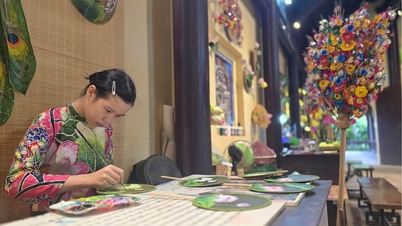
| Couplets express auspicious and meaningful wishes for the new year (Illustrative image) |
First and foremost is the richness of imagery: Horses not only "run," but also "gallop," "jump," "neigh," "whistle," and "whistle"; not confined to a single setting, but traversing all kinds of spring landscapes: falling snow, moonlit mountains, green willows, southern and northern regions; sometimes "horses treading on spring's brocade," sometimes "horses whistling over the mountain moon," sometimes "red hares flying in the snow," "yellow horsemen chasing under the moon." The beauty of the couplet lies in the fact that each verb, placed correctly, transforms the sound of hooves into rhythm. The five-character couplet is concise yet brilliant: 萬馬爭飛躍, 百花展笑顏 (Ten thousand horses compete in galloping, a hundred flowers display smiling faces) - one side represents the power of leaping, the other represents a smile; movement and stillness open together like the door of spring. Interestingly, the shorter the couplet, the more it resembles a brushstroke; just a few words can create a whole picture "with wind, flowers, and horse hooves."
But what gives the "depth" of the Year of the Horse couplets is not just the scenery. Behind the scenery lies the thought of the horse - a very ancient, very East Asian symbol: The horse is associated with motivation (advancement), talent (extraordinary, magnificent horse), fortune (success upon arrival), and the principle of knowing people (Bao Lac). Therefore, there are couplets that not only wish a happy new year but also remind us of the principles of being a good person: "馬逢伯樂馳千里" (Ma phong Ba Lac chi thien li) - a horse that meets someone who understands it will travel a thousand miles; implying the importance of employing talented people and the serendipitous encounter. There are couplets that place "literature" and "martial arts" side by side very gracefully: "柳營晨試馬,虎帳夜談兵" (Liu ying shen shi ma, hu zhang ye dan bing) - testing horses in the morning, discussing military strategy at night; a rhythm of military life that is still poetic.
At a deeper level, we see a traditional concept: the horse is a symbol of "the road." It's no coincidence that "road," "path," "long march," and "ten thousand miles" appear so frequently. "The vast sea is filled with leaping fish, the long road is filled with galloping horses" (海闊憑魚躍,路遙任馬馳) – the world unfolds in two directions: "water" and "road," and humanity is encouraged by the spirit of overcoming limitations. Therefore, the Year of the Horse is not just a year of "fast running," but a year that reminds us: To reach the destination, one must possess the fortitude for the long journey – the endurance of hooves, the perseverance of will.
Another noteworthy aspect is the diversity of "tones." There are couplets purely wishing for peace and happiness: "馬躍康莊道,人迎幸福春" (Horses gallop along the spacious road, people welcome the happy spring). There are couplets rich in lyricism: "春色綠千里,馬蹄香萬家" (Spring colors stretch for a thousand miles, horse hooves spread fragrance to ten thousand homes) - the "fragrance" here is not just the scent of grass, but the fragrance of life spreading to every home. There are couplets that reflect the spirit of the times: “馬騰改革路,國展富強圖” (Horses advance the road, the nation develops a path to prosperity and strength), “萬馬千軍創大業” (Ten thousand horses and a thousand troops create a great undertaking) - horses become a metaphor for a grand process: a community rushing forward together. Looking at this, we realize that the couplets for the Year of the Horse are both a beautiful Tet custom and a “spiritual message” of society - people are sending their faith in “new paths,” “new endeavors,” and “new prospects.”
Another unique feature: Year of the Horse couplets often exaggerate in quantity – “ten thousand horses,” “thousand cavalry,” “thousand troops.” The large numbers aren't just for fun, but to create a sense of convergence, resonance, and unity. “一夜春風來小院,千匹駿馬闖雄關” (One night, the spring breeze comes to the small courtyard, a thousand galloping horses storm the pass): Just one night, the spring breeze visits the small courtyard, and a thousand horses storm the pass. The dynamism of spring is amplified into the dynamism of the times. In the East Asian consciousness, spring is “opening,” “opening”; horse is “movement,” “advancement”; combined, the Year of the Horse couplet has a very distinctive energy: the energy of departure.
And then, in the verses with horizontal plaques, we see the folk spirit crystallized into beautiful maxims: “策馬揚鞭” (The horse leads the way), “一馬當先” (One horse leads the way), “馬到成功” (Success comes when the horse arrives), “龍馬精神” (Dragon horse's spirit), “天馬行空” (Heavenly horse's spirit soars through the air). This is where the couplets step out of the paper to live in everyday life: hung at the door, contained in the blessings, entering the way of thinking. The Year of the Horse, therefore, is not just a time marker, but a reminder: Maintain your “spirit” like maintaining the rhythm of your hooves – neither hasty nor hesitant; not noisy but still powerful; go far but remember your direction.
After reading those couplets, I understood why horses have always been so beloved in tradition: Horses symbolize not only speed, but also virtue. They are loyal, persistent, capable of climbing steep slopes and enduring long journeys; horses meeting the legendary Bo Lac bring fame; horses encountering spring inspire poetry. And perhaps the most beautiful thing that the Year of the Horse couplets give us is the feeling that a new year needs not only "good fortune," but also a spirit of adventure – the spirit of "horses galloping across countless homes," the spirit of "thousands of horses galloping" within each person, so that spring doesn't linger at the flower branch in front of the gate, but rushes straight into work, into aspirations, into the paths we choose.
Source: https://huengaynay.vn/van-hoa-nghe-thuat/tan-man-ve-cau-doi-nam-con-ngua-162935.html
![[Image] Close-up view of the interchange connecting the two expressways and Long Thanh Airport.](https://vphoto.vietnam.vn/thumb/1200x675/vietnam/resource/IMAGE/2026/05/25/1779703378210_ndo_br_z7863716673926-224453a31600126cce10622af6290afd-4549-jpg.webp)
![[Image] Hanoi's urban life under the challenge of a "scorching hot" environment](https://vphoto.vietnam.vn/thumb/1200x675/vietnam/resource/IMAGE/2026/05/25/1779706979265_nang-nong-t5-2026-minh-duy-7-4636-jpg.webp)










































































Comment (0)