Dealing with surplus real estate is difficult due to a supply-demand imbalance.
According to data reported by the Ministry of Finance , as of now, across the country, there are 11,412 surplus land and property facilities that have been subject to recovery and transfer decisions to local authorities but have not yet been fully processed or put into full use.
This figure, compared to nearly 29,000 surplus land and buildings resulting from organizational restructuring and administrative unit reorganization, accounts for almost 50%. Meanwhile, according to the plan, the whole country must ensure the completion of processing and utilizing all surplus land and buildings by the second quarter of 2026, preventing damage, deterioration, and waste.
In fact, following the reorganization of the administrative apparatus and units at all levels, the provision of office space according to the two-tiered local government model has been implemented promptly. Many properties and land parcels, after reorganization, have been allocated to serve educational , medical, cultural, and other public needs, thereby creating additional resources to serve the people and the locality.
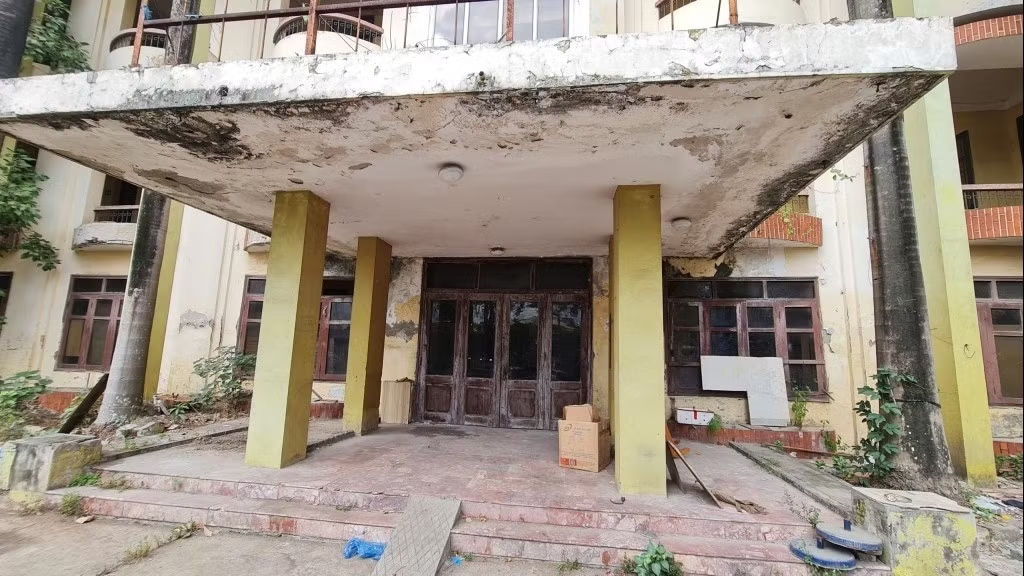
Specifically, there are 3,015 facilities designated for education and training; 648 facilities serving the healthcare sector; 2,385 facilities used as cultural and sports institutions; and 626 facilities serving other public purposes.
In addition, surplus housing and land funds are also allocated to organizations responsible for managing and trading housing and land development organizations to serve long-term development goals, while creating resources for investment and development through land allocation and leasing in accordance with the law.
However, according to the Ministry of Finance's assessment, the progress in handling surplus houses and land is still slow and uneven across localities.


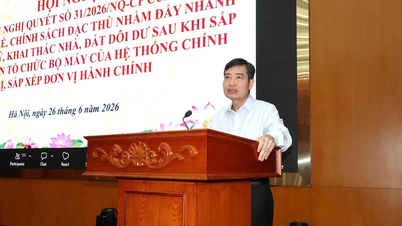
Among the listed difficulties, Mr. Nguyen Tan Thinh, Director of the Public Assets Management Department (Ministry of Finance), stated that when reorganizing the administrative apparatus and restructuring administrative units at all levels, a large number of surplus offices, houses, and land are generated that need to be put into use, creating a large supply; while the demand from the State sector (for offices and operational facilities) and the non-State sector (the demand for renting houses and land from non-state organizations and individuals) in areas with surplus assets decreases (due to agencies and units relocating to new provincial centers and new communes, and the shift of business models from direct to online), leading to an imbalance between supply and demand.
Furthermore, many surplus properties are small-scale, scattered, located in difficult areas, remote regions, and lack commercial advantages. Non-state organizations and individuals have no need to rent them, while using them for public works requires funding and management personnel.
In addition, many surplus properties and land have been assigned to commune-level authorities for management, exploitation, and disposal; however, some commune-level units are still struggling with implementation…
Applying KPIs to expedite the processing of surplus real estate.
To expedite the handling of surplus land and properties after mergers, the Ministry of Finance has identified further improvement of the legal system for the management and use of public assets as one of its key tasks in the coming period.
Specifically, regulations on standards and norms for the use of specialized public assets and documents delegating authority in the management and use of public assets will continue to be reviewed and improved to create a comprehensive legal basis for the process of handling assets after restructuring.
The Ministry of Finance also requested ministries, sectors, and localities to strengthen leadership and guidance in the management, exploitation, and disposal of public assets; and to continue reviewing the properties under their management to ensure their timely use or exploitation in accordance with regulations, avoiding loss and waste.
In particular, a noteworthy solution proposed by the Ministry of Finance is that the results of managing, exploiting, and disposing of surplus houses and land will be considered one of the criteria for evaluating the performance of heads of ministries, sectors, localities, agencies, and units. Linking the responsibility of the head to the results of handling public assets will create additional motivation in implementation and simultaneously enhance the effectiveness of supervision over public resources.



Furthermore, to create a breakthrough in mechanisms, the Ministry of Finance has submitted to the Government a draft Resolution on specific mechanisms and policies to accelerate the process of handling and exploiting surplus houses and land arising after the reorganization and streamlining of the organizational structure and the reorganization of administrative units.
"The draft proposes several solutions to shorten the processing time, such as simplifying the method of determining rental prices, decentralizing power more strongly to local authorities, allowing flexible adjustments to management and exploitation plans, and reducing unnecessary administrative procedures. Notably, the draft also proposes allowing adjustments to rental prices in cases where the price has been publicly announced but no tenant has been selected, in order to avoid the situation of properties being left vacant for extended periods," Mr. Thinh said.
With over 11,000 properties still awaiting processing, the draft Resolution on specific mechanisms and policies to accelerate the handling and exploitation of surplus properties is expected to shift the mindset from asset management to resource exploitation, avoiding waste while generating resources for development.
Source: https://cand.vn/tao-co-che-dac-thu-de-xu-ly-nha-dat-doi-du-post813492.html


![[Photo] "Hanoi Lotus Festival" honors the lotus flower that has been associated with Vietnam for thousands of years.](https://vphoto.vietnam.vn/thumb/1200x675/vietnam/resource/IMAGE/2026/06/27/1782516943048_sen-ha-noi-2026-minh-duy-1-jpg.webp)