


Optimizing infrastructure value
The resolution supplements policies for the Transport-Oriented Development (TOD) model, aiming to maximize the economic value of public land and existing infrastructure, and enhance urban connectivity. This is a key mechanism for generating resources for urban rail, as the city retains 100% of the revenue generated from the exploitation of land in TOD areas, prioritizing investment in urban rail and other key projects within the city.
Specifically, the Da Nang City People's Committee is authorized to utilize land for the development of urban areas, residential areas, commercial and service centers surrounding the hubs of the urban railway line, and road intersections connecting the city center - Hoi An - Chu Lai and surrounding areas.
According to the planning for the period 2021-2030, with a vision to 2050, Da Nang plans to develop 3 urban railway lines (MRT), 12 light rail lines (LRT), and 3 LRT lines for tourism purposes, with a total length of nearly 283km.
The network is designed to closely connect Da Nang with the southern satellite urban system such as Dien Ban, Hoi An, Duy Xuyen, Tam Ky, and Chu Lai. The most notable route is the Da Nang - Hoi An - Chu Lai line, comprising LRT and MRT sections running along the Nguyen Huu Tho - Le Van Hien - Tran Dai Nghia - DT607 axis, connecting from Da Nang International Airport to Chu Lai. Between 2025 and 2030, the city will prioritize the Da Nang - Hoi An section, before extending to Tam Ky and Chu Lai after 2030.
Associate Professor Phan Cao Tho, former Rector of the University of Technical Education (Da Nang University), and an expert in urban transportation, believes that developing urban railways will promote the development of a modern public transportation system to connect and leverage the potential and advantages of the southern part of the city. This is an important strategy that will help improve transportation, promote socio-economic development, and ensure green and sustainable development for Da Nang and the entire Central region.
Expedite implementation
In the future, when decentralization and delegation of authority are implemented within the new legal framework, the Management Board of Da Nang High-Tech Park and Industrial Zones will perform its functions, tasks, and powers related to business registration, investment, labor, and environmental procedures within the functional zones under its management under a "one-stop shop" mechanism.
This is one of the most important innovations of Resolution No. 259/2025/QH15 amending and supplementing several articles of Resolution No. 136/2024/QH15 on piloting some specific mechanisms and policies for the development of Da Nang city, in that it assigns authority to the Management Board of the High-Tech Park and industrial zones to directly receive, verify dossiers, issue decisions on land lease, and sign land lease contracts within zones invested with state budget funds. This helps reduce intermediate steps, increase processing speed, and save time and costs for businesses.
The resolution also adds the authority to reclaim land, in addition to the cases stipulated in Article 79 of the Land Law, for the implementation of socio-economic development projects. Specifically, this includes projects to establish logistics centers; exhibition and trade fair centers under 100 hectares; logistics centers serving seaports, airports, and inland waterways ports over 50 hectares; and projects for the exploitation of minerals used as common construction materials…
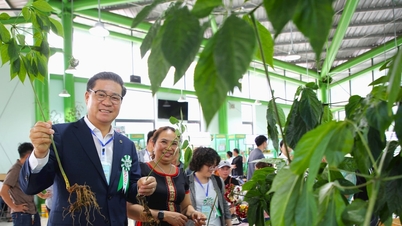
Notably, the resolution adds a series of projects and sectors to the list of those eligible to attract strategic investors. These include projects for the construction and operation of infrastructure in functional areas within free trade zones; projects for the cultivation, development, and processing of products from Ngoc Linh ginseng and other precious medicinal herbs with investments of VND 4,000 billion or more; projects for the construction of science parks with investments of VND 5,000 billion or more; projects for the construction of seaports or airports with investments of VND 10,000 billion or more; and projects for the construction of urban railways with investments of VND 30,000 billion or more. Particularly noteworthy are projects for the construction of reclaimed land urban areas with investments of VND 100,000 billion or more.
According to Mr. Vu Quang Hung, Head of the Management Board of Da Nang High-Tech Park and Industrial Zones, the National Assembly's approval of the amendment to Resolution No. 136/2024/QH15 is not just a technical legal adjustment, but a very clear message: to achieve breakthroughs, we must boldly empower and assign responsibility appropriately.
From the moment the resolution was implemented, the management board was tasked with managing a new, multi-sectoral, multi-spatial model, encompassing investment, planning, construction, environment, science and technology, and the operation of functional zones within the free trade area. Therefore, further improving the mechanism and expanding the authority of the Management Board of the High-Tech Park and industrial zones is an essential requirement of practical development.
At the 5th session of the 10th term of the Da Nang City People's Council, held on December 10, 2025, the city set a target of achieving an average economic growth rate of 11% or higher per year over the next five years, with a GRDP (Gross Regional Domestic Product) at current prices reaching over 720,000 billion VND by 2030. To achieve this goal, Da Nang City outlined three breakthrough tasks: effectively implementing special mechanisms; removing difficulties and obstacles to strongly develop the private economy; and mobilizing resources to invest in infrastructure development, promoting rapid and sustainable growth.
Source: https://baodanang.vn/tao-he-sinh-thai-chat-luong-cao-3316040.html
![[Photo] National Assembly Chairman Tran Thanh Man arrives in Türkiye to attend IPU-152](https://vphoto.vietnam.vn/thumb/1200x675/vietnam/resource/IMAGE/2026/04/15/1776261003665_tnk10-jpg.webp)

![[Photo] Mrs. Ngo Phuong Ly meets and exchanges views with Mrs. Peng Li Yuan](https://vphoto.vietnam.vn/thumb/1200x675/vietnam/resource/IMAGE/2026/04/16/1776277858080_phu-nhan-1-jpg.webp)
![[Photo] National Assembly Chairman Tran Thanh Man attends the opening session of IPU-152](https://vphoto.vietnam.vn/thumb/1200x675/vietnam/resource/IMAGE/2026/04/16/1776277863731_ctqh5-jpg.webp)
![[Photo] The General Secretary, President and his wife meet with Vietnamese-Chinese friendship leaders.](https://vphoto.vietnam.vn/thumb/1200x675/vietnam/resource/IMAGE/2026/04/15/1776264829725_vna-potal-tong-bi-thu-chu-tich-nuoc-to-lam-gap-mat-nhan-sy-huu-nghi-viet-nam-trung-quoc-8703641-3130-jpg.webp)
![[Photo] My Son at night: A thousand-year-old heritage site amidst the Milky Way](https://vphoto.vietnam.vn/thumb/1200x675/vietnam/resource/IMAGE/2026/04/15/1776261039184_ndo_br_chon6-jpg.webp)


















































Comment (0)