

The "National Defense and Security Cultural Villages" in Hoa Binh province are a prime example of the effectiveness of building such models. Over the past 16 years, through the implementation of this model, officers and soldiers of the Hoa Binh Provincial Armed Forces have coordinated the construction of 38 "national defense and security cultural villages," providing thousands of households with support in terms of crops and livestock to develop their economy ; repairing and rebuilding over 60 houses and nearly 3,500 livestock pens for poor households; and concreting dozens of kilometers of rural roads...
This has helped villages and hamlets in remote areas and ethnic minority regions gradually transform; the rate of hunger and poverty has continuously decreased over the years, and people's lives have steadily improved; the electricity, road, school, and health station systems are increasingly being built and modernized. This result directly contributes to strengthening the solidarity between the military and the people, and building an increasingly solid "people's defense posture" in the provincial defense zone.
Sharing the secret to maintaining the model's effectiveness over a long period, Colonel Trieu Kim Thang, Political Commissar of the Hoa Binh Provincial Military Command, said: "Before implementation, the Provincial Military Command surveyed the current situation and implemented the model with four basic objectives: prosperous villages, free from hunger and poverty; clean roads and beautiful alleys, free from disease; harmonious families, filial children; and peaceful and joyful villages. These objectives, which met the urgent needs and aspirations of the people, along with the involvement of local authorities and sectors, especially the core role of the armed forces, helped the model achieve effectiveness from the very first year of implementation, and it has continued to spread to this day."
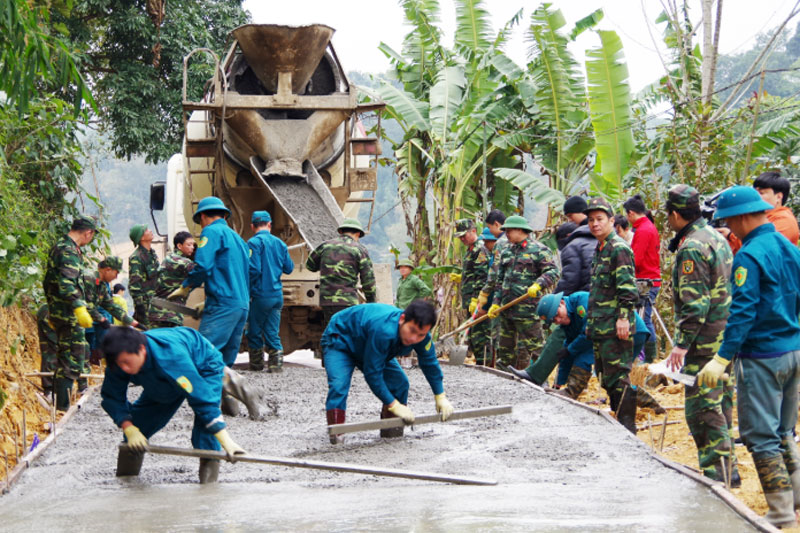 |
| Officers and soldiers of the armed forces of Hoa Binh province helped the people build concrete roads in the "National Defense and Security Cultural Village" in Cam hamlet, Doc Lap commune (Hoa Binh city, Hoa Binh province). |
Currently, most units have distinctive and exemplary models that contribute to improving the quality of training, combat readiness, building a regular army, instilling discipline, engaging with the civilian population, implementing policies, and supporting the military's rear areas. Each model has its own implementation methods, suited to the needs and practical conditions of each agency and unit, thus attracting a large number of officers and soldiers to participate, thereby spreading widely, having lasting vitality, and bringing practical results.
However, alongside models that maintain order and are implemented effectively, there are also many models that sound impressive but are not regularly operational. In particular, some models are established but do not function, or function only superficially and half-heartedly, with very low effectiveness. The main reason is that agencies and units do not proactively innovate the content and diversify the forms of implementation.
Furthermore, some units mechanically copy the models of other units, leading to the determination of content and operational forms that do not closely match the nature of the tasks, characteristics, and practical needs of the agency or unit. Therefore, they fail to utilize the responsibilities, strengths, and intelligence of officers and soldiers in implementation. Some agencies and units also take on too many models, leading to overlapping in implementation.
Colonel Nguyen Ngoc Bo, Political Commissar of Brigade 405, Military Region 3, further analyzed: “There are women's associations with only 5 members, or youth union branches that only focus on building environmental landscapes, but they still implement 3 or 4 models. This leads to the unit lacking sufficient human and material resources to organize implementation. Units should base their decisions on the specific situation to unanimously choose and implement appropriate models, focusing on key priorities; prioritizing important and urgent political tasks, aiming to overcome weaknesses and solve difficult problems. In this way, the models will bring more practical results.”
Lieutenant Colonel Tran Kim Trong, Head of Political Affairs of the 395th Division, Military Region 3, stated that when implementing the model, it is necessary to conduct practical surveys, based on the characteristics of each agency and unit and related factors, to develop specific plans and programs. These plans should clearly identify which forces will participate, what forms of activity will be used, what tasks will be performed, and when the implementation will take place. Party committees and commanders at all levels, especially political officers and political agencies, must pay attention to leading and directing the maintenance of the models' activities; periodically organize reviews and summaries, draw lessons learned, and assign responsibility to the collective and individuals in charge of implementation.
Text and photos: NGUYEN TRUONG
---------
Thoughts and Suggestions
Adhering closely to political tasks.
In implementing the Emulation Movement for Victory, over the years, Regiment 1, Division 324, Military Region 4, has seen the emergence of many effective models and movements such as: "Helping children go to school"; "Pink dreams"; "Economic goat farming"... in carrying out mass mobilization work, helping localities build and consolidate political foundations, and develop the economy, culture, and society. Implementing breakthroughs in training, political education, and legal education, the Regiment has models such as: "One increase, one decrease, three practical aspects"; "One question, one answer each day; one law learned each week"... creating a strong transformation in awareness of law compliance, discipline, and professional and technical quality. To widely disseminate these models and emulation movements, the Party Committee and command of Regiment 1 always pay attention to leading, directing, and guiding to ensure high-quality implementation. However, there have also been times when the application of the model has not been closely aligned with the characteristics and tasks of the agency or unit, leading to low effectiveness and failure to fully unleash the creative potential of officers and soldiers.
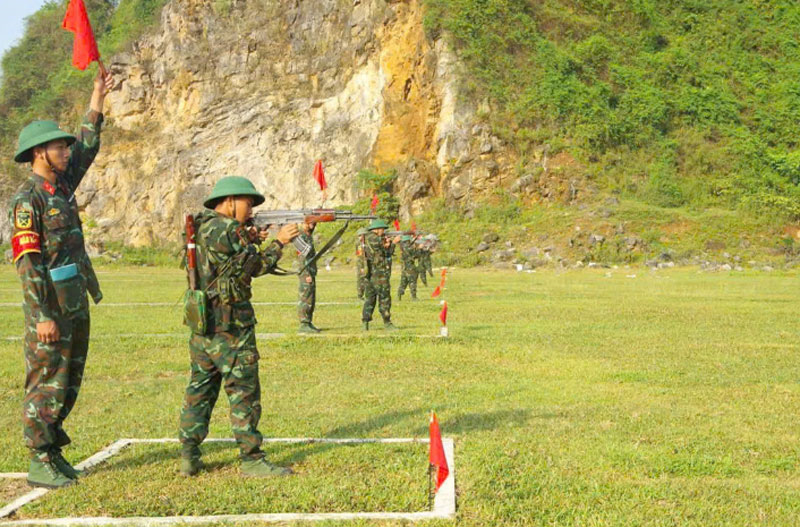 |
| AK submachine gun shooting training, lesson 1, for soldiers of Company 5, Battalion 2, Regiment 1, Division 324, Military Region 4. Photo: GIANG ĐÌNH |
To thoroughly overcome limitations and shortcomings, the Party Committee and command of Regiment 1 focused on leading and directing effective propaganda and education work to ensure that soldiers deeply understand the position, significance, and effectiveness of the models. They guided agencies and units in applying models and emulation movements, emphasizing adherence to political tasks and focusing on key objectives; and decisively addressing weaknesses and shortcomings. They directed a rigorous assessment of the effectiveness, quality, and applicability of models before widespread application throughout the Regiment; and closely integrated models and emulation movements with major campaigns. From these effective models and methods, many exemplary and outstanding collectives and individuals have emerged, encouraging officers and soldiers to actively strive to fulfill their assigned responsibilities and tasks.
Lieutenant Colonel DANG VAN DANH
(Political Commissar of Regiment 1, Division 324, Military Region 4)
----------
Don't chase after achievements.
The radar stations of the 551st Radar Regiment (Naval Region 5) are stationed independently and dispersed. Maintenance and transportation are difficult; the economic conditions and living standards of the people in the areas where the unit is stationed are still very challenging and lacking. Based on this reality, in addition to general movements such as: "The Army joins hands in building new rural areas"; "The Army joins hands for the poor - no one left behind"; "Officers and soldiers compete to implement workplace culture, worthy of the name of Uncle Ho's soldiers"; "The Army's logistics sector follows Uncle Ho's teachings"... we also developed some specific models tailored to the realities of the areas where we are stationed, such as: "Each radar station is linked to a charitable address"; "A drop of water of compassion"; "The Navy sponsors the children of fishermen". Implementing these initiatives, over the past five years, the Regiment has donated nearly 8 tons of rice, more than 500 cubic meters of fresh water, and hundreds of gifts to policy beneficiary families, poor households, and poor but studious students... The Regiment has been recognized by the Command of Naval Region 5 as a shining example in carrying out civilian outreach work.
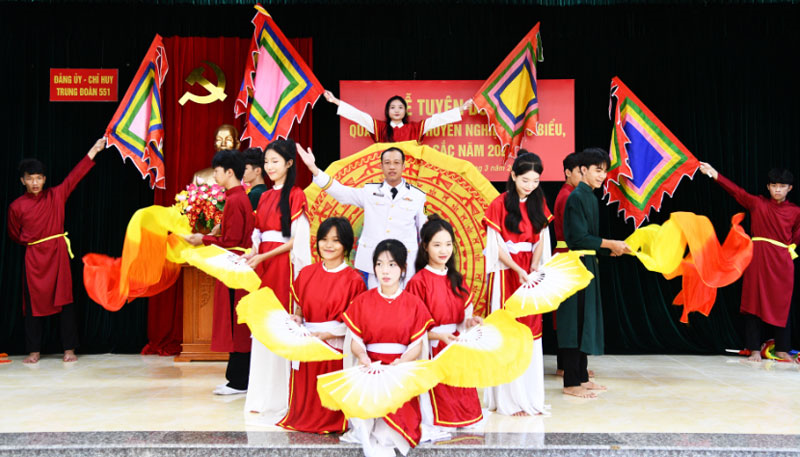 |
| Soldiers of the 551st Radar Regiment participate in a cultural exchange with their sister unit. Photo: BAO NGOC |
I believe that the success of these models stems from many factors, first and foremost the leadership and guidance of Party committees and commanders at all levels. Party committees and commanders, especially leading cadres, must be dedicated and highly determined in building their units and localities; they must know how to leverage the combined strength of all forces and resources, dare to think, dare to act, dare to take responsibility, and not be afraid of difficulties and hardships. In reality, some models are suitable for one unit but not for another. Therefore, before applying and implementing a model to a unit, it is necessary to conduct a thorough survey to understand the practical situation, avoiding indiscriminate, rigid application driven by a pursuit of achievements. During the implementation process, shortcomings and limitations must be promptly identified and addressed, supplemented, and adjusted accordingly.
Lieutenant Colonel DANG TRONG SON
(Deputy Political Commissar of the 551st Radar Regiment, 5th Naval Region)
*Please visit the Defense and Security section to view related news and articles.
Source: https://www.qdnd.vn/quoc-phong-an-ninh/xay-dung-quan-doi/tha-it-ma-hieu-qua-826925
![[Photo] President Luong Cuong presides over the welcoming ceremony for the President of the European Council, Antonio Costa.](/_next/image?url=https%3A%2F%2Fvphoto.vietnam.vn%2Fthumb%2F1200x675%2Fvietnam%2Fresource%2FIMAGE%2F2026%2F01%2F29%2F1769662707713_ndo_br_1-jpg.webp&w=3840&q=75)


![[Photo gallery] The architecture of Cat Lai Bridge with the idea of 'reaching new heights'](/_next/image?url=https%3A%2F%2Fvphoto.vietnam.vn%2Fthumb%2F402x226%2Fvietnam%2Fresource%2FIMAGE%2F2026%2F01%2F29%2F1769669914488_bia-anh_1_20260129112605_20260129130655.jpeg&w=3840&q=75)

![OCOP during Tet season: [Article 4] Elevating local products](/_next/image?url=https%3A%2F%2Fvphoto.vietnam.vn%2Fthumb%2F402x226%2Fvietnam%2Fresource%2FIMAGE%2F2026%2F01%2F29%2F1769652810578_2935-z6982071462129_649e82db06fb2f2ea701388b1f5f5b0b-173322_176-185229-202804_457.jpeg&w=3840&q=75)


![OCOP during Tet season: [Part 3] Ultra-thin rice paper takes off.](/_next/image?url=https%3A%2F%2Fvphoto.vietnam.vn%2Fthumb%2F402x226%2Fvietnam%2Fresource%2FIMAGE%2F2026%2F01%2F28%2F1769562783429_004-194121_651-081010.jpeg&w=3840&q=75)

![OCOP during Tet season: [Part 2] Hoa Thanh incense village glows red.](/_next/image?url=https%3A%2F%2Fvphoto.vietnam.vn%2Fthumb%2F402x226%2Fvietnam%2Fresource%2FIMAGE%2F2026%2F01%2F27%2F1769480573807_505139049_683408031333867_2820052735775418136_n-180643_808-092229.jpeg&w=3840&q=75)


Comment (0)