

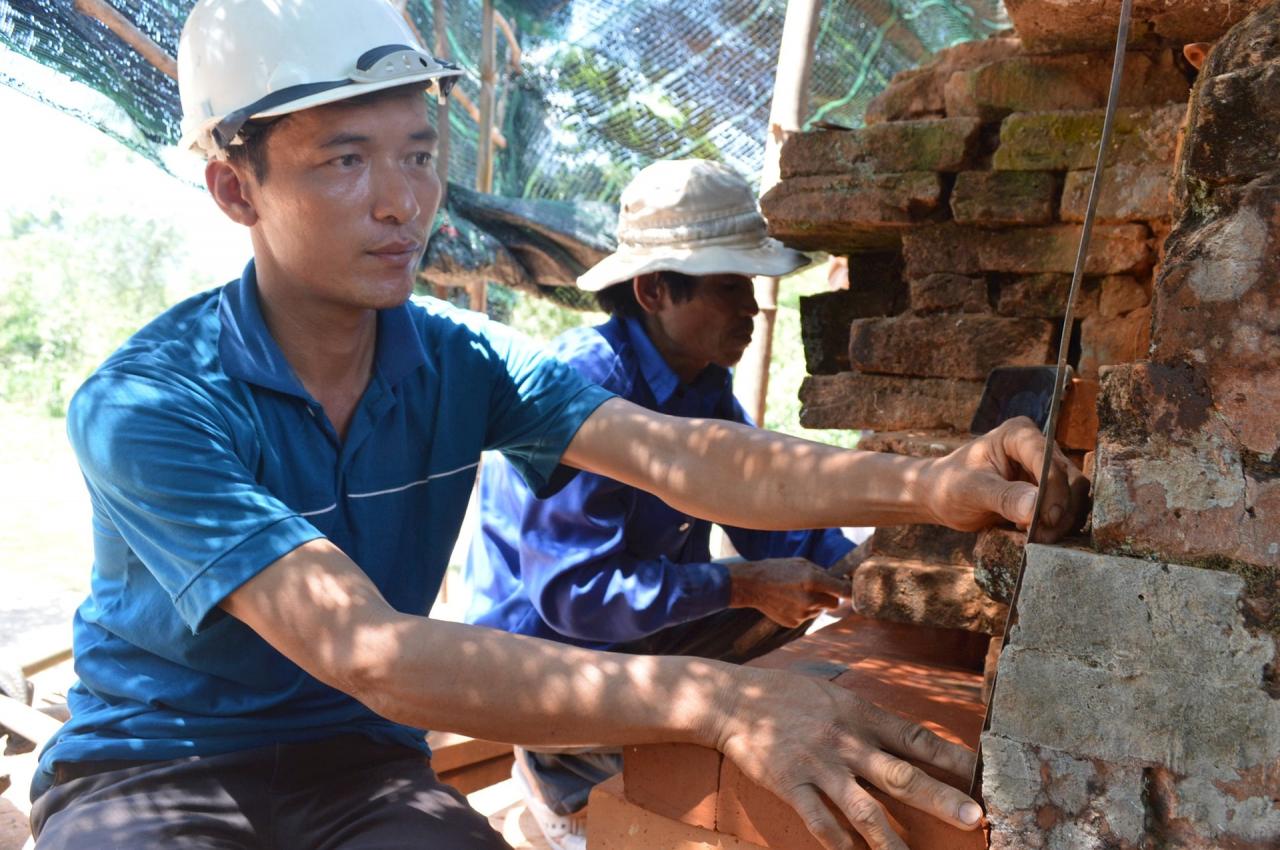
Concerns about artifacts such as bricks and stones.
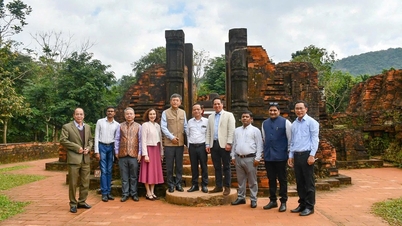
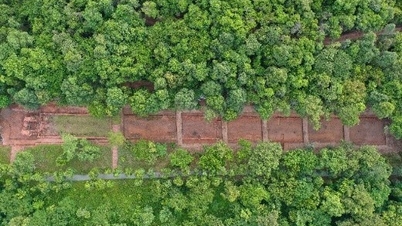
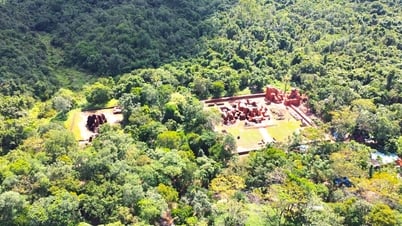
The My Son Sanctuary currently comprises 40 temples and towers, a system of surrounding walls, and 1,803 artifacts, mostly made of sandstone, ceramics, and terracotta (architectural elements, decorative sculptures, altars, statues of gods and mythical animals, ceremonial objects, etc.).
Specifically, there are 708 artifacts on display at the site and 93 artifacts on display at the My Son Museum, with the remainder stored in warehouses.
According to the My Son Cultural Heritage Management Board, preserving materials at the My Son site, like an open-air museum, is a major challenge, as most artifacts are displayed outdoors in the harsh environment of the My Son valley.
In particular, climate change, with its increased sunshine and rainfall, causes greater expansion and contraction of temples, towers, and artifacts, making them more susceptible to cracking, chipping, and moss and mold infestation.
Furthermore, preserving stone artifacts (door pillars, door sills, lintels, wall decorations, corner ornaments, fire brackets, tower finials, altars, inscriptions, etc.) or other materials such as laterite (Group G towers), stones and pebbles in the wall core (Group F towers); or decorative ceramics, terracotta roof tiles, cobblestones used for foundation reinforcement, wall core construction, etc., also presents difficulties.
In fact, since the 1980s, the temples and towers in areas B, C, and D of My Son have been reinforced, primarily using recycled old bricks bonded together with cement mortar.
However, moss, mold, and various microorganisms proliferate, damaging the surface of the restored bricks and spreading to the original wall sections. In the A, H, K, and E7 towers, which were restored (2003-2022) using restored bricks bonded with resin oil and lime mortar, salt efflorescence and decay of the new brick surfaces appeared after a short time, and moss and mold quickly emerged.
In order to preserve artifacts and relics, the My Son Cultural Heritage Management Board has mainly focused on cleaning every two months. In addition, they regularly clear overgrown vegetation around the walls surrounding the towers, creating an open and airy space.
Specifically, the phenomenon of fungi, mold, and lichen adhering to the surfaces of relics and artifacts displayed outdoors, or some artifacts displayed on the walls of towers D1 and D2, also face the problem of dampness and mold clinging firmly over time.
Even after examination, surface deterioration has been observed, causing deformation and potentially rendering the carved patterns unrecognizable, thus diminishing the artifact's value and durability.
Finding conservation solutions
To preserve the brick and stone materials of the relics, since the late 20th century, the My Son Cultural Heritage Management Board has implemented several experiments on preserving the surface of bricks on the temple towers by boiling resin oil and applying a thin layer to the original brick surface on tower D2.
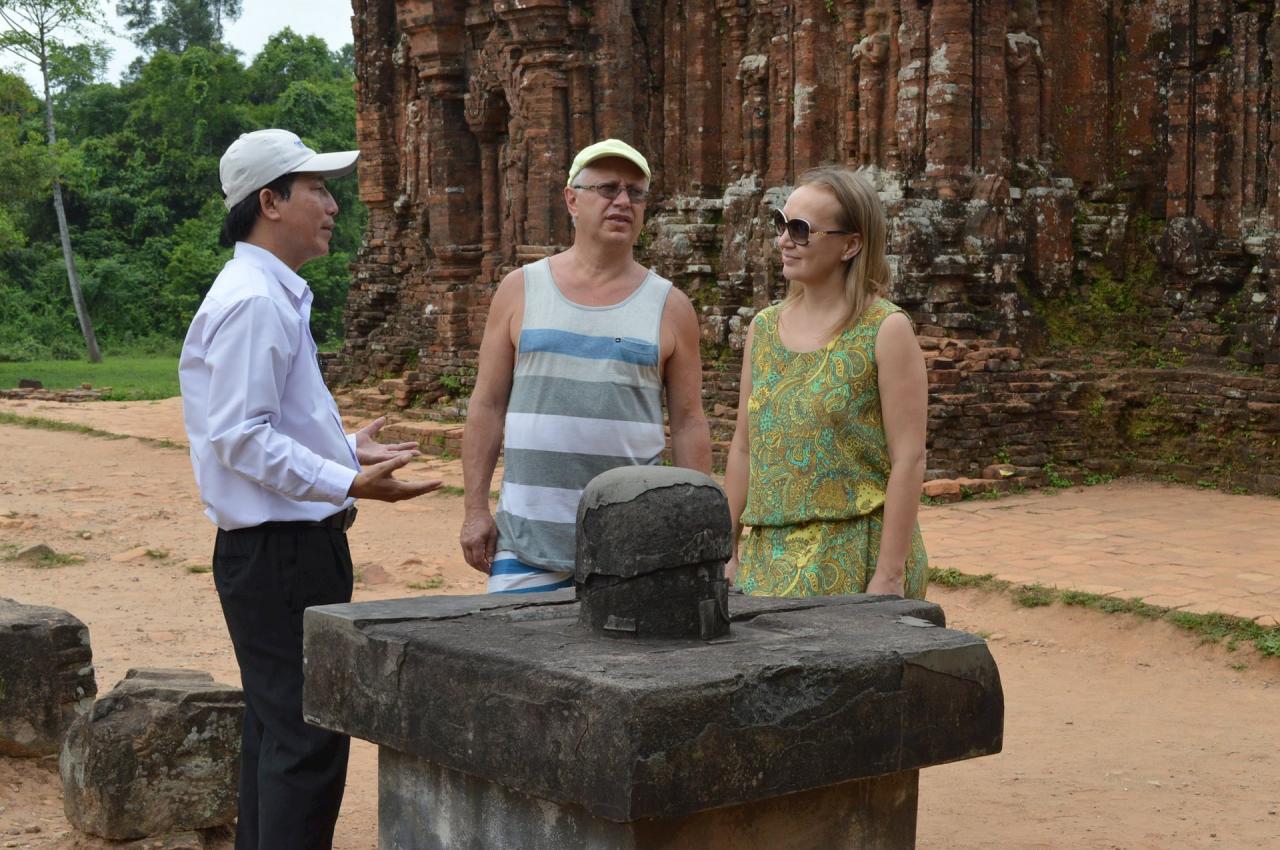
Based on observations by staff at the time, the moss and mold significantly decreased during the first two years. However, the lichen and mold gradually returned to normal, appearing on symmetrical sections of the wall. When Tower E7 was restored in 2015, a thin layer of resin oil was also used to preserve the newly restored brick surface on the tower roof. To date, this resin oil protective layer has faded and is no longer effective.
In 2018, Indian experts restoring the H tower group also experimented with applying resin oil to a newly restored 1m2 section of wall in the northern corner of tower H1. For the first two years, the wall section was bright and showed a noticeable difference, but in subsequent years, as the resin oil layer faded, there was no longer any difference between the preserved wall section and the symmetrical wall section.
In 2017, the Institute of Conservation of Monuments, in collaboration with the My Son Cultural Heritage Management Board, conducted experiments on preserving the wall surfaces of towers F1 (indoors) and F2 (outdoors). This preservative essentially helped harden the brick surfaces and significantly reduced the growth of moss, mold, and lichen. However, the color after preservation appeared new, not quite matching the natural color of the ancient bricks.
In April 2022, the My Son Cultural Heritage Management Board continued to cooperate with the Institute of Conservation of Monuments to conduct a trial treatment of mold, lichen, moss, and algae on the surface of brick and stone materials at a specific location in towers B4 and E7.
The testing was conducted on wall sections that had undergone different stages of restoration and reinforcement, were exposed to varying weather conditions (sun and rain), and had surfaces heavily damaged by mold, lichen, and algae. The test area had minimal impact on the activities of the historical site.
The technical team selected sunny, dry days for the tower walls and carefully carried out the steps to thoroughly clean the surface of the bricks and stones, removing moss, fungi, and lichen without affecting the original elements. Then, they sprayed a thin layer of chemicals onto the tower walls and stone pillars. The results were quite positive, but this was only the first step and continued monitoring was necessary.
According to Mr. Tran Quoc Tuan, Deputy Director of the Institute of Conservation of Monuments, with the advancement of science and technology, advanced methods of monument preservation such as chemical, physical, and biological methods are being increasingly applied worldwide today.
The trend of preserving heritage sites using chemical methods, especially materials like bricks and stones, is being widely researched, developed, and applied. This method has yielded positive initial results, meeting stringent requirements for maintaining the integrity and enhancing the sustainability of heritage sites.
Source: https://baoquangnam.vn/thach-thuc-bao-quan-gach-da-tai-my-son-3143176.html


![[Photo] National Assembly Chairman Tran Thanh Man successfully concludes his participation in IPU-152](https://vphoto.vietnam.vn/thumb/1200x675/vietnam/resource/IMAGE/2026/04/18/1776502638199_vna-potal-chu-tich-quoc-hoi-ket-thuc-tot-dep-chuong-trinh-tham-du-ipu-152-8709975-jpg.webp)




















































Comment (0)