

There are still many obstacles.
Many provinces and cities have implemented AI chatbot solutions to support citizens and businesses in accessing public services. However, according to many experts, the effectiveness remains limited. Specifically, chatbots can only answer a few simple and basic questions. Regarding administrative procedures, users still have to look up information directly or visit the relevant office in person. "AI technology in the public sector in Vietnam is still in its infancy," commented Ms. Nguyen Thi Dung (Truong Thi ward, Thanh Hoa province ) after spending nearly two hours submitting the necessary documents to obtain a certificate of single status.
Half a day after submitting the relevant documents, a judicial officer from the ward called to give further instructions, adding, "Why didn't you come here to get it done quickly!" As a result, to obtain her certificate of single status, Ms. Dung still had to go and get confirmation from both her old and new neighborhood leaders, and then go to the ward office again to complete the procedure.
In October 2024, the United Nations Development Programme in Vietnam (UNDP Vietnam) collaborated to develop a tool called dichvucong.me to support citizens in finding information and filling out forms as required by the government. After 5 months of implementation, dichvucong.me has only reached 1,600-1,700 uses. This result shows the limited popularity of the service.
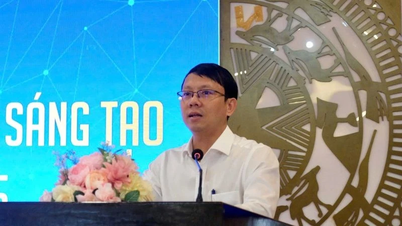
Recently, at the seminar "Overview of Artificial Intelligence in the Public Sector in Vietnam," Mr. Tran Anh Tu, Deputy Director of the Department of Science , Technology and Engineering (Ministry of Science and Technology), stated that the application of AI in the public sector in Vietnam still faces many challenges. One of the major obstacles is that the pace of policy development has not kept up with the rapid development of technology. In addition, the data system remains fragmented and lacks centralization, while AI applications have not been deployed synchronously, hindering practical application.
Meanwhile, Associate Professor Dr. Nguyen Xuan Hoai - Director of the Artificial Intelligence Institute (University of Technology, Vietnam National University , Hanoi ) - stated that to achieve AI development goals, three key factors need to be emphasized: human resources, data, and infrastructure. Currently, there is a significant shortage of human resources working in the field of artificial intelligence. Each year, only about 30% of information technology graduates are immediately employable, and even fewer are able to work in fields related to artificial intelligence.
 |
Residents submit applications online at the ward committee. Photo: SONG ANH |
Don't follow trends.
Globally, the successful experiences of Singapore and South Korea serve as evidence of the effectiveness of AI application in the public sector. Ms. Do Thanh Huyen, a public policy expert at UNDP Vietnam, analyzed: In 2007, South Korea began the process of e-cigarettes and digitalization in the healthcare sector, contributing to seamless connectivity between the public and private sectors. In the automation phase, doctors only need to call out a name, and the system will automatically provide a complete electronic medical record. "We should start with small, systematic steps because sometimes the core issue isn't technology. Complex, cumbersome, and difficult-to-understand processes are difficult for technology to support," Ms. Do Thanh Huyen stated.
Returning to the Vietnamese context, the initial success in Tay Ninh is considered an example of correctly identifying the "problem" that needs solving. Accordingly, the Tay Ninh Smart application is helping people submit applications online, check processing status, and report incidents without having to travel to administrative agencies. After a period of implementation, the application now has over 400,000 user accounts. Although many challenges remain, these efforts are highly commendable!
Digital transformation in public service is not just about technology; it's also about changing the culture, processes, and mindset of agencies to better serve the people. Experts recommend applying AI selectively, in accordance with the needs and actual conditions of the public sector.
"Each agency should clearly define its own 'problem' in order to choose the appropriate AI technology," emphasized Mr. Nguyen Quang Dong, Director of the Institute for Policy Research and Media Development.
Source: https://nhandan.vn/thach-thuc-ung-dung-ai-trong-khu-vuc-cong-post867452.html

























































































Comment (0)