

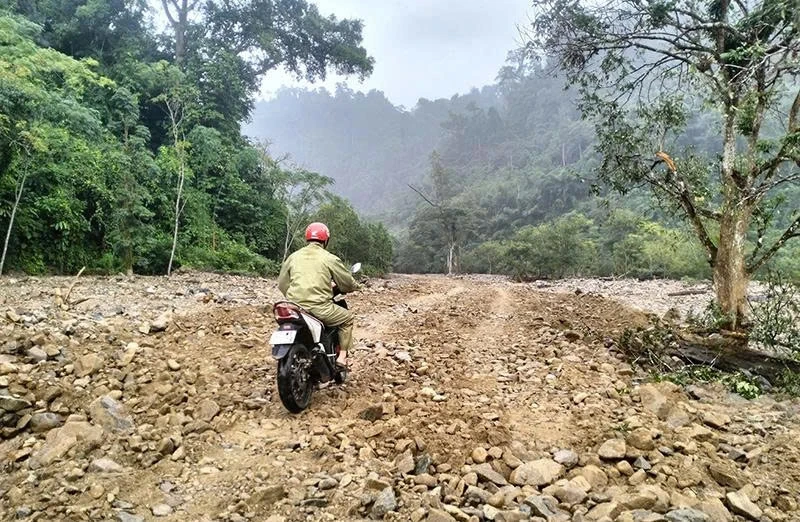
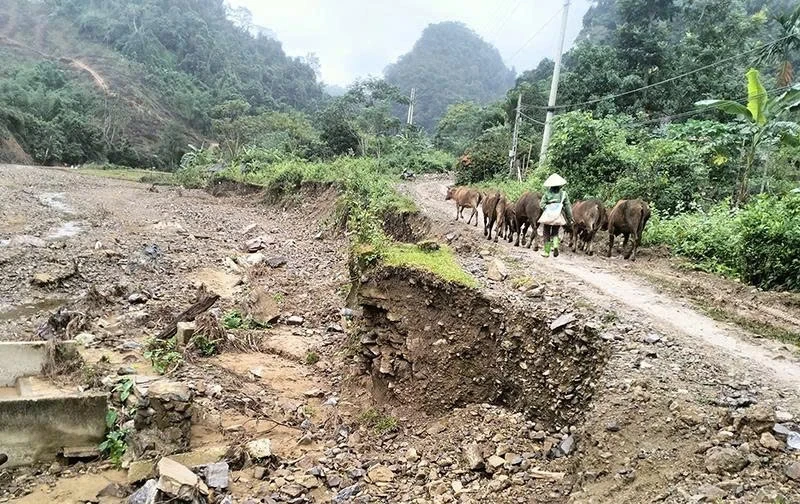
The road leading to Ruong village in Bat Mot border commune is in a rough condition after the storm.
They have been there for decades, dedicated to cultivating greenery on this borderland, making it more prosperous each day. But it has never been easy; all the hard work and wealth accumulated by generations were suddenly wiped out after just one flood. From houses and fish ponds to even the fields they painstakingly cleared and cultivated...
As winter approaches, thick fog blankets the remote border region. More than two months have passed, yet the scars from the historic flood caused by Typhoon No. 10 remain, jagged and devastated. The concrete road leading from the center of Bat Mot border commune to Ruong village, like a precarious vine clinging to the hillside and stream, the only means of communication between the villagers and the outside world , is now broken and fragmented. Only a small portion of the more than four kilometers of road still has its foundation. Much has been swept away by the raging, muddy water.
Excavators and bulldozers roared and worked urgently to level and excavate a temporary path so that the children could get to school on time. Meanwhile, the villagers' goods remained unclaimed, and motorized vehicles couldn't get in or out.
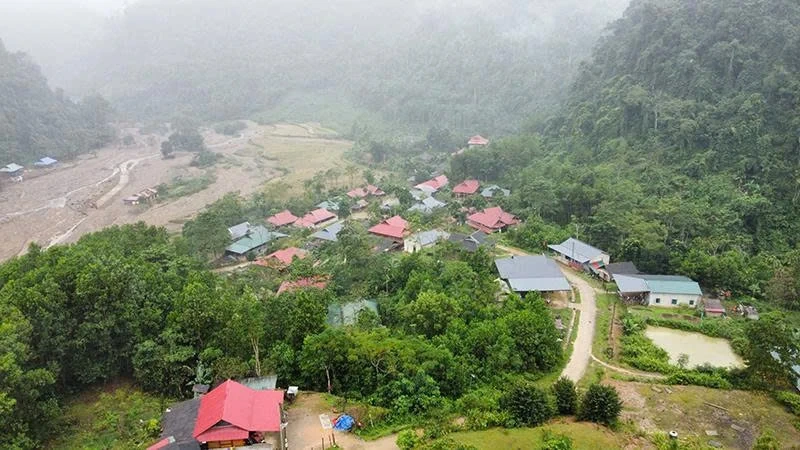
A corner of Ruong village, Bat Mot commune.
In 2025, all three natural disasters struck Ruong village. First, heavy rains caused serious landslides after typhoon number 3, followed by the impact of typhoon number 5, and most severely, flash floods after typhoon number 10. All property and capital, from rice and vegetables in the fields to chickens and ducks in the coop, were swept away. The village was already in a difficult situation, and the floods only compounded its hardships.
But this is not the first time the people in this border village have suffered such a terrible disaster. Since the village was first settled around the 1950s, they have constantly fled floods amidst hardship and scarcity. Just eight years ago, the historic flood of 2017 left Ruong village like a lonely landmark on the map, cut off and isolated for almost a week. Many border guards I met that year had to struggle to carry sacks of rice and boxes of instant noodles, wading through the water and struggling for hours up the slippery hillsides to deliver supplies to the village. Even now, the people of Ruong village still tell each other about the hardships, poverty, and the human kindness and solidarity between the soldiers and the villagers.
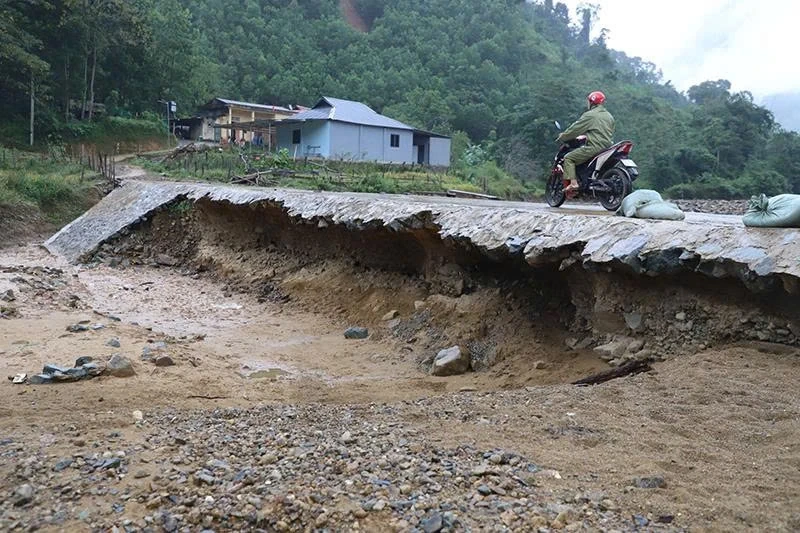
Many sections of the road from the center of Bat Mot commune to Ruong village were severely damaged by the floods.
The house of the Party branch secretary and village head, Ruong Luong Van La (born in 1990), is located right at the top of the mountain and has just been renovated after being damaged by torrential rain and strong winds. He sighed and said, "Everything the villagers had built up after the historic flood of 2017 has been almost completely lost after the last three floods. Now we have to start all over again. Our biggest concern right now is the livelihood, the food and clothing for the villagers."
How could they not worry? After the flood, not only were mountains and roads buried under landslides, but their fields, which they had painstakingly cultivated for their livelihood, were also gone. The fields, which ran along both sides of the stream and were rebuilt after the 2017 flood, once golden during the rice harvest season, are now just barren gray pebbles. Party branch secretary Luong Van La gazed wistfully at the fields, letting out a sigh carried on the wind: "These fields were our food and clothing. Now..."
According to the young Party branch secretary's rough estimate, over 2 hectares of rice paddies were swept away by the flood. Here, looking up, you see steep mountains; looking down, you see deep ravines. Where can you find flat land or gentle hills to reclaim for rice cultivation, and then develop an irrigation system? Having lost their rice paddies, the villagers thought about the forest, but the income from contracted forest care and protection is barely enough to make ends meet. Each year, they receive about 600,000 VND in support per hectare of forest. Meanwhile, the household with the largest forest area under contract only has about 30 hectares, while the smallest is 15 hectares. Besides rice paddies and forest, they have nothing else.
Even before the floods, the total area of farmland in the village wasn't much. 52 households with 312 people only had 5 hectares of rice paddies. That means each person only had half a sao (a unit of land measurement). Therefore, escaping poverty here has never been easy. In 2025, the village will still have 30 poor households and 6 near-poor households.
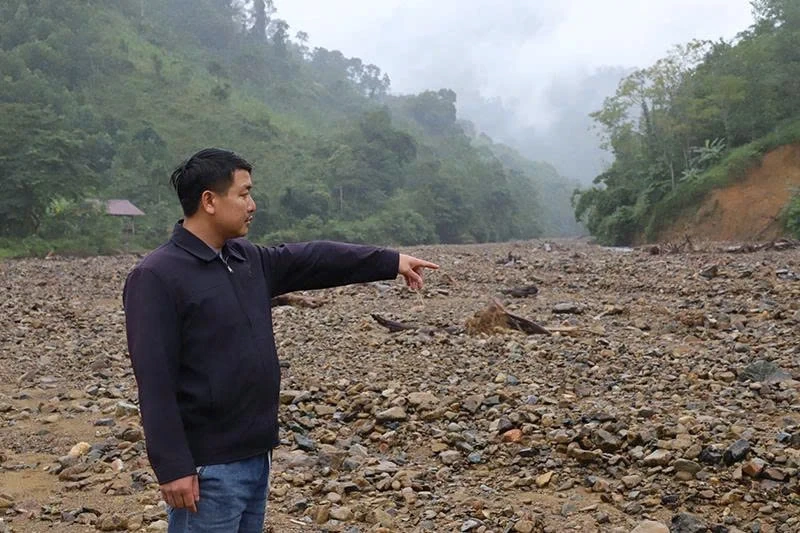
After the flood, the fields of Ruong village are now just bare pebbles.
The hardworking villagers of Ruong hamlet have never sat idly by waiting for government assistance. In 2017, nearly 3 hectares of rice fields were swept away. They hired excavators and trucks to transport soil from the mountain to rebuild the land and construct an irrigation system. Not including labor costs, the cost of renting equipment, machinery, and materials for each plot of land amounted to 8-10 million VND.
Party branch secretary Luong Van La confided: "The villagers have also considered doing it the same way as in 2017, but now prices are soaring, and the cost of renting trucks and excavators has increased significantly. I'm afraid the villagers won't be able to afford it."
Last winter, when I was at the border, the fields along the stream were lush with corn, peanuts, and vegetables. Now, only sparse stubble remains on the dry, high fields nestled at the foot of the hill.
For now, it's impossible to rehabilitate the fields, a few households have restarted livestock farming, but the majority of people are left with no choice but to rely on the forest, gathering firewood, bamboo shoots, beehives, or to leave their homes and migrate south or north to work as laborers. That's the situation for the young people. But what about the elderly and middle-aged? What will they use to make ends meet?
The aftermath of the flood is in disarray. The Party committees and local authorities of Bat Mot commune are grappling with finding solutions to provide livelihoods for the people of Ruong village. And it's not just because of the flood that they're considering solutions; the village still lacks a community center. Here, the villagers' common gathering place is temporarily occupied by a classroom at a kindergarten located on a steep slope. But the room is devoid of any furniture. When I visited, it was empty and cold, except for a few tattered plastic mats on the floor.
Due to shortages, for a long time, Party branch meetings and village gatherings have been held in the evenings at the home of a family at the foot of the slope leading to the school. As Party branch secretary Luong Van La explained: "The villagers have already worked hard climbing the hill during the day, so no one wants to climb the steep slope to attend a meeting in a cold, empty room at night."
As evening fell amidst a lingering drizzle, the village of Ruong stretched out in a desolate landscape, its inhabitants filled with sorrowful eyes reflecting the anxieties of making a living. The officials I met at the Bat Mot commune office shared this same concern, but as the Party Secretary of the commune, Le Thanh Hai, confided: "The commune has focused on completing what has been accomplished with the highest determination and urgency. However, in the long term, investing in infrastructure and ensuring sustainable socio -economic development, contributing to maintaining border security in Ruong village, requires significant resources, exceeding the commune's capabilities."
Fortunately, not only in Ruong village, but also in Bat Mot commune, following the severe damage caused by Typhoon No. 5, the Chairman of the Provincial People's Committee declared a state of emergency due to the natural disaster, creating favorable conditions for concentrating resources to overcome the consequences of the storm. And now, the province has allocated budget to repair and restore some damaged infrastructure, including the road leading to Ruong village.
But the village of Ruong remains, burdened by the persistent worry of making a living amidst profound poverty...
Report by Do Duc
Source: https://baothanhhoa.vn/tham-tham-thon-ruong-270883.htm


![[Image] A night of light, many layers of message](https://vphoto.vietnam.vn/thumb/1200x675/vietnam/resource/IMAGE/2026/03/10/1773158812907_hoa-nhac9-jpg.webp)



































































Comment (0)