Sweden is the birthplace of legendary games that have captured the hearts of millions of gamers, such as Candy Crush, Minecraft, and Battlefield.

The For Devs 2024 event brings together leading Swedish game developers to share their industry experience - Photo: dataspelsbranschen.se
It is estimated that one in four people worldwide have played a game produced in Sweden, and there have been approximately 7 billion downloads of games from this Nordic country globally.
Culture of sharing
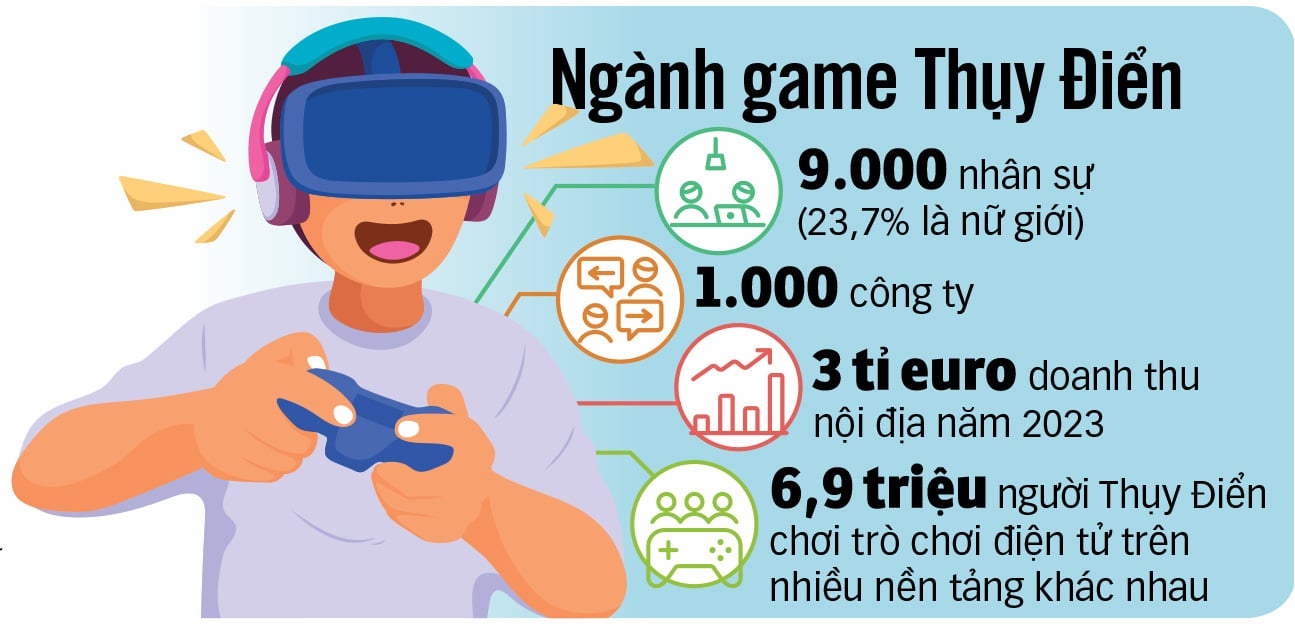
According to the Swedish Gaming Industry Association (Dataspelsbranschen), the domestic revenue of the Swedish gaming industry in 2023 was 3 billion euros, larger than the export value of iron ore and larger than the combined revenue of the Swedish film and music industries.
Including overseas subsidiaries, the Swedish gaming industry generates revenue of 7.9 billion euros.
To better understand this success, in early December, we had the opportunity to visit the headquarters of Dataspelsbranschen in Stockholm – a trade association for game companies and representing the entire Swedish gaming industry. Dataspelsbranschen can be considered the "heart of the Swedish gaming industry".
The gaming industry in this Nordic country "boomed" about 30 years ago, when the Swedish government introduced a program to subsidize internet access and help people buy affordable home computers.
"With everyone having a computer, young people started playing games and even creating their own titles."
"People with the same passion find each other and together create blockbuster games, such as Dice - the developer of Battlefield," Daniel Torbjörnsson, head of skills and development at Dataspelsbranschen, who has worked in the industry for 25 years, told Tuổi Trẻ.
Interestingly, the cold climate characteristic of this Nordic country has also contributed to the development of the gaming industry.
"It's very dark and cold here. Some people spend a lot of time indoors in front of their computers," said Anna Ingler, communications and events manager at Dataspelsbranschen.
With a mission to create the best conditions for the development of the gaming industry, Dataspelsbranschen is considered one of the key organizations acting as a "mentor" for game developers in Sweden.
Around 70 companies, ranging from small game studios with 2 or 3 employees to those with up to 900 employees, are currently members of Dataspelsbranschen. Game development training centers and startup incubators are also members of this association.



The Swedish gaming industry's culture of sharing and mutual growth is clearly evident at Dataspelsbranschen's headquarters.
There are about 20 game companies, large and small, operating in an open space of approximately 100 square meters. Many of these companies have only 2-3 employees and are taking their first steps in their development journey.
"Small startups can rent office space here. They will have the opportunity to interact with and be inspired by experienced game developers."
"Sometimes you'll see multiple game studios having lunch together. Many of the people involved have been in the industry for years and worked for different studios, so they have very extensive networks," Ingler shared.
Recently, the ForDevs event, created by Dataspelsbranschen, provided a forum for member companies and other game developers to openly share their challenges, failures, and experiences.
In addition, Dataspelsbranschen also provides support for policy planning related to the development of the gaming industry.
Graphics: N.KH
Learn about games from an early age.
In Sweden, game development is considered an academic discipline like any other. High school students can begin learning about programming, design, or game development at a basic level. They can then pursue more in-depth studies at university.
Vocational education is also another option for learners to gain practical experience and enter the industry.
"Thanks to the educational foundation, many people have been able to find jobs or start their own businesses in the gaming industry right after graduation. There are even small startups in the industry that have emerged right from the classroom," Torbjörnsson shared.
According to Torbjörnsson, one of the biggest challenges for the industry is finding enough talent for companies. Twenty years ago, there were only about 500 people working in this sector. Now, that number has exceeded 9,000.
He stated that although Sweden has a good education system at all levels, from high school and vocational training to university, the demand for personnel in the gaming industry still exceeds the supply.
"Therefore, we are trying to persuade the government to increase investment in education, especially for the gaming industry," Torbjörnsson emphasized.



Sweden's success in building a gaming industry ecosystem can offer valuable lessons for Vietnam.
"I think markets need to figure out how to develop themselves. Sweden has been very successful in creating gaming 'hubs'."
For example, the Skovde city government provided support in education, housing, and assistance to local companies to develop the gaming industry. These companies then successfully reinvested their profits in later-established local companies, thereby fostering internal growth.
"In addition, many well-known companies there have also decided to stay. The region's success has also benefited Sweden, and many other regions are striving to achieve similar results," Ms. Ingler stated.
Mr. Torbjörnsson suggested that investing in education and startup support programs is a good starting point for Vietnam.
"You will need mentorship from experienced people. In Sweden and many other countries, there are mentoring programs at various levels. We are very willing to support the game development community in Vietnam if they wish to receive assistance from European game companies or organizations like Dataspelsbranschen," said Torbjörnsson.
In 2023, the Vietnamese domestic gaming industry generated $507 million in revenue, with an additional $200 million from game exports. The Ministry of Information and Communications aims for the Vietnamese gaming industry to reach $1 billion in revenue by 2030.
Source: https://tuoitre.vn/tham-trai-tim-nganh-game-cua-thuy-dien-20241215075554104.htm



















































































![[Infographic] Pensions, social insurance benefits, and monthly allowances will increase from July 1, 2026.](https://vphoto.vietnam.vn/thumb/402x226/vietnam/resource/IMAGE/2026/06/29/1782695537956_bna_-anh-8888.jpeg)