"Come back here, comrades!"
From the center of Ha Giang city (formerly), the car traveled along National Highway 2, following the deep blue Lo River, through the territory of Vi Xuyen district (formerly) amidst towering mountains and winding roads. The road not only brought the delegation closer to their destination but also opened up in me thoughts about a land that had endured the flames of war, where every cliff still holds the memory of the struggle to protect the northern border of our homeland.

|
The graves of fallen soldiers were reinterred at the Vi Xuyen Martyrs' Cemetery during the search and repatriation effort. Photo: VAN NGHI |
The Vi Xuyen front in those days was likened to a "century-old lime kiln," a "human flesh grinder," a "waterfall calling souls," or a "crossroads of death"... Today, the mountains and forests still seem to echo the oath inscribed on the rifle stock of Hero and Martyr Nguyen Viet Ninh: To live clinging to the rocks to fight the enemy, to die becoming immortal stone.

|
Water filters are distributed to help people in Vi Xuyen commune overcome the consequences of natural disasters. Photo: PHAM THU |
We stopped at the Vi Xuyen Martyrs' Cemetery as preparations were underway for a memorial service and burial of a mass grave containing the remains of five martyrs recently collected from border communes.
The wind rustled through the palm fronds. We, along with the veterans, walked silently between the neatly arranged rows of graves, then stopped before the rows of upright pine trees behind them. I suddenly remembered the verses from Nguyen Trai's poem "Pine Tree":
In Nguyen Trai's poetry, the pine tree symbolizes unwavering vitality during the three harsh winter months. And you, the soldiers of yesteryear, who clung to every rocky outcrop, defended every inch of our homeland, now rest peacefully beneath the shade of those pine trees. The chanting of prayers echoes among the rows of graves like a mother's lullaby, allowing you to rest in eternal peace.

|
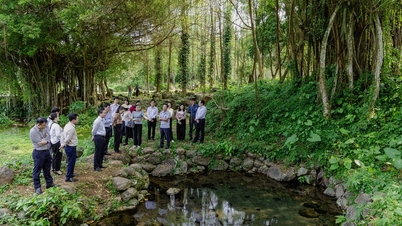
Bridge and road construction in Lung Khoe B hamlet, Thuan Hoa commune. Photo: Center for Community Initiatives and Development Research. |
Then, amidst that emotionally charged and sacred atmosphere, voices rose from the very soldiers of Vi Xuyen from years past: ("Come back here, comrades!" - Truong Quy Hai).
The song, echoing amidst the sacred spirit of the mountains and rivers, will perhaps linger for a long time in the hearts of young people like us – a generation that has never experienced the smoke and fire of war – making us even more deeply appreciate the sacrifices our fathers and ancestors made for the peace, prosperity, and happiness we enjoy today. I couldn't help but be moved by the camaraderie I felt during a casual conversation with the very soldiers who had just sung "Come Back Here, My Comrades." Although I didn't have time to remember their faces and names, I will never forget the tears they shed then, and I know that every year they return here on special occasions, as a promise to their fallen comrades.
Providing livelihood support for the people.
Standing beneath the memorial to the fallen heroes at the cemetery, just before leaving, I suddenly thought that this land of Vi Xuyen, once ravaged by war, still has many highland communes and villages struggling with roads, clean water, and even the inundations of the rainy season.
Over the years, under the leadership of the Party and the State, the work of "showing gratitude and repaying kindness," and caring for the lives of people in border areas, has always been given attention through concrete and practical actions. Along with this, the support of social organizations such as the Center for Community Innovation and Development Research – a non-profit science and technology organization under the Vietnam Union of Science and Technology Associations – has contributed to improving the lives of people in these disadvantaged areas.
During my field trip to Cao Bo commune ( Tuyen Quang province), I clearly felt the genuine affection that the local leaders and people have for the Center.
Late in the afternoon, fog blanketed the Tay Con Linh mountain range. The road from National Highway 2 to the commune was a single, winding path along the mountainside. Some sections were steep, with a sheer cliff on one side and a hidden ravine on the other. Cao Bo, a highland commune formerly belonging to Vi Xuyen district, is not only famous for its rhododendron forests and centuries-old tea trees. Comrade Hoang Van Luong, Vice Chairman of the Commune People's Committee, and Comrade Nguyen Sy Kha, Chief of the Commune People's Committee Office, led us to Lung Tao and Tham Ve villages to see firsthand the projects and livelihood models that have been supported.
Along the way, Comrade Nguyen Sy Kha spoke about the local people's appreciation for RIC, due to the practical changes it had brought to their lives. That evening, by the warm fire, we listened quietly to the simple stories of the people. They didn't mention specific numbers but simply said that since receiving support, their lives had become more stable and their worries had lessened.

|
Distributing breeding calves to the indigenous cattle farming livelihood group in Khau Meng village. Photo: Center for Community Initiatives and Development Research. |
In communes formerly belonging to Vi Xuyen district, such as Thuan Hoa, Cao Bo, and Viet Lam, the Center for Community Initiatives and Development Research has collaborated with the local government and residents to implement many practical models. Over the past year, 14 essential infrastructure projects have been completed, ranging from nearly 3.5km of concrete roads within villages, bridges over streams, a gravity-fed water system in Ban Dang, to reinforcement of shelters. The total cost exceeded 4.8 billion VND, of which nearly 18% was voluntarily contributed by the people, who participated in planning, construction, and supervision.
In addition to infrastructure, disaster prevention and mitigation initiatives and a safe school program, with 510 million VND supporting three schools in mountainous areas, are gradually helping nearly 2,000 students have a stable learning environment in the face of increasingly severe and unpredictable natural disasters in the context of climate change.
Notably, climate-adaptive livelihood models led by women have begun to take root in Khuoi Luong, Ban Dang, Hoa Son, and Khau Meng: raising indigenous black pigs, cultivating Giang leaves on 10.2 hectares, and raising breeding cattle… Dozens of households, mostly poor, have received support in terms of livestock, techniques, and methods for organizing production adapted to climate change. But the most important thing is not the amount of money provided, but the fact that the people themselves have taken the initiative to establish group regulations, manage themselves, and decide on their own direction.
Mr. Le Van Hai, Director of the Center for Community Initiatives and Development Research, enthusiastically told us about the projects he and his colleagues had implemented in the highland villages of Vi Xuyen in the past. Mr. Hai emphasized: “Each project is designed based on the actual needs of the people, from natural conditions to production practices. We only play the role of connecting resources, transferring technology, and supporting the initial stages. Sustainability, however, must come from the participation and decisions of the local community.”
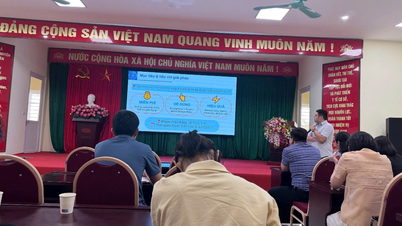
During this trip, we also accompanied the delegation to distribute water filters to the people of Vi Xuyen commune. The activity was implemented in coordination with the local government, international partners through Plan International, and the Center for Community Initiatives and Development Research. 110 water filters were handed directly to households severely affected by the natural disasters of 2025. After the floods, many water pipelines from the upstream areas in the mountains were damaged, forcing residents to repair and temporarily connect them themselves. Many water sources were turbid and unsafe. Some families had to buy clean water, but the cost was high, and they were not yet accustomed to the smell of chlorine disinfectant.
Ms. Do Thi Lan, from Lang Khen village, Vi Xuyen commune, jokingly said that this Tet holiday, she was able to celebrate spring earlier and in a "fresher" environment. Amidst the cold of the highlands and the lingering worries after the natural disaster, having clean water to cook rice cakes, make tea, and prepare the Tet meal is a simple yet precious source of peace of mind.
Early spring arrives in the villages of the former Vi Xuyen frontline region. Pale pink peach blossoms have bloomed early on the mountain slopes. In this land that once endured the brutal years of fighting to defend the northern border of the Fatherland, the color of the peach blossoms today is like blood mingled with the earth, silently following the flow of life to sprout, quietly and persistently, just like the people of this land.
We returned to Hanoi as the fog had lifted from the mountains. Thin wisps of smoke rose from the stilt houses, mingling with the tranquil air, welcoming the new year. Looking at those roofs, I suddenly remembered a line from Hoang Trung Thong's poem: "The rice yields more grains, the roofs are filled with more warm smoke."
Source: https://www.qdnd.vn/phong-su-dieu-tra/phong-su/than-thuong-vi-xuyen-1026503





![[Photo] General Secretary and President To Lam presides over a meeting on preparations for the review of one year of operation of the three-tiered government system.](https://vphoto.vietnam.vn/thumb/1200x675/vietnam/resource/IMAGE/2026/06/02/1780391821195_a1-bnd-4595-9717-jpg.webp)


































































Comment (0)