India is a land of multifaceted emotions, the cradle of the Indus-Ganges civilization, formed from many colorful pieces. Besides the magnificent Taj Mahal, the bustling Old Delhi, the verdant Kerala, the captivating Kashmir, and the prosperous Chennai, there is another memorable stop: Hyderabad. As the capital of the state of Telangana in South India, it embodies both the modernity of a city with its technology centers and skyscrapers, and the preservation of profound historical, cultural, and religious values spanning centuries. Known as the Pearl City, Hyderabad is not only famous for its eponymous trade but also for its unique blend of Islamic and Hindu traditions with other South Indian cultural nuances.
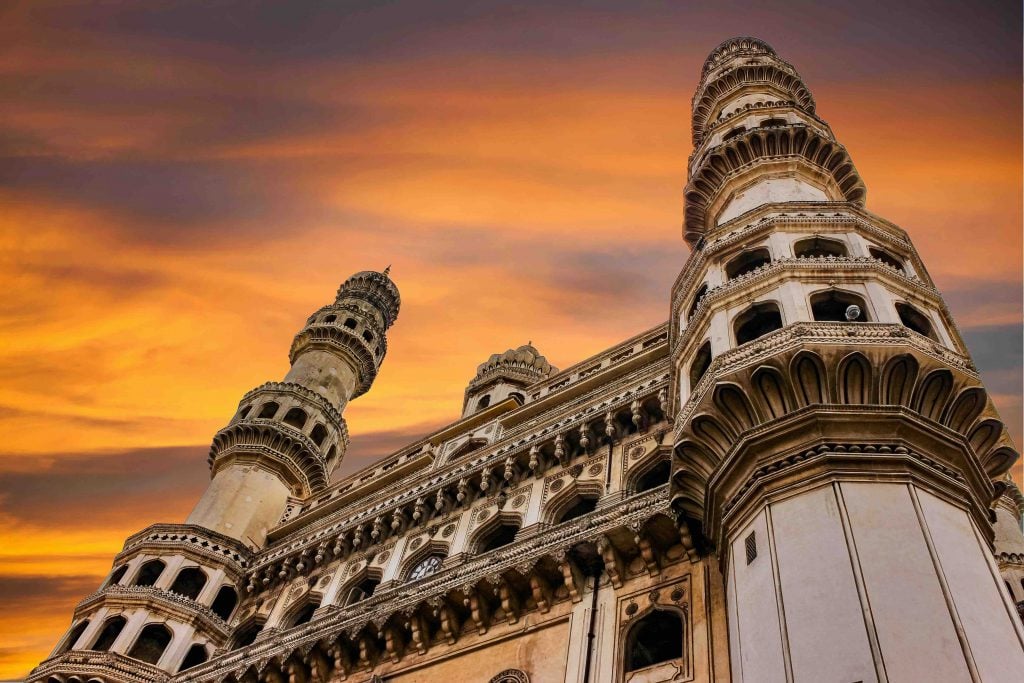
Charminar is considered a symbol of Hyderabad.
Hyderabad – a place where three religions (Islam, Hinduism, and Christianity) intersect.
Hyderabad was founded in 1591 by Mohammed Quli Qutb Shah, the fifth ruler of the Qutb Shahi dynasty. Initially planned on the banks of the Musi River, Hyderabad was the capital of the Golconda kingdom, renowned for its rare diamond mines. By the 17th century, Hyderabad was a bustling commercial center, a hub for trade between India, Persia, and the Middle East. After the fall of the Qutb Shahi dynasty, the land fell to the Mughals, and later to the Nizam of Hyderabad – one of the wealthiest dynasties in the world . The Nizam left behind many valuable legacies: palaces, temples, ancient libraries, and a rich cultural heritage. In 1948, after India gained independence, Hyderabad was incorporated into the Union of India. Today, this city, with its centuries-old history, is also a major information technology development center of the country, known as Cyberabad – the high-tech city. As one of the fastest-growing cities in India, Hyderabad still preserves its old quarters with traditional markets, street food, and craft villages. Hyderabad's cuisine is renowned for its blend of Mughal and South Indian traditions. The most memorable dish is Hyderabadi Biryani – a mixed rice dish of basmati rice with seasoned chicken or goat meat, onions, and saffron milk, slow-cooked in an earthenware pot. In terms of commerce, Hyderabad is famous for its pearl and gemstone markets, such as Laad Bazaar, long known as a "paradise of bracelets and pearls."
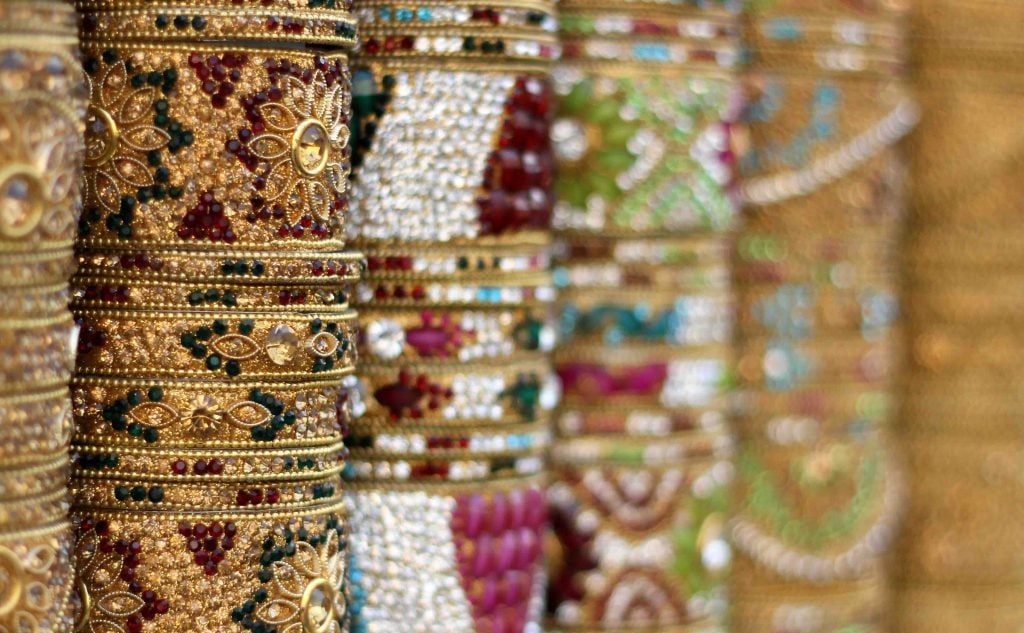
These bracelets are on display at Laad Bazaar.
A particularly noteworthy aspect of Hyderabad is the harmonious coexistence of Islam, Hinduism, and Christianity. Hinduism, the oldest indigenous religion, plays a significant role in the spiritual life of the local people, with temples like Birla Mandir and Chilkur Balaji always bustling with pilgrims. Islam, on the other hand, only emerged during the reign of Qutb Shahi, bringing about profound changes in art, architecture, and cuisine . Notable structures such as the Charminar, Mecca Masjid, and the Qutb Shahi mausoleums all bear the strong influence of Persian Islamic design in their decorative details. Finally, Christianity was introduced during the colonial period, leaving its mark in the numerous Gothic churches scattered throughout Hyderabad. The blend of religions creates a unique and peaceful atmosphere for the city, and is also a strong testament to the open and tolerant nature of religion that has permeated the people here.
A glorious, regal past goes hand in hand with the technology city.
The city's iconic tourist attraction is the massive Charminar Gate Tower, built in 1591. It commemorates both the relocation of the Qutb Shahi dynasty to Hyderabad and the successful containment of the then-spreading plague epidemic. The name Charminar, meaning "four pillars" in Urdu, is fitting for its architecture: four towers over 50 meters high, elaborately decorated in a blend of Indo-Islamic and ancient Persian styles. Inside, the towers feature a balanced structure with staircases leading to the upper levels and doors opening in four directions of the city. With a history spanning over four centuries, Charminar is featured on the coat of arms of Telangana state and has been remarkably well-preserved throughout history. In the urban planning of Hyderabad's old city, Charminar occupies a central position, surrounded by other prominent landmarks such as the Laad Bazaar and the Mecca Mosque. This is also the largest mosque in the entire state, built in the 17th century with a capacity of up to 10,000 people for prayer. Legend has it that every brick used by Muhammad Qutb Shah – the sixth ruler of the Qutb Shah dynasty – to build Mecca Masjid was cast from clay brought from the holy city of Mecca, Saudi Arabia. This meticulous craftsmanship has made this mosque one of the most beautiful architectural heritage sites in India, with its massive scale, grandeur, and magnificence, and it is an important pilgrimage site for Muslims both domestically and internationally.
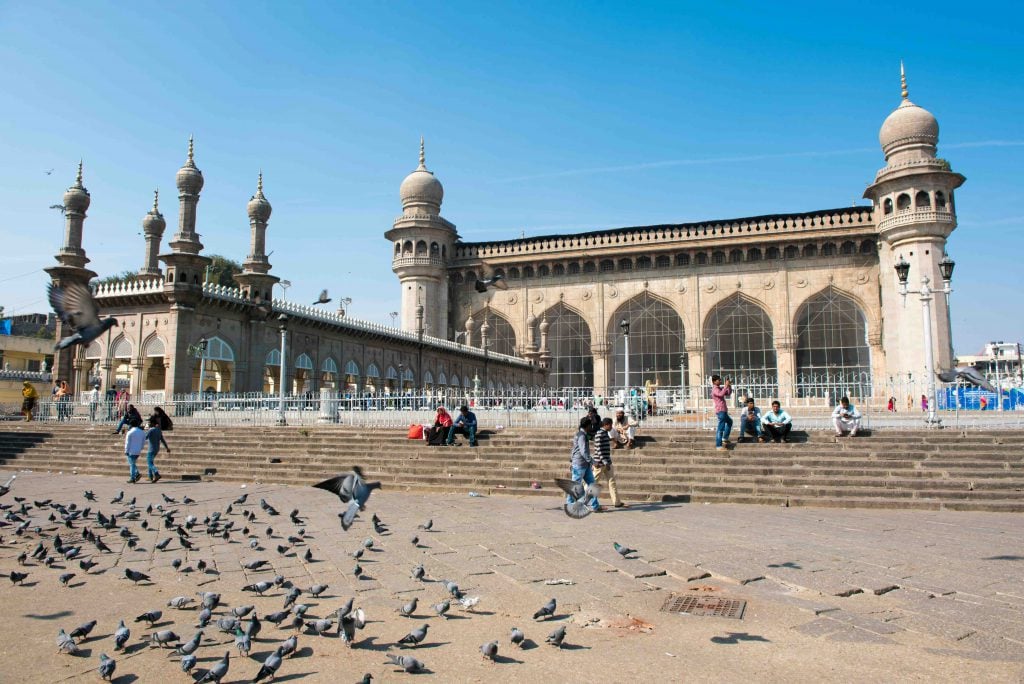
The oldest mosque in Mecca is the Masjid.
Located 11km from the city center is another unique structure – Golconda Fort – once the capital of the Qutub Shahi kingdom. Built on a 130m high hill, covering an area of 4km2 divided into four smaller forts and surrounded by 11km of walls, Golconda is known for its impressive architecture and is a testament to Hyderabad's powerful history. Initially built of mud in 1143, Golconda was gradually reinforced with brick by the Bahmani Sultans and the Qutub Shahi dynasty between the 14th and 17th centuries. The outermost wall of the fort is Fateh Darwaza, or the "Gate of Victory". Inside the fort are the ruins of palaces, mosques, cannon emplacements, armories, stables, and large lakes. The domes of the fort, in particular, create a reverberating sound near the entrance when clapped, a sound clearly audible from the hilltop about 1km away, and were once used as a warning system for the inhabitants inside. Today, Golconda has become a historical landmark much loved by the people of India; from the top of the fort, one can see the Deccan plateau and the bustling metropolis of Hyderabad. When night falls, the fort becomes even more vibrant with a spectacular sound and light show showcasing the golden age of royalty that once existed here.
Hyderabad is a city steeped in history, where Eastern cultural identity blends with modern Western influences, and where past and present coexist. With its magnificent temples and sacred sites, diverse cuisine, and vibrant daily life, the Pearl City is a must-see destination on any journey through South India. 
Source: https://heritagevietnamairlines.com/thanh-pho-ngoc-trai/






![[Photo] General Secretary and President To Lam presides over the meeting to approve the draft report on the results of the second inspection by the Politburo of the Standing Committee of the Hanoi City Party Committee.](https://vphoto.vietnam.vn/thumb/1200x675/vietnam/resource/IMAGE/2026/05/26/1779789811432_a2-bnd-4430-9620-jpg.webp)


































































































Comment (0)