

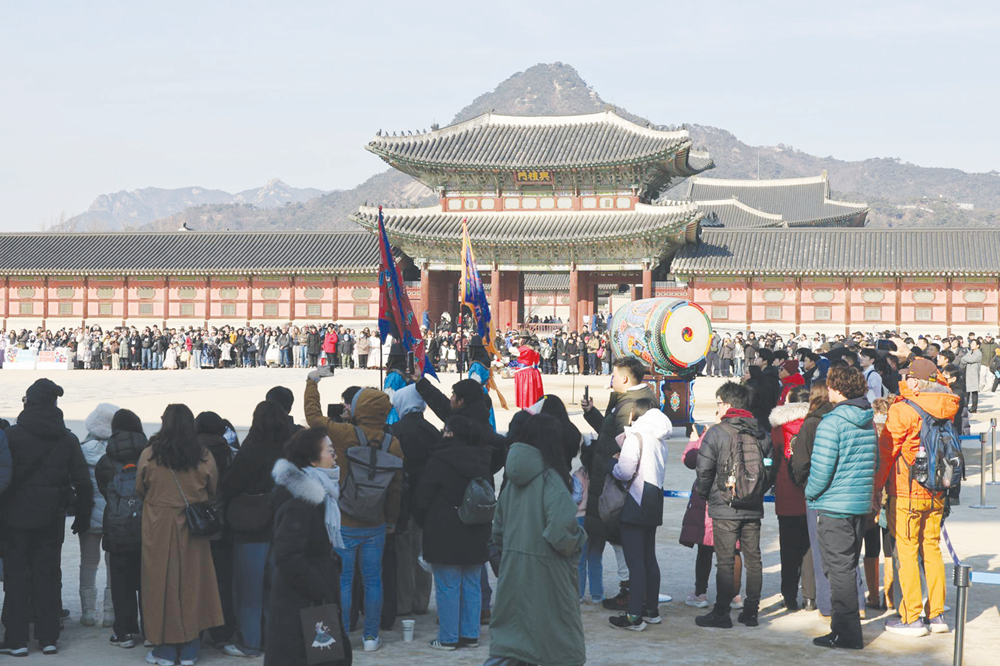
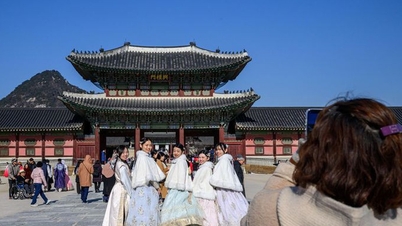
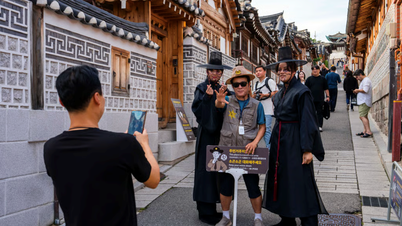
Palaces in South Korea attract a large number of visitors. Photo: KOREA TIMES
Images of long lines of people queuing in front of the gates of numerous palaces reflect the allure of an important historical heritage site. According to South Korean officials, a total of 17.81 million people visited royal palaces, tombs, and Jongmyo Shrine across the country in 2025. This figure demonstrates a strong resurgence in heritage tourism and reflects the growing appreciation for local historical and cultural values in modern South Korean society.
The Royal Palace and Tomb Center, under the Korea Heritage Agency, announced that the total number of visitors to key historical sites in 2025 reached 17.81 million. This represents an impressive increase compared to the previous year's 15.78 million, setting a new record.
This also marks the first time in history that the total number of visitors to the four main royal palaces—Gyeongbok, Changdeok, Changgyeong, and Deoksu—along with Jongmyo Shrine and the royal tombs, has surpassed 17 million.
Jongmyo Shrine, one of South Korea's most important cultural heritage sites, houses the ancestral tablets of the Joseon dynasty's royal family. Beyond its architectural and historical value, Jongmyo is a sacred space deeply connected to traditional ancestral worship rituals, reflecting the profound Confucian ideology that dominated Korean political and social life for centuries.
The number of visitors to royal sites plummeted during the Covid-19 pandemic, reaching only 6.7 million in 2021. However, since then, South Korea's heritage tourism industry has steadily recovered. For four consecutive years following the pandemic, visitor numbers have consistently remained above 10 million each year. Specifically, 14.37 million visitors were recorded in 2023, increasing to 15.78 million in 2024 and reaching 17.81 million in 2025.
Among the attractions, Gyeongbok Palace continues to hold the top position in terms of visitor numbers. With 6.89 million visits in 2025, Gyeongbok accounts for 38.7% of the total number of visitors to all royal palaces and tombs.
As the largest royal complex in Seoul, Gyeongbok Palace is not only notable for its magnificent architecture but also as a quintessential symbol of the power of the Joseon dynasty. Following Gyeongbok Palace is Changgyeong Palace with 3.56 million visitors, followed by Deoksu Palace with 2.22 million and Changdeok Palace with 1.60 million.
Notably, the number of international visitors is also expected to increase sharply in 2025. A total of 4.27 million foreign visitors are projected to visit the royal sites, a 34.4% increase compared to 2024. International visitors now account for nearly a quarter of the total number of tourists, demonstrating the growing global reach of Korean culture and history.
According to the Korea Heritage Agency, at Gyeongbok Palace, foreign visitors accounted for 40.4% of the total number of visitors, reflecting its role as an indispensable destination for Seoul tourism. Meanwhile, at Jongmyo Shrine, the estimated percentage of international visitors was around 16.8%, showing that despite its highly ceremonial and traditional significance, the site still attracts considerable interest from the international community.
These impressive figures not only demonstrate the strong recovery of the tourism industry after the pandemic, but also affirm the increasingly important position of royal heritage in contemporary Korean cultural and tourism life.
Source: https://baovanhoa.vn/du-lich/du-lich-di-san-han-quoc-bung-no-195576.html
![[Photo] Prime Minister Pham Minh Chinh holds a phone call with Angolan President João Manuel Gonçalves Lourenço](https://vphoto.vietnam.vn/thumb/1200x675/vietnam/resource/IMAGE/2026/03/16/1773674632171_ndo_br_dsc-4772-jpg.webp)
![[Photo] Secretary of the National Assembly Party Committee, Chairman of the National Assembly presides over the fourth meeting of the National Assembly Party Committee Executive Board.](https://vphoto.vietnam.vn/thumb/1200x675/vietnam/resource/IMAGE/2026/03/16/1773656046264_ndo_br_bnd-0533-jpg.webp)
![[Photo] Prime Minister Pham Minh Chinh presides over meetings of the Government Standing Committee to discuss several important issues.](https://vphoto.vietnam.vn/thumb/1200x675/vietnam/resource/IMAGE/2026/03/16/1773674631996_ndo_br_img-5789-jpg.webp)
![[Photo] General Secretary To Lam receives the Chinese Ministers of Foreign Affairs, National Defense, and Public Security attending the Conference on the “3+3” Strategic Dialogue Mechanism](https://vphoto.vietnam.vn/thumb/1200x675/vietnam/resource/IMAGE/2026/03/16/1773659640884_a1-bnd-0963-2144-jpg.webp)
![[Photo] Prime Minister Pham Minh Chinh receives the Ministers of Foreign Affairs, Defense, and Public Security of China.](https://vphoto.vietnam.vn/thumb/1200x675/vietnam/resource/IMAGE/2026/03/16/1773659638054_ndo_br_dsc-4386-6157-jpg.webp)

































Comment (0)