 |
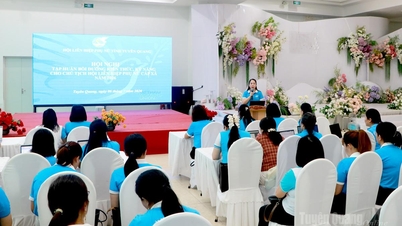
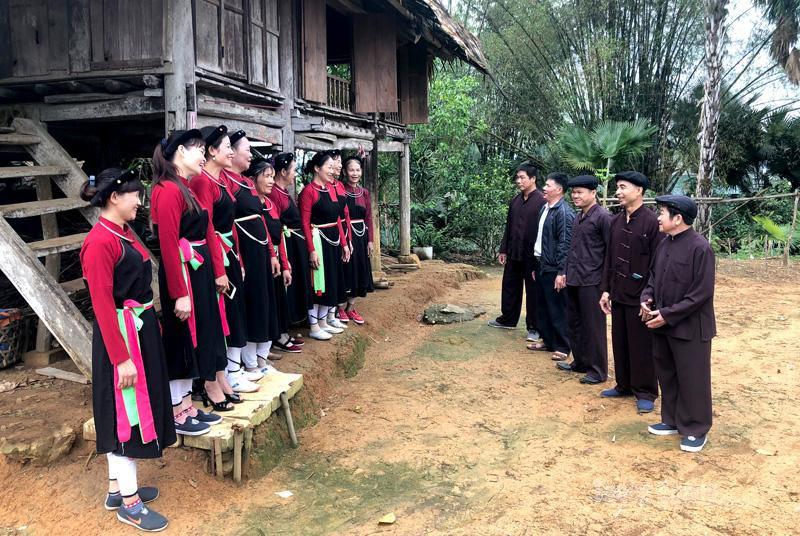
| Many localities with Cao Lan ethnic minority populations have established clubs to preserve the tradition of singing sình ca (a type of folk song). |
Singing during spring festivals is usually done during the day, while working, going about daily life, and at weddings; it includes: Calling songs (vèo ca), introductory songs (sạo ca), and oath songs (mầng ca).
Calling songs: These are usually sung outdoors. When young men and women, unfamiliar with each other, see each other, they proactively sing to call out:
He asked her...
I don't know if she's an old woman or a young woman.
If it were the old woman, she would just cleverly take a step.
If the lady would stop for a moment...
Or :
I met her out today.
Look at her feet in those pretty little shoes.
He wanted to ask her for the lyrics.
I don't know what she thinks.
The women's group immediately responded:
Thousands of miles of road planted with pine and cypress trees.
Thousands of miles of road ablaze with flowers
Thousands of villages and hamlets came searching for her.
Do you want to pair up with her like flowers again?
After exchanging pleasantries and understanding each other, they both admitted that they were unmarried and had not received any marriage proposals. They continued their conversation on the way to the festival, sometimes singing in groups, sometimes just the two of them.
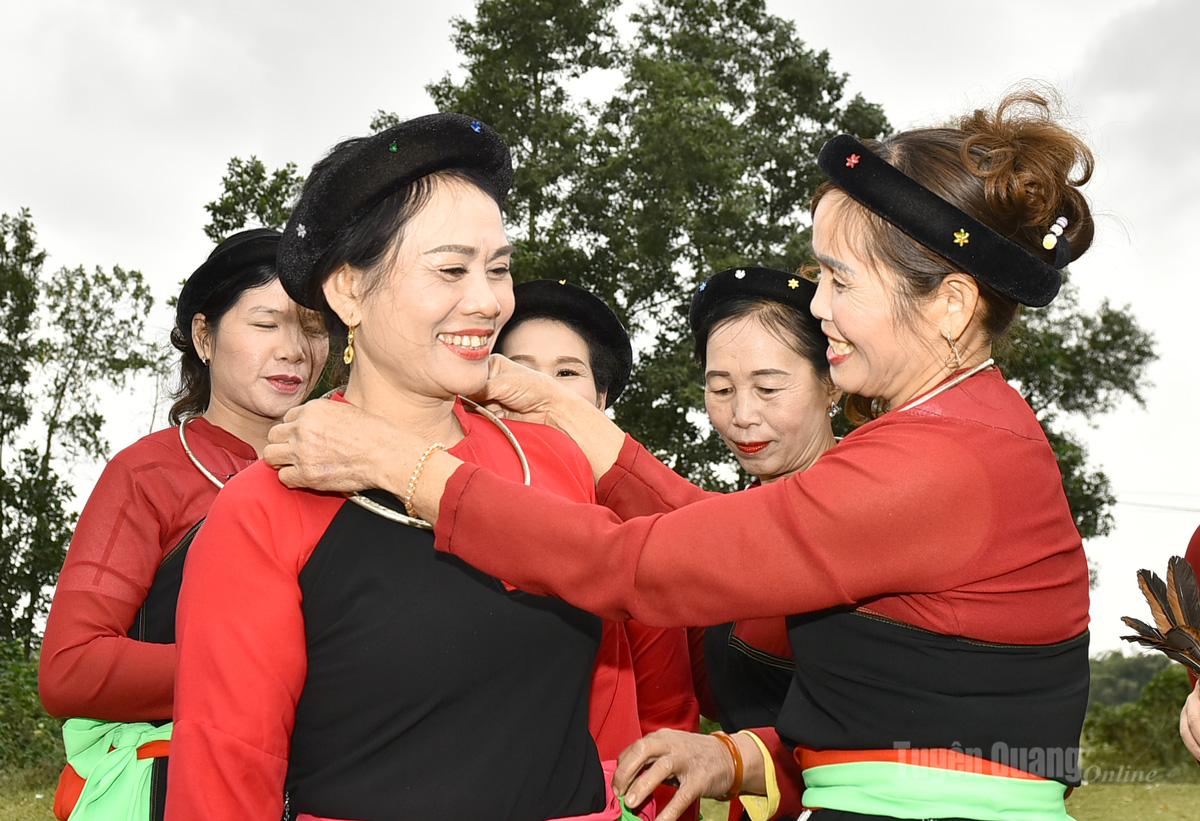 |
| The traditional courtship songs of the Cao Lan people still resonate, reflecting their love for life, for others, and for their ethnic identity. |
Introductory song (or folk song)
It is a form of group singing between a group of men and a group of women in a stilt house. On spring days, when young men or women from other villages come to visit, the young men and women of the village will proactively ask the host for permission to sing sình ca with the guests.
Stepping onto the ladder, I asked the owner.
Excuse me, host, a guest has arrived at your house.
Excuse me, host, where are the guests?
Can we sing folk songs instead?
When the host agrees, the host's singing group takes the initiative to sing a song as an invitation, with the intention of provoking the other party:
People who don't sing or perform will grow old.
If you don't spend money, it will eventually run out.
Seventeen, eighteen flowers bloom
Twenty years old, in the prime of her youth.
The female customer immediately replied:
At thirty, the flowers begin to wither.
If you don't sing, when will you?
After the folk songs, the host and guest, male and female, would actually sing in call-and-response style—songs of love and courtship.
The male singer takes the initiative to sing first.
In the Lower Nguyên region, the shallot plant produces eight leaves.
The eight-leafed shallot plant has formed.
My parents had him when he was 18 years old.


You only start dating when you're 18.
And then it continued:
She is intelligent and quite quick-witted.
Ask her if she's in love or not.
If she finds love, I wish her well.
If love doesn't blossom, don't blame me.
The woman replied:
I have feelings for someone and I've been in love.
Throwing vegetables into the stream, the knife sinks.
The knife that sank to the bottom, I already have.
A knife floating on the water's surface is devoid of emotion.
Suspecting the girl was lying, the boy didn't believe her:
Is she in love or not?
She asked whether there was love or not.
He went to the edge of the village to listen to the thrushes singing.
The birdsong tells her she's in love.
The girl's song sounded like an explanation:
My boyfriend isn't here yet, my dear.
The knife was thrown into the stream for posterity to witness.
If the knife floats, then you're heartless.
The knife sinks to the bottom of our pure love.
The young man used the excuse of singing a celebratory song to test the girl's feelings:
A song of congratulations to the lady of the house.
The husband is good, and the wife is also good.
The husband is good, and the wife is also good.
The page features the portrait of Zhu Yingtai.
The girl replied:
It's true that I'm still unmarried.
I wish this sentence were really not good.
If only my husband were home
Why did we come to this place together for no reason?
In some songs, the boy shifts to praising the girl:
The poem is a tribute to her parents.
Her parents gave birth to her like a flower.
Her parents gave birth to her, Lotus Flower.
Stepping out the gate, the entire family was bathed in light.
The girl replied:
A song to wish my parents well.
My parents gave birth to me, but I'm not a beautiful flower.

My parents gave birth to me, Lien Hoa.
Becoming a monk brought ruin to an entire family.
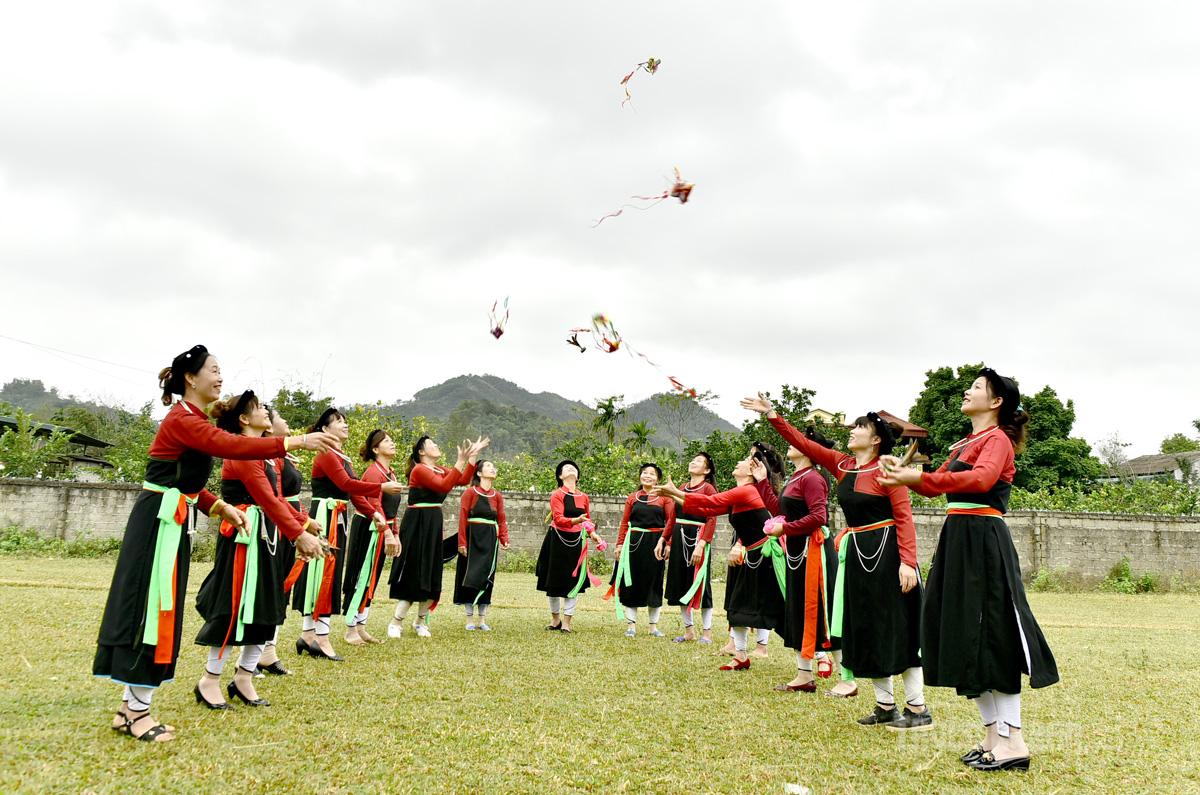 |
| The folk songs sung during the spring festival are usually performed during the day, while the Cao Lan people are working and going about their daily lives. |
Singing oaths (mừng ca)
Every celebration eventually comes to an end. When the festivities disperse, groups of men and women, or young men and women, sing farewell songs together, promising to meet again at another festival. The lyrics are filled with longing and nostalgia:
Even with wine laid out before me, I still feel sorrowful.
There's so much meat on the table, but I won't eat it.
Even with rice and tea, I'm still tired of it.
While still hungry, remember each other's words.
The lyrics are like a bold promise:
He met her, and then she met him.
Like a carp finding a big pond.
Carp enter the pond to eat treasure.
We met and decided to share a bed.
Springtime courtship singing is a good opportunity for young men and women to get to know each other, leading to many blossoming romances. The love between couples in these songs is incredibly pure and passionate, but also clearly reflects the tradition of respecting morality. Before going to sing, one must ask permission from their parents. Upon arriving at the village, one must sing a song until the gate is called. If the homeowner agrees to let them in, they must sing another song asking permission from the host, and songs of greeting to the host, the elders, the parents of the singer, and the young men and women of the village... finally, congratulations and praise for the singer.
Through the folk singing tradition, even if a couple is deeply in love, they must still obtain the consent of both sets of parents before they can get married. At the end of each performance, there are folk songs expressing gratitude to the host for providing all the necessary conditions for the performance to be complete.
Spring is still fresh and vibrant throughout the Cao Lan villages. The melodious love songs of the spring festival still resonate, reflecting the Cao Lan people's love for life, for their fellow human beings, and for their ethnic identity.
Ngoc Mai ( According to "Initial Study of Folk Songs of the Tay, San Diu, and Cao Lan Ethnic Groups", Tuyen Quang Department of Culture and Information, 2007 )
Source: https://baotuyenquang.com.vn/van-hoa/du-lich/202603/tieng-sinh-ca-ngay-xuan-82b2f74/

![[Photo] General Secretary and President To Lam working with the Technical and Professional Center, Ministry of Public Security](https://vphoto.vietnam.vn/thumb/1200x675/vietnam/resource/IMAGE/2026/07/06/1783318005842_a1-bnd-1129-2263-jpg.webp)