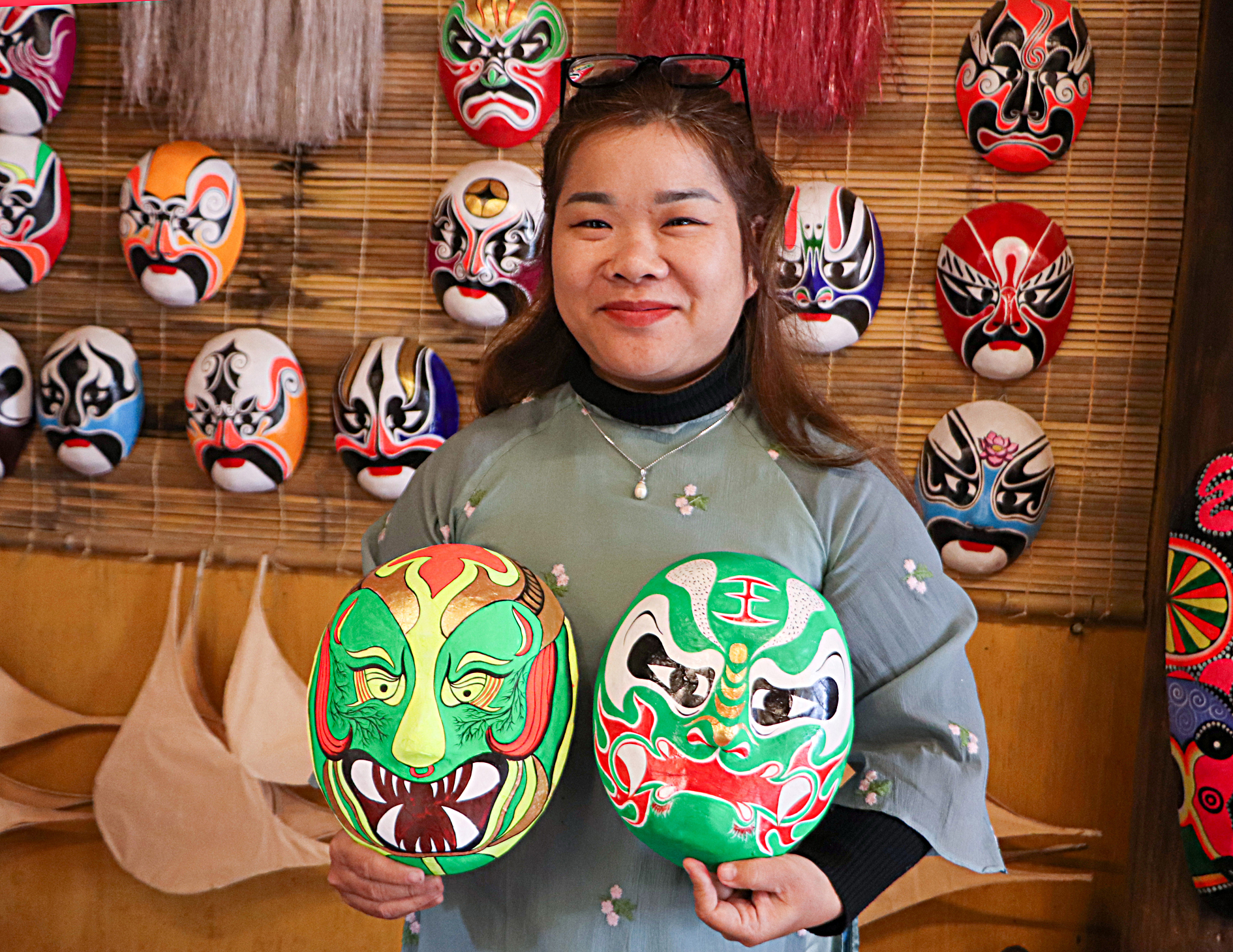
From Trang's hands, thousands of masks have traveled with tourists to tell stories about the culture and soul of Hoi An.
For Nguyen Thi Huyen Trang, painting papier-mâché masks is not just a craft to earn a living, but also a way to preserve the cultural heritage of the traditional Vietnamese opera (hat boi) that was once closely associated with the people of the Old Quarter. Trang skillfully portrays faces with a myriad of emotions, conveying meaningful stories and messages about life to visitors.
Masks tell stories
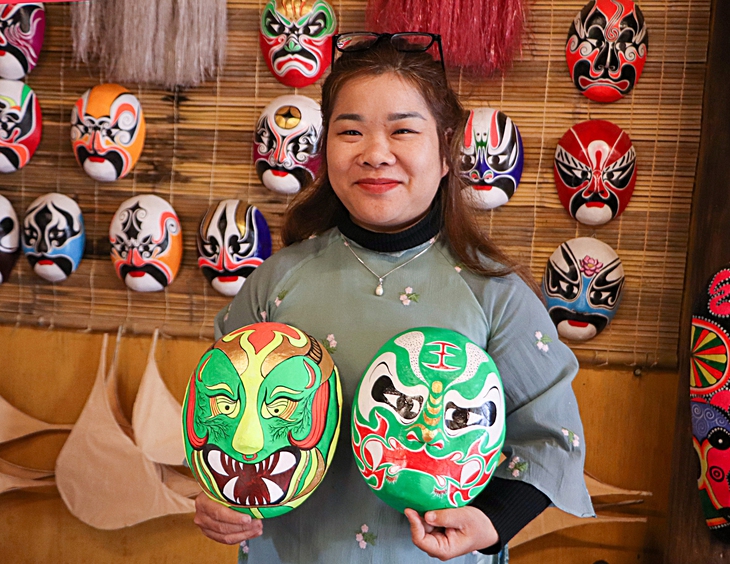
Holding an elaborately painted mask with two halves of a face, Trang introduced: "This one has one female side and one male side, symbolizing the harmony of yin and yang, representing the bond and unity in marriage. Many couples buy them to hang in their bedroom as a reminder of sharing and understanding."
Trang pointed to the mask hanging in the center, which had an angry face with clearly visible frowning wrinkles.
"This reminds people of the harmful effects of anger. When angry, the soul becomes distorted, and one's appearance turns ugly. Knowing how to control anger is also a way to preserve positive energy for oneself," Trang explained about the meaning of the mask.
The shop is filled with countless different masks. What's special about the masks she paints is their magical quality: at first glance, anyone can think of a particular character, but the more you look closely, the less you recognize them.
The masks are painted with lines that recreate the images of characters from past traditional Vietnamese opera, and partly convey messages of the modern era, the stories Trang wants to transmit.
Besides cheerful masks, many tourists choose to buy fierce-looking masks to hang in their homes, believing they ward off bad luck and evil spirits.
For Trang, the greatest value of the masks still lies in the cultural message and philosophy of life hidden behind each detail. Besides the colors and lines, a particularly noticeable feature is that all the masks here do not have hollowed-out eye sockets.
You may also like

A series of exciting events will take place in Da Nang during July.DNO - A series of large-scale cultural, artistic, festival, and entertainment events will take place simultaneously in July, transforming Da Nang into a vibrant destination for the summer tourism season. This series of programs is expected to offer many exciting experiences, contributing to increased attractiveness for both domestic and international tourists. 
Highlights of the "Melodies of Peace" art program.Within the framework of the 2026 People's Security Force Mass Art Festival, on June 23rd, at the Vietnam-Japan Labor Culture Palace, the Political Affairs Department and the Communications Department of the People's Public Security (Ministry of Public Security) jointly organized the art program "Melodies of Peace" with the theme "80 Years of People's Security - A Glorious Golden Page of History," to practically celebrate the 80th anniversary of the Traditional Day of the People's Security Force (July 12, 1946 - July 12, 2026). 
Nurturing the dreams of young talents.From singing and painting competitions to art playgrounds for teenagers, many young talents in Hai Phong have been discovered, nurtured, and had their passions given wings. Trang explained: "I only drew the eyes, I didn't cut them out so that the mask could be displayed respectfully like a painting, not as an item to wear for fun. Moreover, the eyes are where the depth of the character's soul is most clearly expressed, something that a hollowed-out mask can hardly convey."
Each role in traditional Vietnamese opera is like a story from our own lives. There is suffering, tragedy, joy, and sadness. I decided to follow in my father's footsteps, choosing a small house to preserve the old faces, the form, and the soul of the once glorious art of traditional Vietnamese opera.
Nguyen Thi Huyen Trang
Connecting passions from childhood memories.
Trang's passion for papier-mâché masks came naturally, stemming from very early memories. Her father was one of the few artisans in Hoi An who pursued and created the traditional folk opera mask craft.
"Since I was little, I've been used to sitting next to my father, watching him paint each mask, each head of the celestial dog. I don't know when, but I was drawn to those colors and brushstrokes. My family has two sisters, and both of us have followed in our father's footsteps. We loved to create and draw from a young age, so pursuing this profession came very naturally to us," Trang recounted.
According to Trang, to paint masks, the artist not only needs skillful hands but also a deep understanding of traditional Vietnamese opera – a form of folk theater that was closely associated with her childhood and that of many people in Hoi An.
However, the art of traditional Vietnamese opera declined and faded away very quickly after 1986, and by 2000, even in a bustling place like Hoi An ancient town, not a single opera troupe was still active. The artists gradually passed away, the masks disappeared, and the paints, fake beards, props, flags, and fans were also gradually lost.
Preserving Hoi An's culture
A complete mask is made entirely by hand. Using simple, environmentally friendly materials such as bamboo and papier-mâché, the craftsman must go through many stages: creating a mold, shaping the structure, applying the paper, drying, surface treatment, and only then moving on to the painting stage to express emotions and creativity.
"No two masks are alike, because each time I paint, it reflects a different emotion. Whether I'm happy, sad, or troubled, it's all conveyed through the mask. Importantly, I have to determine the meaning of the mask beforehand," Trang shared.
Each color and line on the character's face carries its own meaning: loyalty or deceit, good or evil, righteousness or wickedness. Combining this with the foundation of traditional Vietnamese opera masks, the artist adds personal creativity to create masks with unique personalities, unlike any other mask style found abroad. For over 20 years, countless masks painted by Trang have traveled with tourists to many places, telling stories about the cultural heritage of Hoi An.

Vietnam encourages US businesses to expand investment in high technology.On the morning of June 26th, at the Government Headquarters, Deputy Prime Minister Ho Quoc Dung received Mr. Jeff Place, Supply Chain Director of Coherent Group (USA). During the meeting, the Deputy Prime Minister affirmed that Vietnam encourages US businesses to expand investment, especially in high-tech, innovation, and semiconductor industries. Experience making a face mask.
Each mask typically sells for around 350,000 VND, while larger, more elaborate ones can cost several million VND depending on size. According to Trang, smaller masks are more popular with tourists, especially foreigners, because they are easier to carry. Some performances and exhibitions sell hundreds of masks in a single night.
Beyond just selling products, for many years, Trang has also dedicated her time to guiding tourists in the experience of making masks. Here, visitors can learn about and personally paint their own masks. "That's how tourists understand that behind each mask lies a treasure trove of Hoi An's culture," Trang said.
Source: https://tuoitre.vn/niem-dam-me-mat-na-hat-boi-20260314085205015.htm






![[Photo] "Hanoi Lotus Festival" honors the lotus flower that has been associated with Vietnam for thousands of years.](https://vphoto.vietnam.vn/thumb/1200x675/vietnam/resource/IMAGE/2026/06/27/1782516943048_sen-ha-noi-2026-minh-duy-1-jpg.webp)