The echoes of historical landmarks
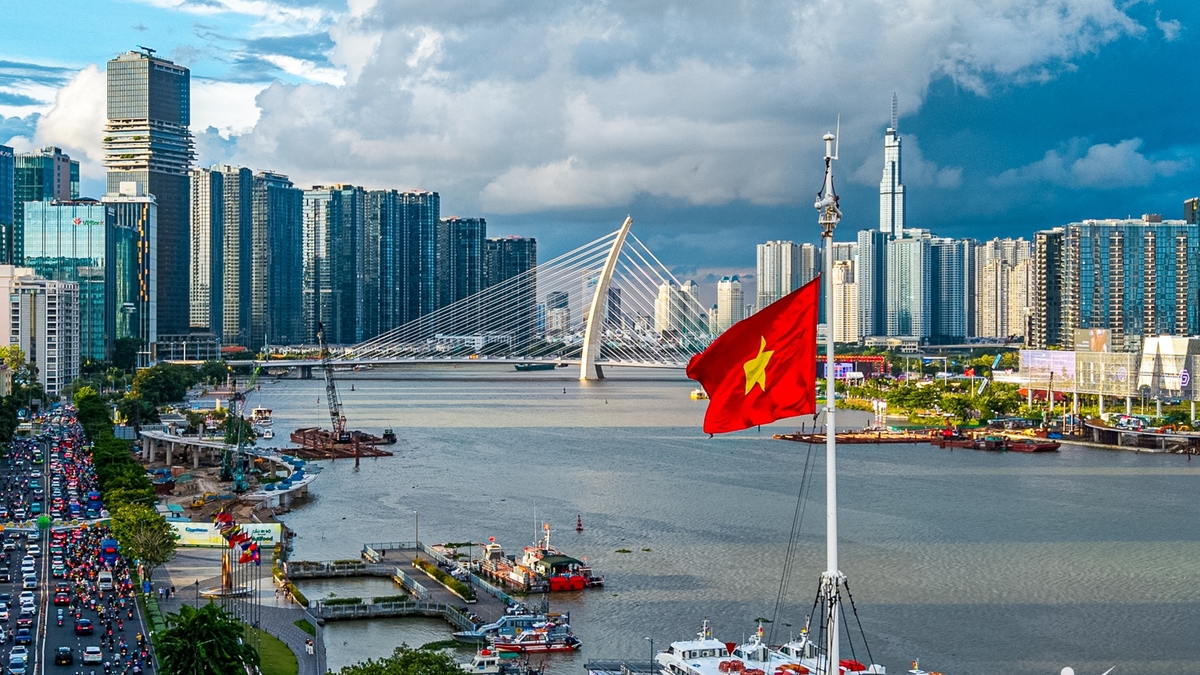
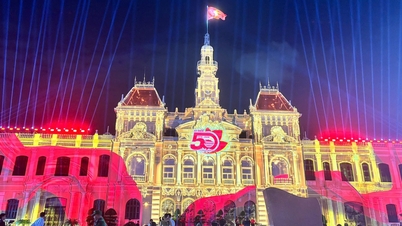
Immediately after the great victory of Spring 1975, Vietnamese poetry recorded the historical atmosphere with an epic, solemn, and emotionally rich tone. In the poem "Complete Victory is Ours," To Huu wrote: "Oh, this midday, the sun is exquisitely beautiful / Uncle Ho! Complete victory is ours / We come, shining with the light of steel / The city named after you is resplendent with flags and flowers." Here, the city named after you becomes a symbol of independence, of the aspiration for unity, and of national faith. The poet invokes Uncle Ho's name with sacred emotion, linking the city to revolutionary ideals and its special historical significance.
Following the same theme, in his epic poem "The Road to the City," poet Huu Thinh recreates the atmosphere of the liberation army's march: "The Ho Chi Minh Trail / The Ho Chi Minh Campaign / Ho Chi Minh City / Soldiers marching and asking / Soldiers marching and urging / Soldiers marching and singing / Camouflage branches blowing through the wind across three regions …" The rapid rhythm of the poem creates an atmosphere of marching towards the final destination of the historic campaign. There, the city appears as the destination of the journey to national reunification, the place where the aspirations of North and South reunion after many years of separation converge.
While the poetry of Tố Hữu and Hữu Thỉnh is imbued with epic overtones, in Viễn Phương's work, the city is viewed from the moment of transition between war and peace, interwoven with a lyrical love story between a man and a woman. In "Wedding in Spring," he writes: "Determined to go to Saigon to sing the song of liberation / To plant the flag on the glorious city / Ho Chi Minh City shines brightly with golden stars / I come to find you..." (Remember to sew a new dress). Amidst this historical moment, poetry not only speaks of victory but also focuses on human life. "Wedding in Spring" becomes an image of everyday happiness, marking the return of peace after the war.
Xuan Quynh's poetry is poignant, deeply moving, and infused with profound philosophy. Upon arriving in Ho Chi Minh City, the poetess experienced it with a rich, intuitive inner resonance. She wrote in "Singing with the Ship": "Silent, can you hear me clearly, my love? / My heart beats amidst the vastness of earth and sky / When entering the city named after you / The ship seems to speak with heartfelt emotion." The city becomes a space of emotion. The journey south is perceived as a spiritual movement, where one listens to the very beat of their heart.


In *Writing to My Child on Victory Day*, Xuan Quynh continues to expand that imagery towards the future: "You will return to Ho Chi Minh City / The land will no longer be divided into North and South / You will grow up in a unified Vietnam…" The city is not only a memory of victory but also the beginning of images of the future, where the younger generation grows up in peace and unity.
The city is revived and developing.
Following the Liberation of South Vietnam and the reunification of the country on April 30, 1975, along with the process of peace and reconstruction, the image of Ho Chi Minh City in poetry also transformed. While the initial period emphasized war memories and victory, later on, the city emerged as a revitalizing and developing metropolis.
In "White Clouds at Nha Rong Wharf," poet Bao Dinh Giang wrote: "The city named after the beautiful May / The streets crowded with bicycles on the way to work / The kindergarten yard shaded by star apple trees / Children playing happily in the shade." The city is emerging with its simple working life, with images of children, streets and green trees, with familiar daily routines.
Meanwhile, poet Hoài Anh (Trần Trung Phương) has a more intimate perspective, infusing genuine emotions into each place name and street: "Ho Chi Minh City has a small street / Nguyễn Thái Bình Street, a vibrant red... A road xuyên through space connecting to Hanoi / Where the Ho Chi Minh Mausoleum is, I send my love from afar..." In the poem, Nguyễn Thái Bình Street becomes a place that preserves memories, where the name of a place is linked to the story of a person and to the layers of historical sediment of the city.



Throughout its history, Ho Chi Minh City has been immortalized in poetry with its own unique colors. There is the spirit of the day of complete victory, the joy of reunion, and the pulse of a city undergoing transformation. Poems written about the city always preserve love, memories, and faith.
Source: https://www.sggp.org.vn/thanh-pho-ten-nguoi-trong-thi-ca-post860244.html