


After nearly 45 years of being known, the Khanh Son stone xylophone – a unique musical instrument of the Vietnamese people – has become a source of pride for generations of people in Khanh Hoa . The melodious sounds that once resonated through the mountains and forests of Khanh Son district have now spread far and wide to friends all over the world.
Going back in history
In 1979, Mr. Bo Bo Ren, a Raglai man from Khanh Son, handed over to the Phu Khanh provincial government two sets of stone musical instruments that his family had protected and preserved as sacred objects for many years. This achievement came from the efforts of local cultural workers and the then Ministry of Culture and Information. Along with the two sets of stone musical instruments, members of the Khanh Son Stone Musical Instrument Working Subcommittee also discovered a workshop for crafting stone musical instruments at the top of Doc Gao hill (To Hap town). From this, scientists have drawn many important conclusions, opening up many new avenues of research.
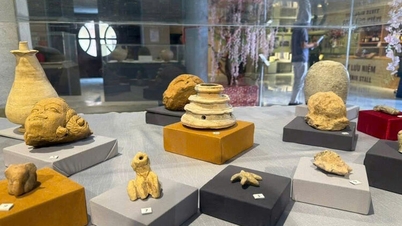
 Two sets of Khánh Sơn stone xylophones were handed over to the government by Mr. Bo Bo Ren in 1979. The photo was taken at the Vietnam National Institute of Culture and Arts in Ho Chi Minh City in early 2023. |
On September 12, 1979, in Nha Trang City, the People's Committee of Phu Khanh province, in coordination with the Ministry of Culture and Information, officially announced information about the two sets of Khanh Son stone xylophones. The Party and State leaders showed interest and assigned the task to the Culture sector to search for traces of these stone xylophones. The two sets of stone xylophones, donated by Mr. Bo Bo Ren years ago, were handed over by the Phu Khanh provincial leadership to the Institute of Music Research for study and to be performed in many places domestically and internationally. Later, the two sets of stone xylophones were brought to the Vietnam National Institute of Culture and Arts in Ho Chi Minh City for safekeeping.
The sound of the guitar continues to echo.
For nearly 45 years, the sound of the stone xylophone has not only resonated in remote mountain villages, but its melody has also become familiar to the public in art performances. Since then, artists across the country have unleashed their creativity, with an increasing number of musical and dance works written specifically for the stone xylophone. In Khanh Hoa province, many musicians have also been closely associated with the stone xylophone through their compositions and performances with this unique instrument, such as Ngoc Anh and Nguyen Phuong Dong.
 Raglai girls in Khanh Son district perform a solo on the stone xylophone. Photo: Cong Dinh. |
In 2022, Khanh Son district handed over 10 sets of stone xylophones to performing arts groups in communes, towns, and the District Cultural, Information, and Sports Center. All of these stone xylophones are crafted from Rhyolite stone quarried in Khanh Son, ensuring the correct size and resonant sound, suitable for solo performances, ensemble performances with other musical instruments in community cultural and artistic events, or performances for tourists. The district also requested that localities and units receiving the stone xylophones send representatives to participate in stone xylophone performance classes. “For many years, the district's performing arts group has performed stone xylophones in all cultural and artistic activities, competitions, and art festivals organized by various levels. From there, we have continuously introduced and promoted the unique features, beauty, and charm of this musical instrument to a wide audience both domestically and internationally,” shared Mr. Nguyen Van Nhuan, Chairman of the Khanh Son District People's Committee.
 The performance features a musical ensemble of stone xylophones and other instruments, presented by the Hai Dang Dance and Music Troupe. |
The stone xylophone is also becoming increasingly popular in the performances of the Hai Dang Music and Dance Troupe. The troupe has staged many solo and ensemble performances, as well as performances combining stone xylophone with dance and singing. At some tourist areas, such as Hon Chong Scenic Area and Truong Son Craft Village, stone xylophone performances are often organized to entertain visitors. What's special about stone xylophone performances is that the artists not only play folk melodies or music with the folk influences of the Central Highlands, but can also perform new pieces, even foreign music. In recent years, musician Nguyen Phuong Dong – former Director of the Provincial Cultural Center – has made many efforts in crafting stone xylophones to supply to organizations in need. Stone xylophones from Nguyen Phuong Dong's workshop are standardized in sound to support more effective performances by artists.
 Members of the Khánh Sơn district's performing arts team performed a musical piece featuring stone xylophones. |
To this day, through numerous studies, experts both domestically and internationally recognize the stone xylophone as one of the oldest musical instruments of humankind. The Khánh Sơn stone xylophone, in particular, has a history spanning from the legends of the Raglai people about rolling stones or stone gongs, to sets of stone xylophones placed along streams near fields to ward off birds and wild animals, and to provide entertainment while working. Later, the stone xylophone was played by the people during festivals celebrating the new rice harvest. And today, the stone xylophone has become a musical ambassador, connecting unique cultural values from the past to the future, as in the lyrics of the song "Sing Along with Us, My Guitar!" by composer Bằng Linh: “…The sound of the stone xylophone today/Calls the Ngọc Lũ bronze drum/Rhymes with the T'rưng/Enthusiastically calls the bầu lute/Praises our homeland/The beautiful land and water like flowers…”
HUMAN HEART
Source























































Comment (0)