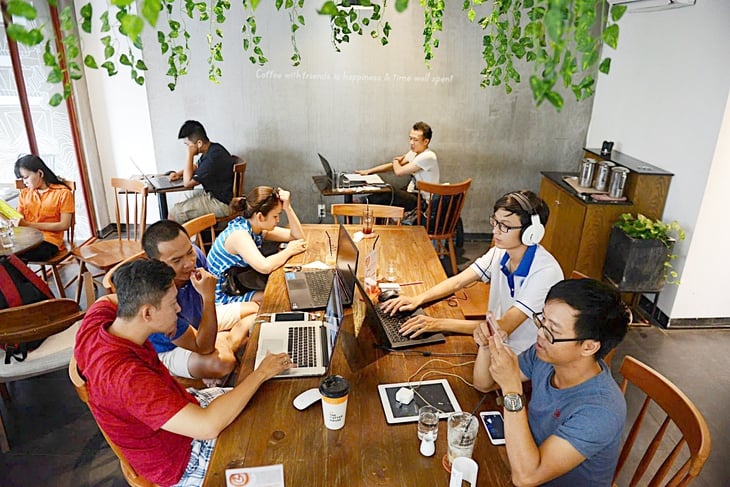
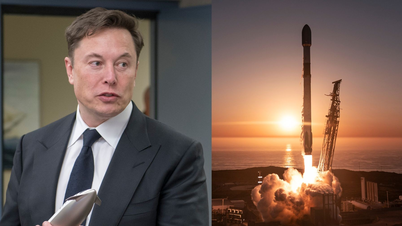
Vietnamese users will soon be able to use Starlink's service if they accept what may be a relatively high cost - Photo: Q. DINH
In mid-February 2026, the Radio Frequency Department ( Ministry of Science and Technology ) officially granted a license to Starlink Services Vietnam Co., Ltd. (Starlink). According to the plan, in the initial phase, the giant owned by billionaire Elon Musk will operate four gateway stations located in Phu Tho, Da Nang, and Ho Chi Minh City, with a capacity to serve up to 600,000 terminal devices.
Wherever you see the sky, there's the Internet.
Unlike traditional fiber optic internet services that rely on cables and ground-based base stations, Starlink uses a network of thousands of low-orbit (LEO) satellites for coverage. This means that wherever there is a view of the sky, there is Starlink internet. This is a significant advantage of satellite internet compared to other traditional internet services.
This service is also seen as the perfect solution for "white zones" in border areas, islands, or areas with complex and fragmented terrain – where mobile internet coverage is difficult and laying fiber optic cables is an economically impossible task.
Speaking to Tuổi Trẻ newspaper, Mr. Nguyen Ba Dung - Director of the MVNO (Virtual Mobile Network Operator) product lineat FPT Shop - commented that Starlink's low-orbit satellite internet model is a new technological development direction in the global telecommunications sector. This model has been deployed in many countries to expand connectivity in areas that are difficult to access with traditional infrastructure.
"In Vietnam, Starlink's market accessibility will depend on several factors such as regulatory policies, actual user demand, and the level of maturity of the existing infrastructure," Mr. Dung said.
According to the license, Starlink will deploy two types of satellite telecommunications services: fixed satellite services (Internet access; leased lines for mobile base stations); and mobile satellite services (Internet access at sea; on airplanes). The maximum number of subscribers is 600,000 terminal devices.
This is a rather modest number compared to the approximately 25 million fixed broadband internet subscribers or over 110 million mobile internet subscribers currently in Vietnam. This also means that even if Starlink grows rapidly and reaches its maximum allowed subscriber count, its market share will still be very low compared to the major telecommunications providers in Vietnam.
Furthermore, research conducted in many countries where Starlink services are available reveals that users must pay two fees: the cost of the satellite transceiver and a monthly subscription fee. The price of the transceiver can start from $349 (over 9 million VND). The subscription fee ranges from a few tens to over $100 per month.
For example, in the US, a household internet package costs around $120/month. In Japan, the price is around 6,000-7,000 yen/month, or about $45-50. In the Philippines, the price is around 2,700 pesos/month ($50)... Thus, the total cost for Vietnamese users in the first year of using Starlink's service is about $1,000 (over 26 million VND), much higher than traditional fiber optic internet for households (only a few million VND/year).
Domestic network providers: not significantly affected yet.
Commenting on competitor Starlink, Mr. Nguyen Minh Phuong - Deputy General Director of VNPT VinaPhone Telecommunications Service Corporation - said: "Starlink's deployment of fixed satellite service will provide users with choices and experiences, but it will not significantly affect network operators, as the tariffs are too high compared to domestic fixed broadband services."
According to Mr. Phuong, potential customers for Starlink services could include: owners of ocean-going vessels and fishing boats, or businesses registering to use the service for testing or as a backup route...
A representative from another network operator also stated that Starlink would not significantly impact the domestic internet service market because internet services, from fixed-line to mobile, in the country have already reached saturation and are highly competitive in terms of price, while Starlink's service is certainly unlikely to be as cheap as domestic services.
"Therefore, we don't consider Starlink a direct competitor, but rather a complementary piece to the telecommunications ecosystem. Having another provider will allow network operators to focus more on improving service quality," a representative from a network operator shared.
"Currently, each type of technology – including satellite internet, fiber optic internet, and mobile internet – has different technical characteristics and application scopes. Therefore, the level of direct competition will depend on each geographical area, usage needs, and market structure. In many cases, these technologies can coexist and complement each other within the overall connectivity ecosystem. In Vietnam, the entry of a new technology into the market will require time to assess its actual impact," Mr. Nguyen Ba Dung commented.
Enhancing Vietnam's telecommunications infrastructure
In Vietnam, terrestrial telecommunications infrastructure is primarily based on fiber optic networks and 4G/5G base transceiver stations (BTS), deployed and operated by major network operators such as Viettel, VNPT, and MobiFone.
Although these infrastructures are capable of serving a large number of users and offer high speeds and coverage, they still face significant challenges in remote areas and islands due to the high cost of construction and operation in complex terrain.
In this context, LEO systems can serve as a complementary solution for providing telecommunications and Internet services with many advantages: wide coverage, rapid deployment, good data access speed and latency, etc.
LEO (Low Earth Orbit) telecommunications satellite systems operate at altitudes ranging from approximately 160 to under 2,000 km above sea level. Thanks to their low orbit, LEOs offer low signal latency (20-40ms), high data transmission speeds (50-500 Mbps), and wide coverage without requiring extensive ground infrastructure.
VIRTUE
Source: https://tuoitre.vn/cuoc-starlink-co-hop-tui-tien-nguoi-dung-viet-20260302011720666.htm






![[Photo] First session of the 14th Congress of the Vietnam Trade Union](https://vphoto.vietnam.vn/thumb/1200x675/vietnam/resource/IMAGE/2026/06/03/1780465947883_ndo_br_img-3852-jpg.webp)












































































Comment (0)