

 |
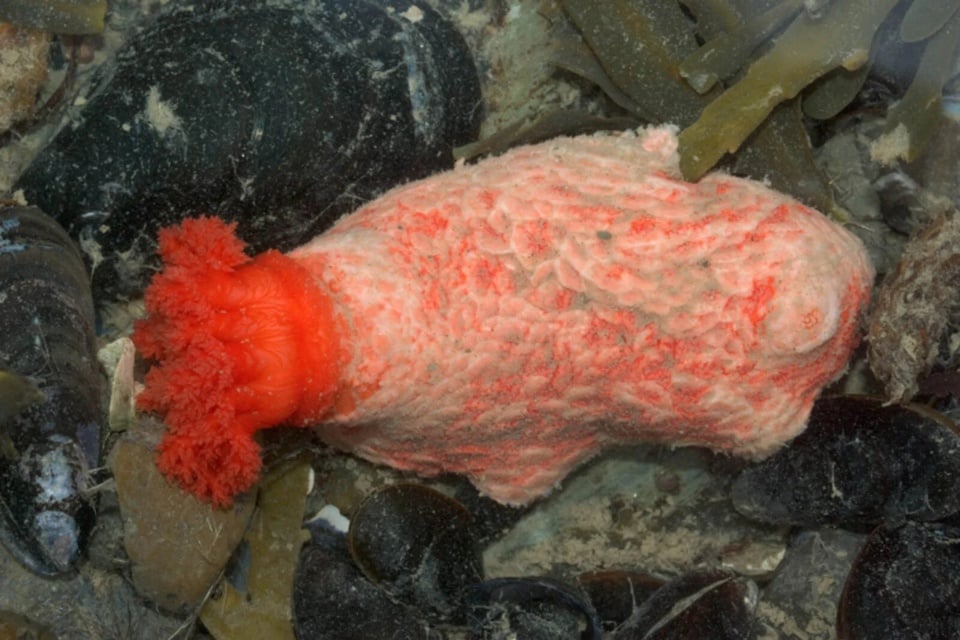
The sea cucumber specimen is still thriving after more than two years. Photo: WoRMS . |
Scientists have just discovered a bizarre phenomenon that could change our understanding of the boundary between life and death. A severed body part from a particular species of sea cucumber has survived for over three years in normal seawater. It continues to regenerate and absorb nutrients despite lacking a mouth.
This finding was published in the journal Science Advances . The detached tissues survived much longer than the experiment lasted. Therefore, after the research was completed, the detached specimens appeared to continue to exist indefinitely, showing no signs of degradation or decomposition.
Psolus Fabricii, a type of sea cucumber that lives in the cold waters of the Arctic and North Atlantic, has long been known for its incredible regenerative abilities. Similar to salamanders or starfish that can regrow lost limbs, this species can also regenerate its tentacles or leg bones.
Previously, scientists assumed that severed body parts would decompose naturally over time. This new discovery shows that this assumption is not entirely accurate.
A research team led by Sara Jobson, a doctoral student at the University of New Foundland, cut small tissue samples from the legs, tentacles, and main body of sea cucumbers and placed them in seawater. The results showed that the detached tissue did not die, but instead repaired the damage and continued to grow by absorbing nutrients from the surrounding environment.
“The initial healing process involves removing damaged and degenerative tissue at the edges. Soon after, the surrounding healthy epithelium rolls inward to help seal the area,” the research team wrote.
These sea cucumber specimens may be the first recorded instance of natural "tissue immortality." They survived in normal seawater, whereas previous experiments were conducted in sterile, strictly controlled cultures.
Although capable of self-preservation, these detached tissues do not develop into a complete new sea cucumber. In other words, their sole purpose is simply to continue existing.
After three years of monitoring, the severed body parts continued to function normally and showed no signs of dying. Finally, the researchers decided to end the experiment and publish their findings.
However, this research could help scientists gain a deeper understanding of tissue regeneration mechanisms and cell biology, thereby opening up potential applications in regenerative medicine and related fields.
The discovery has raised many new questions, including whether an entity that only maintains biological activity but does not grow or reproduce can be considered alive in the conventional sense. The research team also limited this phenomenon of immortality to certain parts, rather than the entire organism.
Source: https://znews.vn/phat-hien-loai-dong-vat-bat-tu-post1656318.html




![[Photo] First session of the 14th Congress of the Vietnam Trade Union](https://vphoto.vietnam.vn/thumb/1200x675/vietnam/resource/IMAGE/2026/06/03/1780465947883_ndo_br_img-3852-jpg.webp)














































![[Video] Sunset at Lap An Lagoon – Where the sun sets over the fishing nets](https://vphoto.vietnam.vn/thumb/1200x675/vietnam/resource/IMAGE/2026/05/31/1780192137701_beach-landscape-sea-water-nature-grass-745871-pxhere-com.jpeg)








































Comment (0)