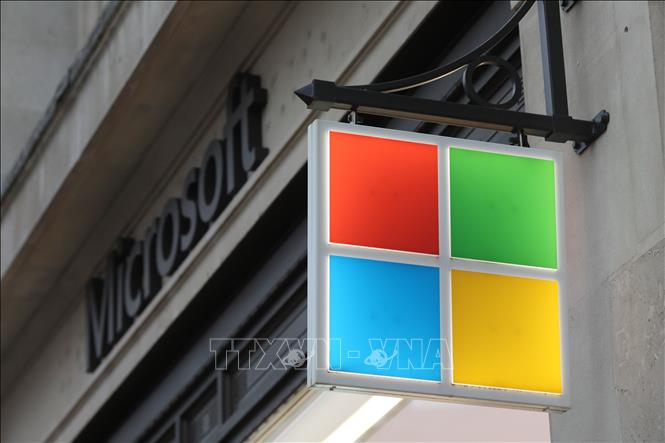
The Microsoft logo in London, England. Photo: THX/VNA

 Báo An Giang•03/06/2026
The Microsoft logo in London, England. Photo: THX/VNA
The corporation announced MAI-Thinking-1, the first "reasoning" model designed to analyze problems step-by-step before providing a response, similar to products from OpenAI, Google, or Anthropic. Microsoft said it built the model from scratch without copying competitor output to train a new system more quickly and cost-effectively. This tool, currently still limited to a certain group of customers, launched about a year and a half later than products from pioneering companies like OpenAI and Google.
Joining the broader Silicon Valley craze, Microsoft aims to capitalize on the wave of autonomous AI, which has pushed the technology beyond simple chatbots into chatbots that act on behalf of users. Microsoft has launched Microsoft Scout, an "always-on" assistant for meeting preparation, schedule management, and email composition, based on OpenClaw, the open-source software that has fueled this wave by late 2025 thanks to its global popularity. Scout is currently aimed at a limited customer base.
Microsoft also announced a mini-computer using Nvidia chips, the Surface RTX Spark Dev Box, capable of running AI models offline, as well as a dedicated AI platform for scientific research. Simultaneously, the company introduced its hardware solution: an ecosystem of Android-based devices designed to interact with AI assistants via voice commands, without needing to open apps as on a computer or smartphone.
Microsoft, the first company to invest heavily in OpenAI, has been working to reduce its reliance on its partner, Sam Altman, for many years. The two sides negotiated a cooperation agreement last year, allowing Microsoft non-exclusive use of OpenAI's models and products until 2032.
According to VNA
Source: https://baoangiang.com.vn/microsoft-cong-bo-cac-mo-hinh-ai-nham-giam-su-phu-thuoc-vao-openai-a487714.html


![[Photo] Secretary of the National Assembly Party Committee, Chairman of the National Assembly presides over the meeting of the Standing Committee and Executive Committee of the National Assembly Party Committee.](https://vphoto.vietnam.vn/thumb/1200x675/vietnam/resource/IMAGE/2026/06/03/1780480353201_ndo_br_bnd-2585-jpg.webp)

![[Photo] First session of the 14th Congress of the Vietnam Trade Union](https://vphoto.vietnam.vn/thumb/1200x675/vietnam/resource/IMAGE/2026/06/03/1780465947883_ndo_br_img-3852-jpg.webp)
![[Photo] General Secretary and President To Lam presides over a meeting with the Central Organizing Committee.](https://vphoto.vietnam.vn/thumb/1200x675/vietnam/resource/IMAGE/2026/06/03/1780482764658_a1-bnd-4741-3342-jpg.webp)






























![[Video] Sunset at Lap An Lagoon – Where the sun sets over the fishing nets](https://vphoto.vietnam.vn/thumb/1200x675/vietnam/resource/IMAGE/2026/05/31/1780192137701_beach-landscape-sea-water-nature-grass-745871-pxhere-com.jpeg)
























Comment (0)