UNIQUE ARCHITECTURE
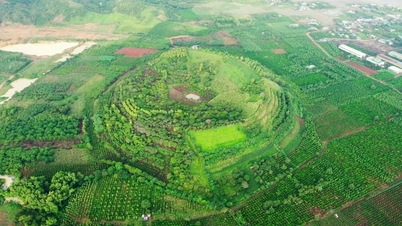
The Ba Mountain Range in Gia Lai province (formerly Phu Cat district, Binh Dinh province) is notable for its 66 majestic peaks. Among this range, Hon Chuong (De Gi commune) stands out with its enormous, cylindrical rock formation, resembling an inverted bell. Even more remarkable is the mysterious ancient brick structure atop this approximately 50-meter-high rock, whose function remains unexplained to this day.
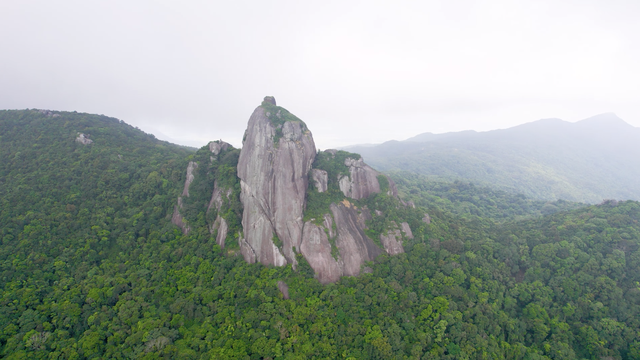
The Hon Chuong Tower is located amidst the majestic Ba Mountain range.
PHOTO: TRIEU THANH
The site is known as Hon Chuong Tower. From the remaining traces of broken bricks and tiles, researchers confirm that this is a structure of the ancient Cham people. According to the Gia Lai Provincial Museum, Hon Chuong Tower is considered the highest Cham tower built in Vietnam, located at an altitude of approximately 800 meters above sea level.
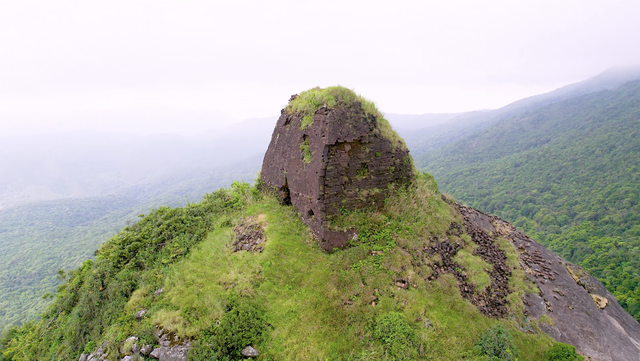
Bell Tower
PHOTO: TRIEU THANH
The tower is approximately 7 meters high, with each side measuring 8.5 meters. Its body is square and straight, tapering towards the top. Unlike many elaborate Champa towers, the body of the Hon Chuong tower is completely devoid of ornamentation, a striking difference.
The Hon Chuong Tower is located about 20 km northeast of Vijaya (also known as Do Ban Citadel, or Hoang De Citadel during the Tay Son dynasty) of the Champa kingdom. From the tower's location, one can have a panoramic view of the entire ancient Vijaya region (the eastern part of present-day Gia Lai province). To the east lies the De Gi lagoon, connecting to the Thi Nai lagoon, and further in the distance, the foothills of the Truong Son mountain range. To the west, and in both the north and south directions, lies the Latin River Delta and the Kon River Delta.
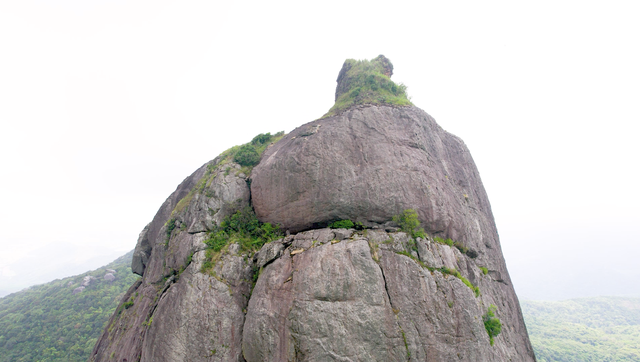
The construction method and function of the Hon Chuong Tower remain a major mystery for scientists.
PHOTO: TRIEU THANH

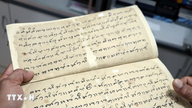

Surprisingly, for centuries, this tower was almost "invisible" in research documents. In 1993, during a survey of Mount Ba, Dr. Dinh Ba Hoa, former Director of the Binh Dinh Museum (formerly), accidentally discovered and named the tower after the shape of the rock formation where it is located.
"The path leading up was treacherous and inaccessible; we could only observe it through binoculars. Local people used to think it was a Nguyen Dynasty temple because of its tiled roof. But the architecture shows it's a Cham tower," recalled Dr. Dinh Ba Hoa.
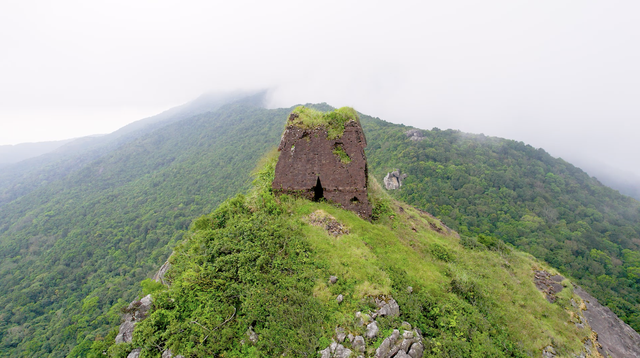
The main entrance of Hon Chuong Tower faces east, like other Cham towers in Gia Lai.
PHOTO: TRIEU THANH
It wasn't until 2020 that the Binh Dinh Provincial Museum officially conducted a survey using drones to document the site. The images showed that the tower had only one entrance facing east, the tiled roof had collapsed, but the main body of the tower remained intact.
What puzzles scientists is why the Cham people chose such a precarious and treacherous location to build the tower, a stark contrast to their tradition of constructing towers in flat, easily accessible areas.
IS THIS A PILGRIMAGE SITE OR A MILITARY OBSERVATION POST?
Dr. Dinh Ba Hoa believes that, given its rugged terrain, the tower could hardly have been a place of pilgrimage or regular religious activity. According to him, the structure may have once served as a military observation post. However, how the ancients managed to transport materials to the top of the rock remains unexplained.
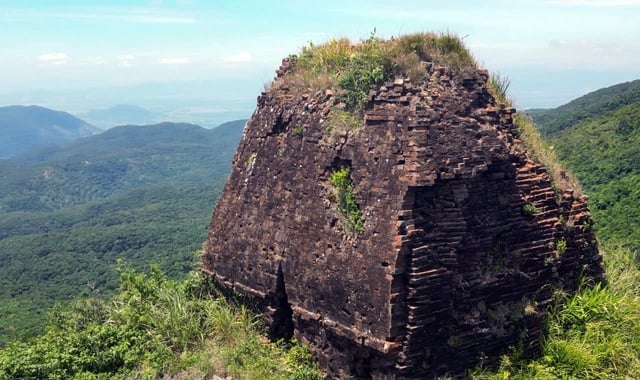
According to scientists, the Hon Chuong Tower was likely built between the 11th and 13th centuries.
PHOTO: XUAN HIEN
Conversely, Mr. Hoang Nhu Khoa (Gia Lai Provincial Museum) views the Hon Chuong Tower as having religious symbolic significance. In Champa culture, mountains were often considered the dwelling places of deities. Seen from afar, Hon Chuong resembles a giant linga, a fertility symbol in Hinduism. The construction of the tower on it demonstrates a unique combination of indigenous beliefs and Hinduism. "Given its location, which is frequently covered in clouds, the tower is unlikely to have a military function. It can only be a spiritual symbol," Mr. Khoa asserted.
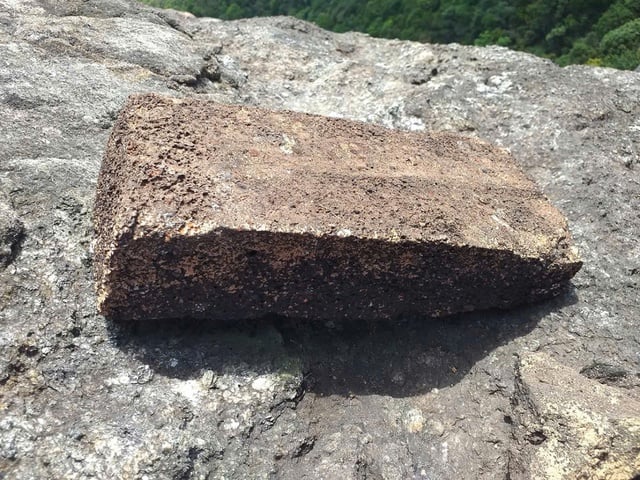
The Hon Chuong Tower was built from giant bricks, each weighing approximately 6 kg.



PHOTO: XUAN HIEN
Dr. Nguyen Huu Manh, Deputy Head of the History Department at the University of Social Sciences and Humanities, Vietnam National University, Hanoi, added another hypothesis: the Hon Chuong Tower may have once functioned as an ancient lighthouse, marking the harbor entrance for ships to dock, or serving defensive purposes. Based on the horn-shaped tiles found, he suggests the tower dates back to the 11th-13th centuries.
According to Dr. Manh, the ancient Cham people may have used scaffolding made of bamboo and wood, along with a pulley system, to lift bricks and stones to the top of the giant rock, thus constructing this extraordinary structure.
To this day, Hon Chuong Tower remains one of the most mysterious structures of the Champa kingdom in Gia Lai. Its unique nature has given rise to fascinating theories that inspire further research.
Ms. Do Thi Dieu Hanh, Director of the Department of Culture, Sports and Tourism of Gia Lai province, said that Hon Chuong Tower has great historical and cultural value, but access to the relic remains extremely difficult. "In the plan to supplement funding for the period 2026-2030, the department will prioritize the restoration of remaining Cham towers, including Hon Chuong Tower. This will be an opportunity to restore the structure and preserve the architectural value of Cham for future generations," Ms. Hanh affirmed.
Source: https://thanhnien.vn/thap-chamky-latren-dinh-da-khong-lo-185251004202719889.htm
![[Image] National conference summarizing one year of operation of the overall organizational model of the political system, the three-tiered government model.](https://vphoto.vietnam.vn/thumb/1200x675/vietnam/resource/IMAGE/2026/07/01/1782882811691_ndo_br_1-jpg.webp)