 |
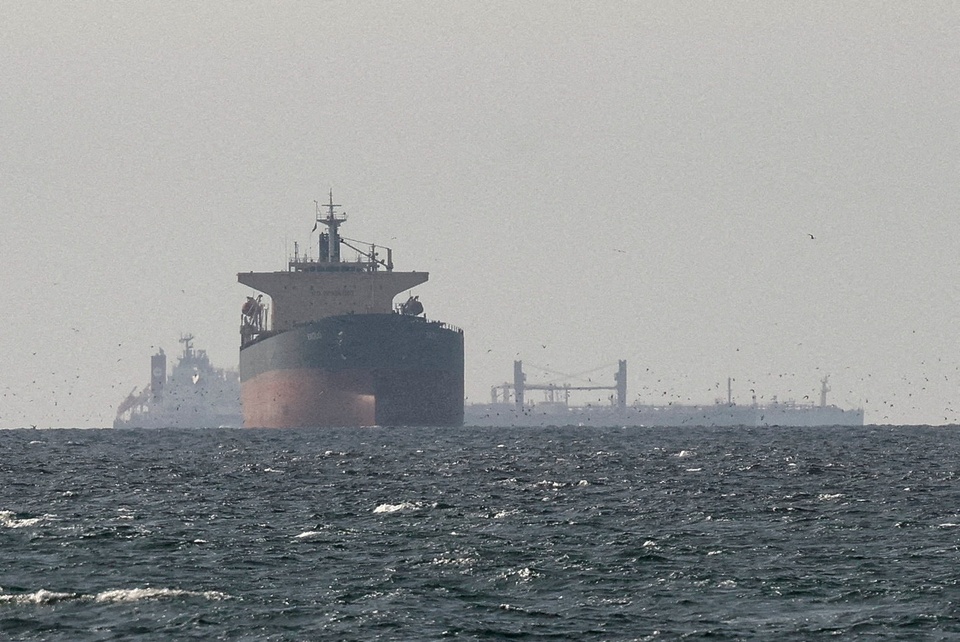
Cargo ships move through the Gulf, near the Strait of Hormuz. Photo: Reuters. |
Conflict in the Middle East has caused the global market to lose approximately 1 billion barrels of oil supply in just three months, equivalent to nearly 2.5 times the size of the US Strategic Petroleum Reserve (SPR), according to the latest report from Rystad Energy.
A Norwegian-based energy research firm says that disrupted oil production in six Gulf countries is currently at around 11.8 million barrels per day. If the conflict continues, the amount of oil lost from the market could approach 2 billion barrels by the end of this year, according to the Financial Express.
Aditya Saraswat, Director of Middle East and North Africa (MENA) Research at Rystad Energy, estimates that the total lost supply has now reached 1 billion barrels and could double under the organization's baseline scenario.
According to Rystad, oil production in the six Gulf nations has fallen from 24.2 million barrels per day before the conflict to around 12.4 million barrels per day. Saudi Arabia is the most affected, with 3.8 million barrels per day disrupted, followed by Iraq with 2.8 million barrels per day and Kuwait with 2 million barrels per day.


The impact has also spread to energy transport. Ship traffic through the Strait of Hormuz has dropped sharply compared to pre-conflict levels, while liquefied natural gas (LNG) shipments have virtually disappeared.
Alternative export routes such as Saudi Arabia's Yanbu port and the UAE's Fujairah port have helped ease pressure but have not fully compensated for the disrupted oil supply due to damaged infrastructure, increased insurance costs, and shipping congestion.
The report was released amid Brent crude oil prices fluctuating around $90 a barrel. Expectations for a diplomatic solution between the US and Iran are dwindling following recent airstrikes between the two sides.
In its baseline scenario, Rystad assumes the US and Iran could reach a limited agreement in June, thereby facilitating the phased reopening of the Strait of Hormuz starting in mid-July. However, the organization estimates that only about 10-15% of the disrupted oil production could return to the market in the first month, while a full recovery could extend into 2027.
Rystad warns that even in a relatively positive scenario, the global energy market still risks losing nearly 2 billion barrels of supply this year, leaving oil prices vulnerable to continued volatility.



Source: https://znews.vn/the-gioi-vua-mat-1-ty-thung-dau-post1659594.html

![[Photo] "Hanoi Lotus Festival" honors the lotus flower that has been associated with Vietnam for thousands of years.](https://vphoto.vietnam.vn/thumb/1200x675/vietnam/resource/IMAGE/2026/06/27/1782516943048_sen-ha-noi-2026-minh-duy-1-jpg.webp)