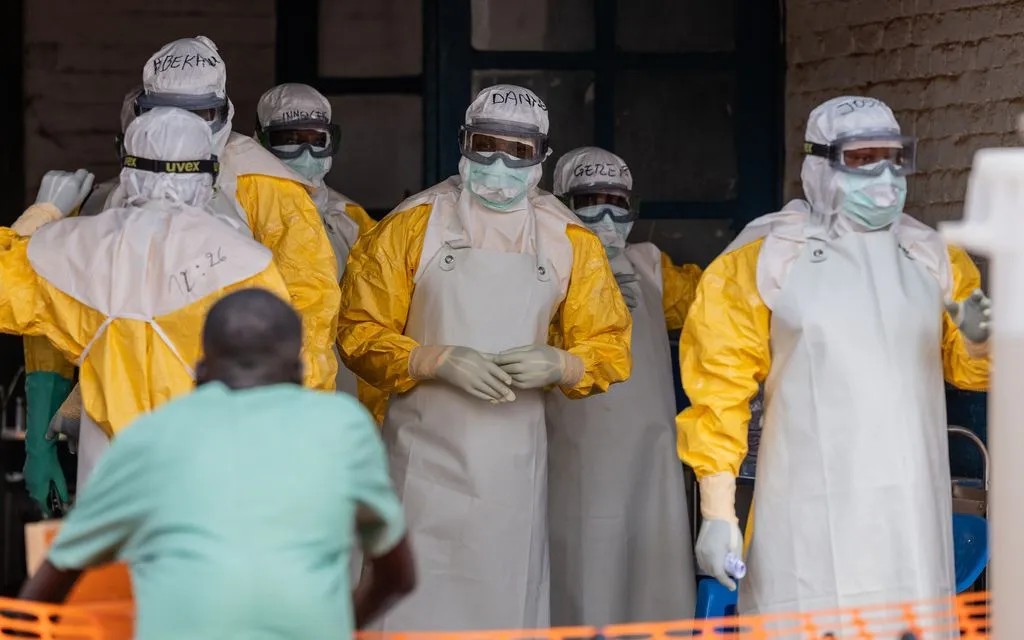
Medical staff prepare for duty at the Mongbwalu treatment center in Congo, June 5, 2026. (Photo: AP)
A newborn girl named Buswaza was brought to a church-run orphanage in Bunia, Ituri province, eastern Democratic Republic of Congo, after her mother died in late May. The nuns there quickly discovered she had a fever. Just a few days later, Buswaza died and was subsequently diagnosed with Ebola.
Following this death, six other children at the orphanage, which was caring for 69 children, were identified as suspected cases of Ebola. These children were taken to the hospital for isolation and testing. Five of them later tested negative and were discharged from isolation at the Protestant Health Center in Bunia.
However, another baby girl, less than a year old and one of the three orphaned triplets, died on June 10th after being confirmed to have Ebola. Dr. Freddy Kibwana, head of the Protestant Health Center, said she did not survive.
Ebola is a dangerous infectious disease that can be transmitted through bodily fluids such as blood, saliva, vomit, and feces of infected individuals. Young children and infants can become a source of infection if they have close contact with their caregivers. Three caregivers of the deceased children, including a nun, also tested positive for Ebola.




Medical staff prepare for duty at the Mongbwalu treatment center in Congo, June 5, 2026. (Photo: AP)
Buswaza, who lived for less than two weeks, was one of the youngest victims of the current outbreak in Congo. The epidemic has infected nearly 600 people and killed at least 115 across the country.
According to the World Health Organization (WHO), the Ebola virus has been detected in amniotic fluid, the placenta, and breast milk, so newborns can be infected from their mothers during pregnancy, childbirth, or through breastfeeding.
The United Nations Children's Fund (UNICEF) says children account for about 17% of confirmed Ebola cases in the current outbreak. The WHO warns that young children may face a higher risk of severe illness and death, while data on the Bundibugyo variant of the Ebola virus and its impact on children remains limited.
In Ituri, the risks to children are further exacerbated by high rates of malnutrition, uneven vaccination rates, and ongoing conflict. A 2023 survey noted that the rate of chronic malnutrition among children under 5 years old in the province was 52.1%.



Medical teams now visit the orphanage daily to check on the health of the children and staff. Aid organizations in Congo have issued a warning about the Ebola outbreak affecting an area already mired in a humanitarian crisis.
Source: https://vtv.vn/dich-ebola-tai-congo-them-2-tre-em-tu-vong-100260610234113113.htm
![[Photo] "Hanoi Lotus Festival" honors the lotus flower that has been associated with Vietnam for thousands of years.](https://vphoto.vietnam.vn/thumb/1200x675/vietnam/resource/IMAGE/2026/06/27/1782516943048_sen-ha-noi-2026-minh-duy-1-jpg.webp)