Memories are awakened.

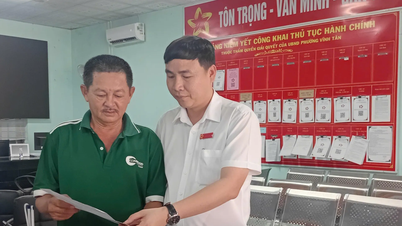
Besides the military and relevant authorities, the memories of the people and veterans are becoming an important source of information in identifying suspected graves of fallen soldiers nearly 60 years after the war. In early June 2026, Mr. Le Van Luot (67 years old, residing in Phu Xuan ward, Hue city) proactively provided information about the area near the West Gate, where he believes about 10-15 revolutionary soldiers were buried in bomb craters after the Tet Offensive of 1968. He has preserved this memory since childhood, when he witnessed the scene with his father.
Based on information provided by Mr. Luot, the Hue City Military Command has repeatedly visited the site to survey and verify the information, and also distributed leaflets encouraging people to continue providing information about suspected locations containing the remains of fallen soldiers. According to the 192nd Fallen Soldiers' Remains Collection Team (Hue City Military Command), this information is highly reliable and consistent with the combat logs of the 6th Regiment - Tri Thien Military Region. Through surveys, many local residents also confirmed having witnessed burials and leveling in the bomb craters. Two officials who took over the area after 1975 also confirmed that a large bomb crater existed near the city wall in the past.

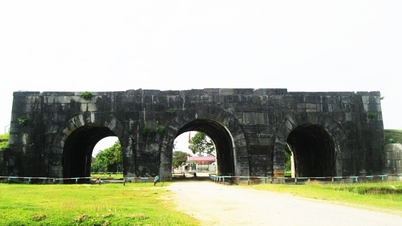
Over the past few days, Mr. Luot has actively coordinated with the military forces to cordon off the area and provided information on two additional suspected locations within the Hue Imperial Citadel where the remains of fallen soldiers might be found. He hopes that his information will contribute to bringing the soldiers back to their families, and also encourages many people to bravely share their remaining memories.
Not only local residents, but also veterans from Hue City are actively participating in the search for their comrades. Based on information from Mr. Pham Ngoc Tuan, a veteran of the 6th Phu Xuan Regiment, the Hue City Military Command surveyed the memorial area for officers and soldiers who died in the 1968 Tet Offensive on Ton That Thiep Street, near the Huu Gate. According to Mr. Tuan, this area was once a surgical and first aid station for revolutionary soldiers during the 1968 Tet Offensive. Despite numerous searches, no remains have been found there, so he proposed further thorough surveys and expanding the scope to neighboring areas.




After nearly 60 years, many traces of war have been erased by time and urban changes. In this context, the memories of the people, veterans, and those who lived through and witnessed historical events become an exceptionally valuable source of information, providing the recovery efforts with a basis for identifying, comparing, and verifying information. Every piece of information provided, even a vague memory or a small remaining detail, can open up opportunities to find the remains of fallen soldiers still lying on the old battlefields. This is also a responsible collective effort of the community, contributing to the "500-Day Campaign to Search, Collect, and Identify Fallen Soldiers" in Hue City achieving its highest goal: bringing the heroic martyrs back to their homeland and families, ending the long-awaited hopes of generations.
Adding more "eyes" to find fallen soldiers.

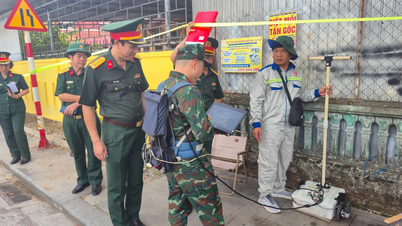
In parallel with gathering information from witnesses, the Hue City Steering Committee 515 has applied ground-penetrating radar to support the survey of areas suspected of containing mass graves. Immediately after arriving in Hue on the afternoon of June 25th, the technical team from the Institute of Design, General Department of Logistics and Technology ( Ministry of National Defense ) quickly deployed to survey Xuan 68 Street and the area around the West Gate.
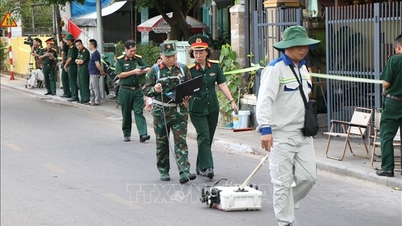
Under the sweltering late June sun, technical staff quickly installed the ground-penetrating radar system. Along the asphalt road and in the patches of earth near the city walls, the equipment was slowly pushed along pre-marked routes. Following closely behind, technicians continuously monitored the computer screen connected to the radar, where the reflected signal bands appeared with each meter of the scan underground. Upon completion of each survey route, all data was checked and stored on-site before moving on to the next area.
Ground-penetrating radar operates on the principle of transmitting electromagnetic waves down into the underlying geological layers. When encountering structures with differences, such as disturbed strata, landfills, or anomalies in the ground, the signal reflects back and is recorded by the device. However, the signals received are only initial data; to make an accurate assessment, experts must continue to process and analyze them in specialized laboratories.
According to Lieutenant Colonel Pham Thi Thanh Van, Deputy Director of the Central Branch of the Institute of Design, after the site survey, all signals will be processed and analyzed to describe the stratigraphic structure, identify disturbed areas or foreign objects suspected to be related to the burial pit before reporting to the Steering Committee 515 for consideration of the next steps. The survey was facilitated by the relatively clean urban area, but the roadbed has many layers of material that limit the ability of the signals to penetrate deep into the underlying soil layers. Nevertheless, the task force will continue to thoroughly analyze all the data obtained to provide the most reliable results for the Steering Committee.
Present at the West Gate from the beginning of the survey, Mr. Le Van Luot attentively followed every step of the technical team's work. He shared his emotion at witnessing the officers and soldiers working with a high sense of responsibility, patiently searching every meter of land with the hope of bringing the fallen soldiers back to their families. According to him, after completing the survey in this area, there are still many other locations that need further verification; he himself has provided two additional locations suspected of being where revolutionary soldiers died.




At the scene, Lieutenant General Ha Tho Binh, Commander of Military Region 4, requested that all forces demonstrate the highest sense of responsibility, conduct a scientific review, and not overlook any suspicious signs; at the same time, the analysis of radar data must be closely combined with information from witnesses, veterans, and historical sources to improve accuracy.
After two days of surveying, ground-penetrating radar initially recorded promising signals. At Xuan 68 Road, the device detected two suspected tectonic disturbance zones at a depth of approximately 1.2 m, a width of about 2.5 m, and a length of 10-12 m. At the Chanh Tay Gate area, the radar also recorded a suspected disturbance zone at a depth of about 1 m, a width of 7-9 m. However, at depths exceeding 3.5 m, significant interference signals were observed, requiring further analysis before drawing any conclusions.
Initial findings cannot yet confirm the presence of burial sites for fallen soldiers, but they have provided additional scientific basis for narrowing down priority locations for verification. Along with witness accounts, historical documents, and the determination of the forces participating in the 500-day and night campaign, ground-penetrating radar is becoming the technological "eyes" supporting the search for and identification of those who fell for the independence and freedom of the Fatherland.
Source: https://baotintuc.vn/xa-hoi/them-doi-mat-tim-liet-si-20260627125711155.htm
![[Photo] "Hanoi Lotus Festival" honors the lotus flower that has been associated with Vietnam for thousands of years.](https://vphoto.vietnam.vn/thumb/1200x675/vietnam/resource/IMAGE/2026/06/27/1782516943048_sen-ha-noi-2026-minh-duy-1-jpg.webp)




![[Infographic] 16 fireworks display locations to celebrate the 50th anniversary of Ho Chi Minh City being honored with the name of President Ho Chi Minh](https://vphoto.vietnam.vn/thumb/402x226/vietnam/resource/IMAGE/2026/06/27/1782539591308_man-ban-phao-hoa-ruc-ro-dem-khai-mac-638jpg-17242995540161175940469.jpeg)