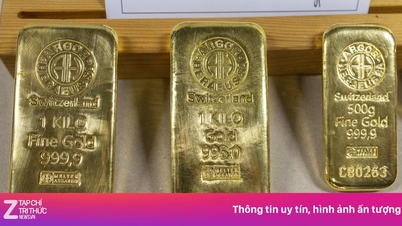
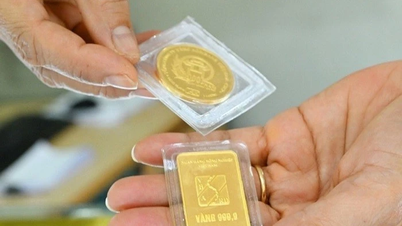
The domestic market has just witnessed contrasting gold prices. At the close of trading on June 26th, while SJC listed gold bars at 144-147 million VND/ounce (buy-sell), an increase of 800,000 VND/ounce in both directions, other major brands saw gold prices adjusted downwards by 400,000-800,000 VND/ounce in each direction. Consequently, buying prices ranged from 142.3 million VND/ounce to 143 million VND/ounce, with the lowest selling price at 146 million VND/ounce.
Globally , the price of gold is currently at $4,071 per ounce, equivalent to approximately 130 million VND per tael (excluding taxes and fees) at the current exchange rate. Currently, the difference between world and domestic gold prices is around 17 million VND per tael. Domestic prices are higher.
Market sentiment for gold remains influenced by the US Federal Reserve (Fed) meeting on June 17th. Although the Fed kept interest rates unchanged in the 3.5-3.75% range, new forecasts suggest that many officials are leaning towards the possibility of at least one more interest rate hike before the end of the year.
Meanwhile, Brent crude oil prices fell to around $72.24 a barrel, nearly back to pre-conflict levels, after oil tanker traffic through the Strait of Hormuz doubled in 24 hours and reached its highest level since late February.
This development helped reduce the demand for gold as a safe haven, while also easing inflationary pressures from energy prices. Analysts note that the ceasefire between the US and Iran remains fragile, and geopolitical risks have not completely disappeared from the market.
Jerry Prior, Managing Director and Senior Portfolio Manager at KMLM, believes the recent correction is creating attractive buying opportunities for gold, despite short-term pressures. Factors supporting a long-term upward trend for gold remain unchanged, notably the trend of many countries diversifying their foreign exchange reserves and reducing their dependence on the US dollar. This is seen as a structural driver that could continue to fuel gold demand in the coming years.



Recent selling pressure has primarily stemmed from the Fed's hawkish monetary policy stance and the easing of geopolitical tensions in the Middle East. However, much of the negative impact has already been reflected in gold prices following the recent sharp correction.
Prior believes that gold prices could still fall below $4,000 per ounce in the short term. Buying pressure from central banks may soon return as many countries continue to increase their gold reserves instead of holding USD-denominated assets.
This expert predicts that the price of gold could rise to around $4,500 per ounce by the end of this year thanks to buying from central banks and the continuing global trend of de-dollarization.
The US dollar depreciated.
The US dollar fell for a second consecutive session on Friday as recent economic data and a decline in oil prices somewhat dampened expectations that the Federal Reserve would continue to raise interest rates. However, the Japanese yen remained in a volatile trading range, keeping markets wary of potential intervention from Japanese authorities.
In the US market, the US Dollar Index (DXY), which measures the fluctuations of the US dollar against six major currencies (EUR, JPY, GBP, CAD, SEK, CHF), fell 0.06%, currently standing at 101.37.



The State Bank of Vietnam announced that the central exchange rate of the Vietnamese Dong against the US Dollar is currently at 25,195 VND.
Source: https://dantri.com.vn/kinh-doanh/vang-trong-nuoc-co-nhieu-gia-20260627072708742.htm