

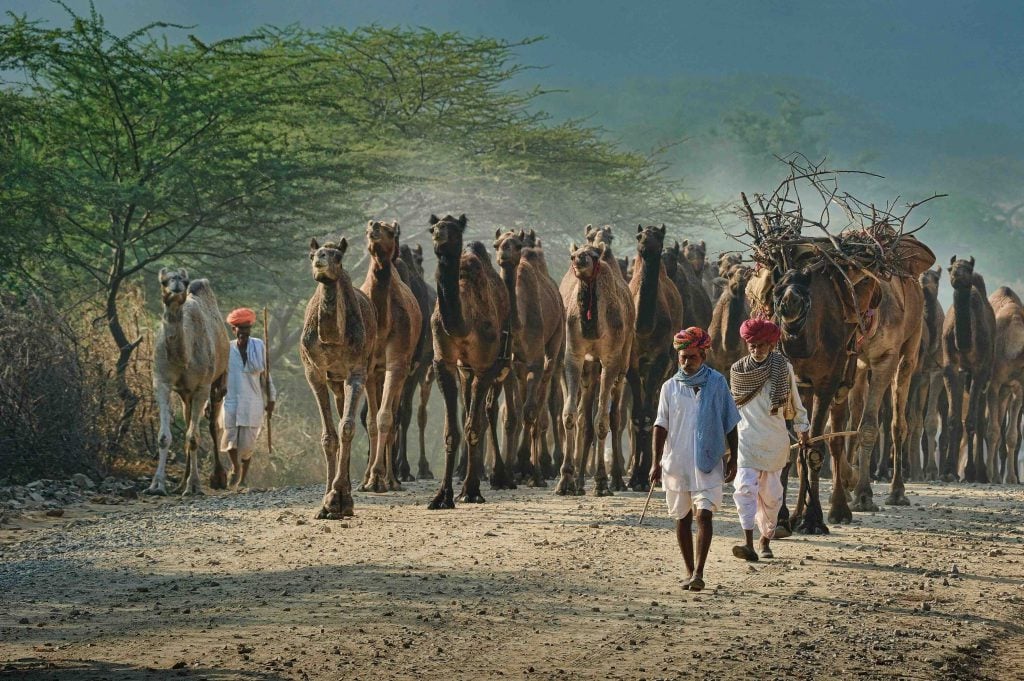
Camel caravans flocked to Pushkar for buying, selling, and trading.
Each year, the market is held for a week, from the end of October to the beginning of November, according to the Hindu calendar. Herds of camels, traveling hundreds of kilometers, flock to the desert, with numbers ranging from 10,000 to 30,000 depending on the year. Pushkar Mela was initially simply a place for buying and selling camels between nomadic communities after a year of herding; and gradually developed into one of the most unique cultural and spiritual festivals in India. For Hindu devotees, this is also the pilgrimage season to Pushkar Lake – a sacred lake with one of the very few Brahma temples in India, where merchants always hope to bathe as a form of purification and healing.
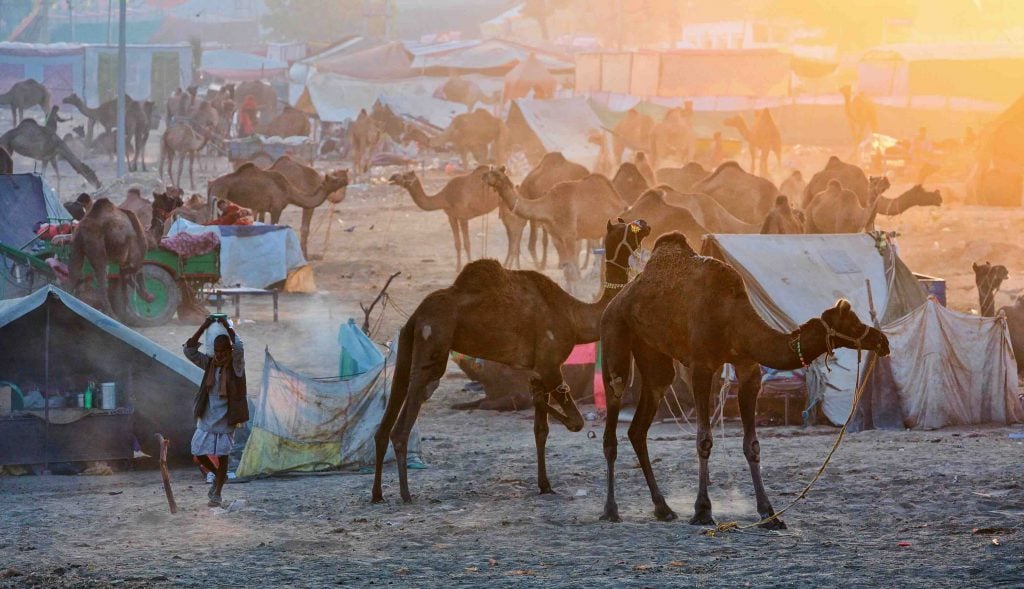
The nomadic people gathered their camels in the sand dunes behind the town.
Mela Ground Stadium is a hub for entertainment, food, and stalls selling agricultural products, household goods, jewelry, and especially camel accessories. But the most exciting and vibrant event is the camel decorating competition and camel riding demonstration.
The first stretch of sand, dotted with only a few camels, was captivating enough for those experiencing nomadic life for the first time. I continued along the trail, lined with cacti on both sides. In the distance, through the swirling dust and smoke, herds of tens of thousands of camels bobbed across the sandy valley. In stark contrast to the bustling fairground, the mournful calls of the herds mingled with the whispered bargaining of buyers and sellers. Gone were the vibrant saris, replaced by three colors: the yellow of the sand, the brown of the camels, and the white of the clothing.
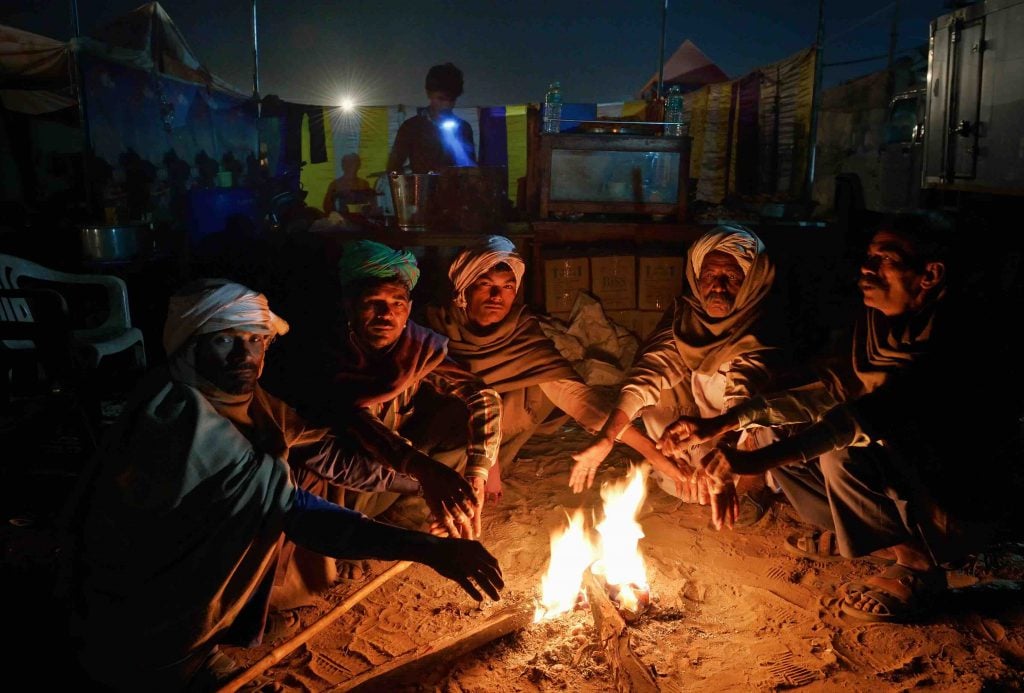
Nomadic life at night
Spending the night here truly reveals the resilience of the nomadic people, as the temperature plummets from 34°C during the day to 16°C at night. Groups of 3-5 people huddle around a campfire with two tarpaulins, one for sleeping directly on the sand, the other for covering themselves – thus spending the night in the desert. At 4 a.m., they rekindle the fire from the embers to prepare tea. Notably, each person always carries a copper teapot, an indispensable item, specifically for brewing Masala Chai – a traditional Indian milk tea whose distinctive flavor of black tea and herbs, once tasted, is unforgettable.
Modern life has led to a decline in camel trading. Demand is weaker each year than the last, so camel owners often pack up and return home early. Groups trudge silently across the desert, leaving trails of dust behind, while the legacy of nomadic life – the Pushkar Camel Fair – continues its boisterous activity, its sounds echoing across the desert.
Pushkar Mela is more than just a market. It is a place where culture, spirituality, and commerce intersect; a vibrant living legacy of nomadic life; a meeting point of a traditional and evolving India, bustling yet full of nostalgia.
Source: https://heritagevietnamairlines.com/theo-dau-lac-da-ve-mien-hoang-mac/
![[Image] National Assembly discusses the implementation of the socio-economic development plan.](https://vphoto.vietnam.vn/thumb/1200x675/vietnam/resource/IMAGE/2026/04/20/1776696707422_ndo_br_img-20260420-185419-jpg.webp)
![[Photo] General Secretary and President To Lam meets with National Assembly delegates from ethnic minorities.](https://vphoto.vietnam.vn/thumb/1200x675/vietnam/resource/IMAGE/2026/04/20/1776696701056_a1-bnd-8331-3342-jpg.webp)

























































Comment (0)