

The government has just issued Resolution No. 16 proposing the drafting of a National Assembly Resolution on piloting the recruitment of individuals with college degrees to teach certain subjects under the 2018 General Education Program.
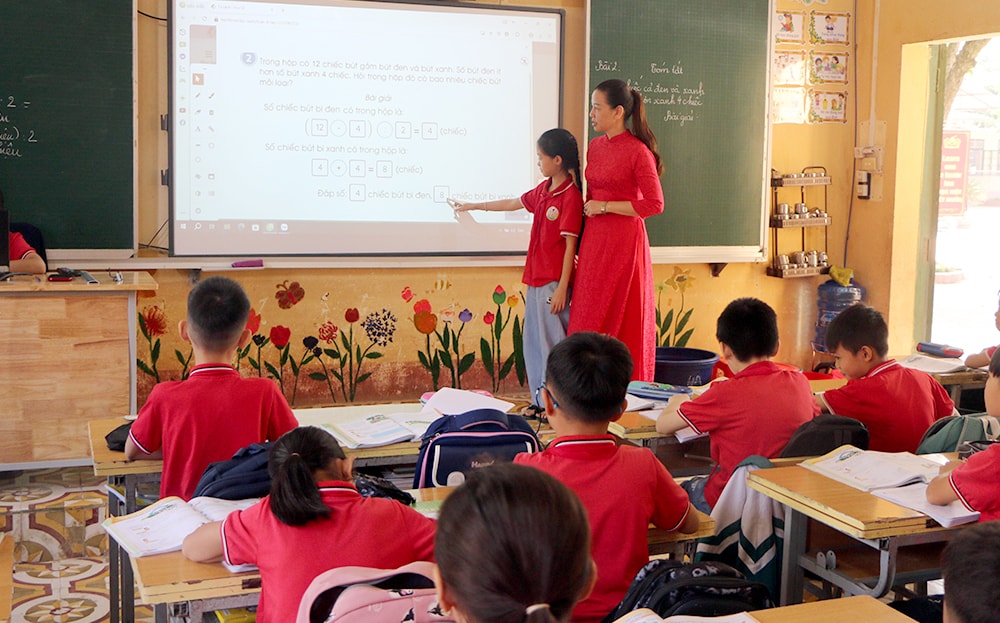
This is an important solution that has been previously proposed by the Ministry of Education and Training (MOET) and many localities to ensure a sufficient number of teachers.
Accordingly, the Government unanimously approved the proposal to draft a Resolution of the National Assembly on piloting the recruitment of individuals with college degrees to teach certain subjects under the 2018 General Education Program, as presented in Submission No. 1142 dated August 28, 2024, and related documents.
The government stated that it plans to submit this matter to the National Assembly at the 9th session of the 15th National Assembly (May 2025) following the procedure for consideration and approval in a single session.
According to the Ministry of Education and Training's report, most high schools lack music and art teachers for students to choose from. The number of secondary school teachers with a university degree or higher is also insufficient. The training of bachelor's degree holders in integrated subjects (History-Geography, Natural Sciences, Music, and Art Education) has not kept pace with demand. Therefore, recruiting individuals with college degrees to teach some new, specialized subjects – that is, below the standards set by the Education Law – is necessary to ensure sufficient teaching staff and thus guarantee the reform of the curriculum and textbooks.
The 2018 General Education Program is being implemented gradually starting in 2020 and is preparing for the first graduating class in 2025. Compared to the old program, primary school now includes compulsory English and Information Technology from grade 3; lower secondary school has two new subjects: History and Geography, and Natural Science; and at the upper secondary level, for the first time, arts (Music, Fine Arts) are included as elective subjects for students to choose according to their career orientation.
Observations in various localities show that there is currently a significant shortage of teachers in English, Information Technology, Music, Fine Arts, and integrated subjects. In Dien Bien province, the 2024-2025 school year will see a shortage of over 2,000 teachers. Specifically, the mountainous district of Tua Chua alone will lack 465 teachers, with difficulties in recruiting for English, Information Technology, and Fine Arts positions. The current solution involves assigning teachers to teach extra classes and teach at multiple schools, with some teachers even teaching at two different educational levels.
According to the draft Mid-Term Evaluation Report on the Implementation of the 2018 General Education Program, it is projected that in the 2024-2025 school year, primary schools will still lack 6,621 computer science teachers and 5,780 foreign language teachers. At the lower secondary level, there will be a shortage of 11,598 technology teachers, 2,366 natural science teachers, and 4,321 art teachers.
Although localities have many policies to attract and recruit teachers, for various reasons, the number of teachers has not been ensured, including a shortage of recruitment sources. The 2019 Education Law stipulates the standard qualifications for teachers: a bachelor's degree or higher in teacher training for primary, lower secondary, and lower secondary school teachers. In cases where there is a shortage of teachers in a subject, a bachelor's degree in a relevant specialized field and a certificate of pedagogical training are required. Notably, many graduates with degrees in Information Technology and Foreign Languages Education do not want to pursue teaching in this field. This creates difficulties in implementing the 2018 General Education Program.
Dr. Hoang Ngoc Vinh, former Director of the Department of Professional Education (Ministry of Education and Training), believes that when applying the teacher qualification standards according to the 2019 Education Law, a shortage of teachers in the initial period is unavoidable. He previously suggested that for specialized subjects, recruitment could be allowed from college level or higher, followed by further training to ensure these teachers meet the required qualifications. However, the recruitment of college-level teachers needs to be formalized by a National Assembly Resolution, creating a legal framework for localities to implement. Without a National Assembly Resolution, localities recruiting teachers below the standard would be violating the law.
"This policy, once implemented, will contribute to expanding the recruitment pool, overcoming the surplus and shortage of teachers, and gradually ensuring the number of teachers to implement the 2018 General Education Program in some subjects. Afterward, the Department and Provincial Departments of Education and Training must have policies to provide advanced training for these teachers," Dr. Hoang Ngoc Vinh stated.
In addition, this expert also suggested that more mechanisms and policies are needed to recruit and attract teachers in order to quickly have a sufficient number of teachers while still ensuring the quality of education, in line with the actual situation.
In the long term, according to Associate Professor Dr. Tran Xuan Nhi - former Deputy Minister of Education and Training, to solve the problem of teacher shortages and surpluses, it is necessary to decentralize the training of human resources to local authorities and hold them accountable. Areas with shortages should receive special attention and support. Along with this, policies and regulations regarding the teaching profession need to be further researched and improved to encourage and attract those who have been trained and love the teaching profession to the sector.
Source: https://daidoanket.vn/thi-diem-tuyen-dung-giao-vien-co-trinh-do-cao-dang-10299390.html


































































Comment (0)