Beginning at the University of Queensland (Australia) in 1927, the asphalt dripping process is widely known as the world's longest-running laboratory experiment. At the time, physicist Thomas Parnell aimed to prove what initially seemed impossible: that a substance appearing solid could behave like a liquid.
The material used in the experiment was asphalt, a black, tar-like substance primarily used as a binder in road construction, waterproofing, and industrial material production. At room temperature, it solidifies like a solid, can be hammered, and crumbles easily like glass. However, scientifically speaking, asphalt is not a true solid, but a highly viscous liquid, meaning it can flow, albeit very slowly.
According to LiveScience , asphalt challenges the conventional notion of solids and liquids. Typically, material is judged by what it appears to be over time. Something that doesn't move is called a solid, and vice versa. However, some substances behave beyond human patience, and asphalt demonstrates that some seemingly solid substances can still flow if given enough time.
According to the University of Queensland, asphalt is the thickest liquid known to mankind. The Guinness World Records recognizes it as having a viscosity approximately 100 billion times greater than water.
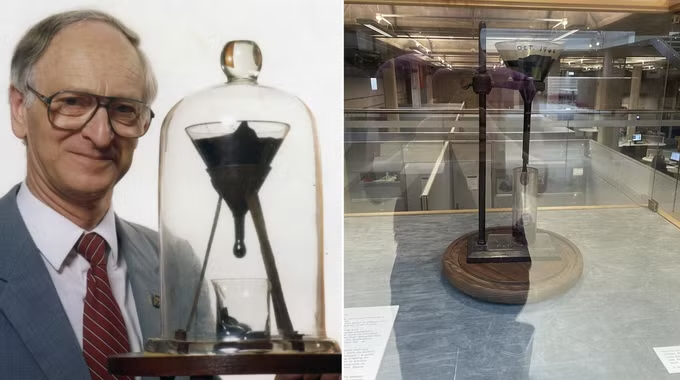
In 1927, Parnell heated the asphalt and poured it into a glass funnel, then left it to settle for several years. In 1930, the stem of the funnel was cut off for the first time to allow the asphalt to begin flowing downwards.



Essentially, the experiment revolves around waiting for drops of asphalt to slowly fall from a funnel into a glass cup below, and this is what made the experiment famous. For decades, no one actually saw the drops fall directly.
A total of nine drops have fallen over nearly 100 years, with the eighth in 2000 and the ninth in 2014. Speaking to CNN in 2013, Professor John Mainstone, the scientist in charge of the research since 1961, said he usually checks five to six times a day, as well as via computer. In 1979, he missed the crucial moment because it was a Sunday. In 1988, he also missed it by just five minutes when he stepped outside to get a drink. He thought he had recorded the 2000 drop with a camera, but a technical error caused everything to be missed.
"We've failed again," Mainstone said at the time.
In 2013, he passed away without witnessing the ninth droplet fall. The experiment was then overseen by physics professor Andrew White.
Currently, the experiment is being streamed live via The Tenth Watch, turning one of the slowest experiments in science into a globally anticipated event. The tenth droplet has clearly formed, but IFLScience says it's not yet possible to predict the exact time of its arrival, which could be this year or next, as its speed depends on ambient temperature.
According to Interesting Engineering , the experiment that attracted attention wasn't its technological complexity. In fact, it was very simple: asphalt, a funnel, a glass cup, and time.



"But it is precisely this simplicity that makes it effective," the page commented. "It makes an intangible idea tangible; transforms 'viscosity' from a textbook term into something everyone can understand: a drop takes years to fall; and also proves that nature doesn't always operate at the pace humans expect."
Source: https://baohatinh.vn/thi-nghiem-cham-nhat-the-gioi-post312486.html