

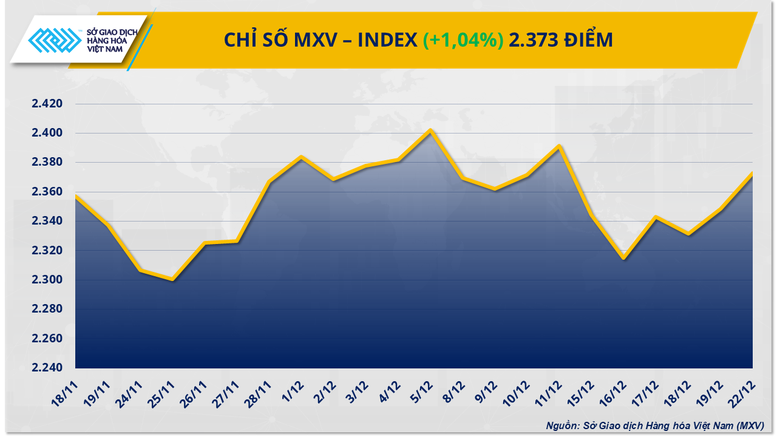
Coffee prices reverse course and surge 2%.
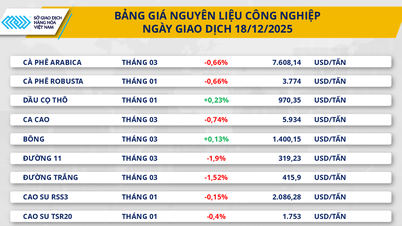
Following the general market trend, the industrial raw materials group also recorded positive buying pressure yesterday, with most key commodities experiencing strong increases. Notably, the prices of both coffee commodities recovered strongly. Specifically, Arabica coffee prices increased by nearly 2% to $7,657 per ton, while Robusta coffee prices rose by more than 2.3% to $3,866 per ton.
According to the Vietnam Commodity Exchange (MXV), unfavorable weather conditions and concerns about supply in Brazil continued to support coffee prices in yesterday's trading session. According to the weather forecasting agency Climatempo, Minas Gerais state – Brazil's largest Arabica coffee-growing region – recorded only 38.3 mm of rainfall in the week ending December 19th, equivalent to about 76% of the multi-year average, increasing the risk to coffee plant growth.
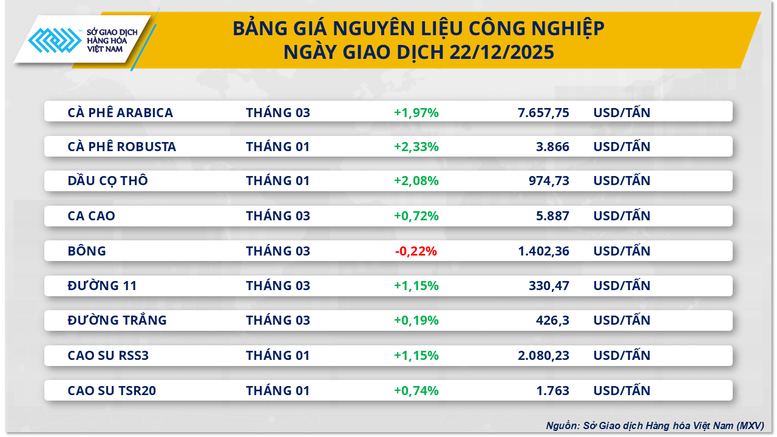
Regarding supply, Brazil's coffee exports are showing signs of stagnation, thereby narrowing the supply to the international market. Notably, although Brazil's Robusta coffee production is projected to increase sharply this year, the export performance of this commodity is presenting a less positive picture. In the first eight months of the 2025-2026 crop year (from April 2025 to March 2026), Robusta exports reached only 3.07 million bags, a decrease of 54.92% compared to the same period of the previous crop year. The main reason is that Brazil boosted Robusta exports to record levels in the 2024-2025 crop year, narrowing the available supply for the current crop year.
In the domestic market, the price of bulk green coffee beans remained stable at the beginning of the week, generally around 92,000 - 93,000 VND/kg. Although prices showed a slight recovery from the end of last week after a series of consecutive declines, market liquidity remained low as farmers and dealers continued to wait for higher price levels.
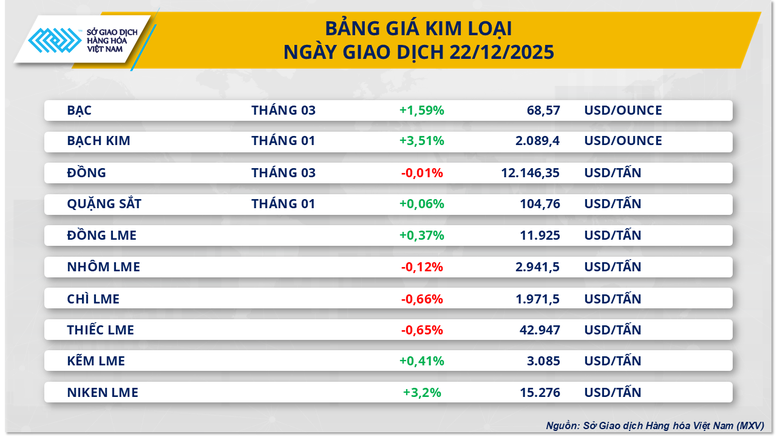
Platinum prices rose for the eighth consecutive session.
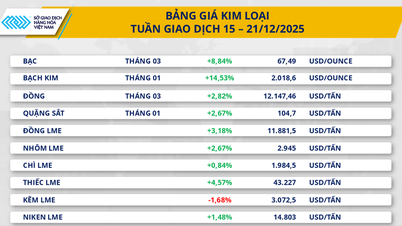
The first trading session of the week continued to see buying pressure dominating the metals market, with 6 out of 10 commodities experiencing price increases. In particular, attention was focused on platinum, as its price extended its upward trend for the eighth consecutive session. Specifically, platinum prices yesterday surged by more than 3.5% to $2,089.4 per ounce.
According to MXV, the prospect of strong demand growth was the main driver supporting platinum prices in the first trading session of the week.
The outlook for platinum demand in the hybrid and gasoline-powered vehicle manufacturing sectors is becoming more positive in the two major markets of Europe and the US. Recently, the European Commission proposed adjusting its plan to ban the sale of internal combustion engine vehicles from 2035. Specifically, the proposal still allows the sale of some non-electric models, with a particular focus on hybrid vehicles. At the same time, the CO2 emission reduction target has been lowered from 100% to 90% of the 2021 baseline.
This concession stems from strong pressure from the European automotive industry. Automakers in the region are facing significant challenges competing with Chinese electric vehicle manufacturers and Tesla. While the proposal still needs approval from the European Parliament and the governments of EU member states, the shift in green policy direction has led the market to believe that the transition to electric vehicles will be slower and more flexible than initially anticipated. This creates room to maintain and expand the production of hybrid and gasoline-powered vehicles, thereby supporting the medium-term platinum demand outlook.
According to the World Platinum Investment Council (WPIC), the amount of platinum used in automotive catalytic converters is estimated to account for nearly 40% of total global platinum demand this year. This figure confirms the crucial role of the automotive industry in the consumption of this precious metal.
Meanwhile, in the US, Ford – one of the world's leading automakers – announced in mid-December that it was canceling several electric vehicle models. This decision came amid declining demand for pure electric vehicles and signs of changing US policy. Instead, Ford stated it would focus more heavily on gasoline-powered and hybrid vehicles, thereby further strengthening the prospects for platinum sales in the automotive industry.
Alongside this, US President Donald Trump has also withdrawn federal subsidies for electric vehicles and proposed loosening regulations on exhaust emissions. These changes could encourage automakers to increase the proportion of gasoline-powered vehicles. Furthermore, after the $7,500 federal tax credit for electric vehicle buyers expired on September 30th, electric vehicle sales in the US fell by approximately 40% in November.
In terms of speculative capital flows, the Commitment of Transactions (COT) report from the U.S. Commodity Futures Trading Commission (CFTC) shows that Managed Money – representing investment funds and institutions – continues to maintain a net long position in standard platinum futures contracts. This position continues to support the upward trend of the precious metal. As of the week ending December 9th, the net long position of Managed Money increased again after three consecutive weeks of contraction, reaching 14,894 contracts. This reflects a gradually more optimistic investor sentiment regarding the platinum price outlook.
Source: https://baochinhphu.vn/thi-truong-hang-hoa-dong-tien-quay-lai-mxv-index-tang-hon-1-102251223085351622.htm


![[Photo] Closing Ceremony of the 15th Conference of the Central Committee of the 13th Party Congress](/_next/image?url=https%3A%2F%2Fvphoto.vietnam.vn%2Fthumb%2F1200x675%2Fvietnam%2Fresource%2FIMAGE%2F2025%2F12%2F23%2F1766462841764_a1-bnd-3731-1647-jpg.webp&w=3840&q=75)





























































































Comment (0)