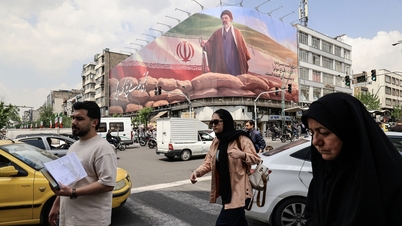
A woman waves the Iranian flag in Tehran on June 14 - Photo: AP
A ceasefire agreement between the US and Iran is nearing formal signing, but its future remains uncertain. From the fate of Tehran's uranium stockpile and Israel's military campaign in Lebanon to the still-unblocked Strait of Hormuz, all are casting serious doubt on any reluctant handshake.
The official signing ceremony is scheduled for June 19th in Geneva ( Switzerland ), but there remains a significant gap of uncertainty.
14 bullet points for "betting"
At the heart of the agreement is a plan to reopen the Strait of Hormuz, but even if Hormuz is fully navigated, the global energy crisis will not immediately subside.
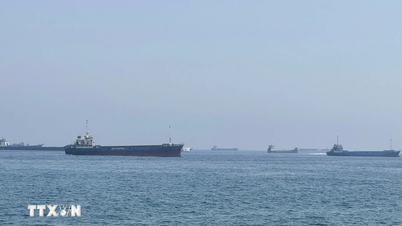
Energy market experts warn that the massive backlog of oil tankers, followed by mine clearance, is necessary before oil and gas transportation and production can be restored – a process that could take weeks, even months.
The entire document—according to some unnamed negotiators—consists of only 14 bullet points across two pages and has yet to be published.
"In high-stakes diplomatic deals like this, success or failure often depends on details," commented the BBC. "And here, the details are scarce."
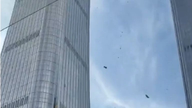
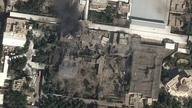

Another major obstacle came from Israel – a country that had joined the conflict alongside the US on February 28th but was not a party to the agreement. On the very day the agreement was announced, the Israeli military continued its airstrikes in southern Lebanon, where they were fighting Iranian-backed Hezbollah militias.
On June 15, Israel's Defense Minister affirmed that the country would not withdraw from the territories it occupies in Lebanon. Prime Minister Benjamin Netanyahu declared that the US-Iran agreement was a decision made by Trump, and that Israel "has its own interests" and will remain in what he called the "buffer zone" "as long as necessary."
Additionally, the memorandum extended the ceasefire and lifted the US naval blockade of Iranian ports, while the most contentious issues were postponed to future rounds of negotiations.
The nucleus: an unsolvable problem.
The most intractable challenge remains Iran's stockpile of highly enriched uranium – which both the US and Israel fear could be used to build nuclear weapons, despite Tehran's long-standing assertions that it has no such intention. Under the agreement, Iran has only 60 days to decide the fate of this uranium stockpile.
US Vice President JD Vance affirmed in an interview with Fox News on the evening of June 14th that the requirement for Iran never to possess nuclear weapons was "integrated into this agreement" and that the US could verify compliance.
But history shows the opposite: it took decades for the international community to reach the 2015 agreement to curb Tehran's nuclear program. Then, President Trump, in his first term, unilaterally withdrew the US from that agreement, setting the stage for a series of escalating tensions that led to the current conflict.
To underscore that fragility, Iran's Supreme National Security Council issued a statement on June 14th saying that "final negotiations will be postponed until after the other party's fulfillment of its commitments under the memorandum is complete." What those commitments are and how Iran interprets them will determine whether the agreement will stand.
The situation is so precarious that even now, with only a few days left until the official signing ceremony, the general sentiment remains that the agreement could collapse at any moment. This is also not the first time the parties have declared they are "close to reaching an agreement," only for everything to fall apart and fighting to resume.
Economic pressure weighs heavily on the White House.



According to the Associated Press, recent opinion polls show that President Trump and the Republican Party are facing increasing impatience from the American public.
A YouGov poll shows that 63% of Americans disapprove of Trump's economic management, with 57% feeling the economy is getting worse.
In this context, the agreement with Iran is seen as an opportunity to alleviate some of the economic pressure from the conflict. If gasoline prices actually start to fall, that would be the most concrete signal to the American people that things are getting better.
Source: https://tuoitre.vn/thoa-thuan-my-iran-nhieu-bat-trac-100260616234043306.htm

![[Photo] "Hanoi Lotus Festival" honors the lotus flower that has been associated with Vietnam for thousands of years.](https://vphoto.vietnam.vn/thumb/1200x675/vietnam/resource/IMAGE/2026/06/27/1782516943048_sen-ha-noi-2026-minh-duy-1-jpg.webp)












































![[Infographic] 16 fireworks display locations to celebrate the 50th anniversary of Ho Chi Minh City being honored with the name of President Ho Chi Minh](https://vphoto.vietnam.vn/thumb/402x226/vietnam/resource/IMAGE/2026/06/27/1782539591308_man-ban-phao-hoa-ruc-ro-dem-khai-mac-638jpg-17242995540161175940469.jpeg)