

 |
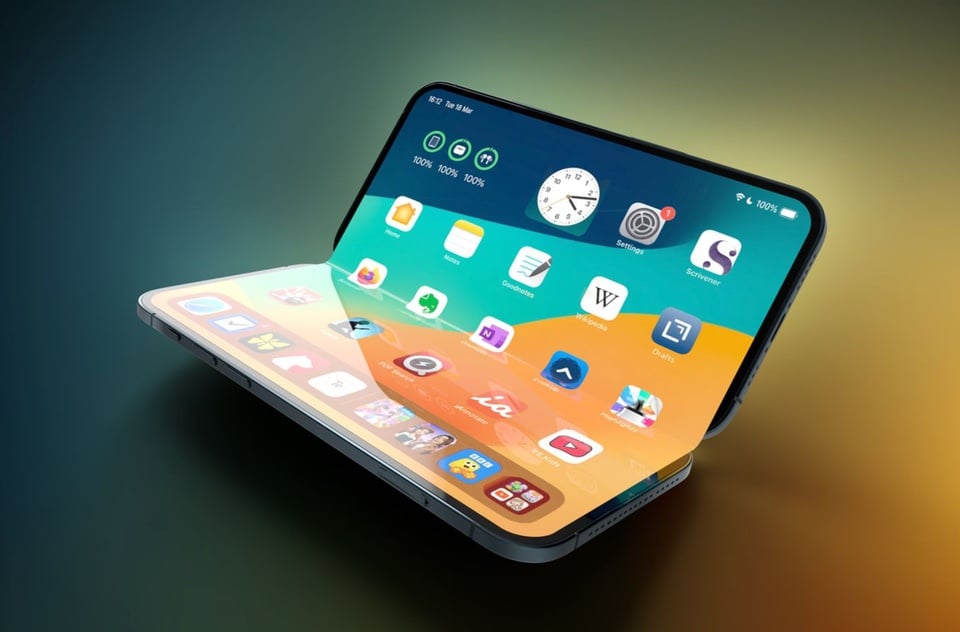
An illustrative image of a foldable iPhone. Photo: MacRumors . |
According to Business Korea , Apple's first generation of foldable iPhones will use OLED panels supplied exclusively by Samsung Display.
If the rumors are accurate, this would be a surprising strategic shift for Apple. Previously, the company typically sourced components from multiple suppliers to reduce costs while maintaining quality.
Apple chose Samsung because of its "technological advantages in minimizing screen imperfections." Meanwhile, other suppliers like LG Display and BOE were eliminated.
Since the launch of the first-generation Galaxy Fold in 2019, Samsung has had six years of experience in improving foldable OLED displays. This is a major advantage that helped the company secure an exclusive contract with Apple.
"For Apple, quality is prioritized over price when choosing component suppliers. Samsung is the most viable option," an industry source said.
Samsung Display is expected to supply screens for foldable iPhones starting late this year or early next year. This agreement could have a significant impact on the foldable OLED display market.
Last year, Samsung's market share fell to around 40%, mainly due to competitors such as China's BOE. If it starts shipping displays to Apple soon, the company's market share is projected to reach 70% in 2026.
Based on rumors, the foldable iPhone will have a book-like design similar to the Galaxy Z Fold. When folded, users will interact with a 5.5-inch outer screen, while the main inner screen will be 7.8 inches. The device is predicted to cost around $2,000 , directly competing with the Galaxy Z Fold.
According to MacRumors , the main screen of the foldable iPhone will have almost no notch. Instead of Face ID, Apple is expected to equip it with a Touch ID fingerprint sensor integrated into the power button.
Previously, the Weibo account of leaker Digital Chat Station predicted that the foldable iPhone would feature a camera hidden under the screen. However, this component is unlikely to support Face ID.
Back in March, analyst Ming-Chi Kuo also confirmed that foldable iPhones would integrate Touch ID instead of Face ID.
Therefore, integrating Face ID under the screen is very difficult because components such as the dot projector and infrared camera cannot function effectively if they are obstructed by the display panel.
Currently, Apple's plans for producing foldable iPhones are unclear. Analysts predict the company could produce 15 million units per year, a significant increase from previous estimates (9 million units).
Source: https://znews.vn/thong-tin-moi-ve-iphone-man-hinh-gap-post1546117.html


![[Photo] Prime Minister Pham Minh Chinh receives Philipp Rösler, Chairman of the Switzerland-Vietnam Economic Forum.](/_next/image?url=https%3A%2F%2Fvphoto.vietnam.vn%2Fthumb%2F1200x675%2Fvietnam%2Fresource%2FIMAGE%2F2026%2F02%2F03%2F1770121222295_ndo_br_dsc-8709-jpg.webp&w=3840&q=75)
![[Photo] President Luong Cuong receives Speaker of the Jordanian House of Representatives Mazen Turki El Qadi](/_next/image?url=https%3A%2F%2Fvphoto.vietnam.vn%2Fthumb%2F1200x675%2Fvietnam%2Fresource%2FIMAGE%2F2026%2F02%2F03%2F1770112220330_ndo_br_1-3704-jpg.webp&w=3840&q=75)


![[Photo] Prime Minister Pham Minh Chinh receives Philipp Rösler, Chairman of the Switzerland-Vietnam Economic Forum.](/_next/image?url=https%3A%2F%2Fvphoto.vietnam.vn%2Fthumb%2F402x226%2Fvietnam%2Fresource%2FIMAGE%2F2026%2F02%2F03%2F1770121222295_ndo_br_dsc-8709-jpg.webp&w=3840&q=75)






Comment (0)