


Although traditional onion varieties are somewhat affected by erratic weather patterns, this year's crop shows a bright spot thanks to a shift in crop structure to adapt to climate change. This step not only helps maintain production but also further affirms the pivotal role of purple onions in the local social welfare system.
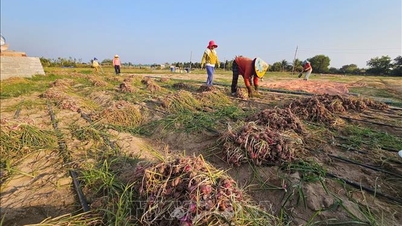
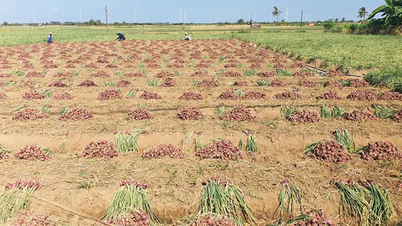
This year's Lunar New Year onion crop in Vinh Chau is facing significant pressure for farmers growing traditional onion varieties. According to Mr. Thai Van Tung, Director of the Samaki Agricultural Cooperative (Vinh Hai commune), prolonged heavy rains have delayed planting. Currently, many areas planted with the new crop have only been sown for about 10-15 days, resulting in almost no onions available for sale during Tet (Lunar New Year). The peak harvest season will only begin after Tet.
Adverse weather conditions not only delayed the planting season but also caused a sharp decline in early onion yields in many areas, with some regions achieving only 200-300 kg per 1,000 square meters. In addition, farmers are also bearing increased input costs as the price of onion seeds has soared to 100,000-150,000 VND per kilogram, approximately twice as high as in previous years.

The high cost of seeds has deterred many farmers from investing. As a result, the planted area of some cooperatives has only reached about 60-70% of the annual plan. Faced with this situation, the Samaki Cooperative is shifting to organic farming, using microbial products to reduce costs and increase the value of its products by 5-10% when sold in supermarkets.
Despite facing various pressures, the price of shallots on the market is fluctuating at a good level, from 25,000 to 30,000 VND/kg, which helps shallot farmers ensure profitability.
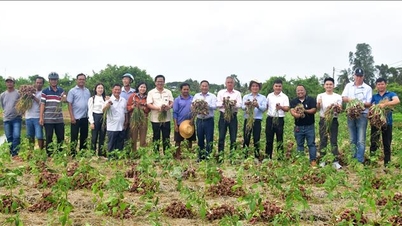
One "highlight" of this year's crop season is the expansion of the experimental cultivation area for the new Maserati F1 purple onion variety (Netherlands). Currently, the Vinh Chau Purple Onion Cooperative is involved in the production and consumption of this onion variety on an area of approximately 20 hectares.

According to Mr. Thach Dil, Director of the Vinh Chau Purple Onion Cooperative, the cooperative's early harvest of purple onions is estimated at 50-60 tons, mainly the Maserati F1 variety. In addition, the cooperative is also collaborating with local farmers to produce an additional 50-60 tons of local purple onions to ensure sufficient supply for the Tet (Lunar New Year) market.
Sharing his thoughts on the effectiveness of the new variety, Mr. Chau Xuan Long (Vinh Chau ward), a long-time purple onion farmer in the area, said that the Maserati F1 variety yields very promising results. Specifically, on an area of 1,000 m², this onion variety achieved a yield of 2.5 tons, significantly higher than the 1.7 – 1.8 tons of the local variety he cultivated last year.

Not only does the Maserati F1 onion variety excel in yield, but it also demonstrates the ability to significantly reduce pesticide costs for farmers. According to Mr. Chau Hai Khanh (residing in Vinh Chau ward), when planted at the same time, the Maserati F1 onion variety showed better weather resistance and fewer pests and diseases, resulting in higher yields. Meanwhile, the local purple onions of the same season suffered considerable damage due to the erratic rainy and windy weather.
Positive signals from pioneering households like Mr. Long and Mr. Khanh are creating great motivation for many other farmers to boldly switch to an adaptive and sustainable agricultural system. To encourage farmers to switch, some cooperatives have implemented a policy of guaranteeing the purchase of their produce at a stable price of 15,000 - 20,000 VND/kg.
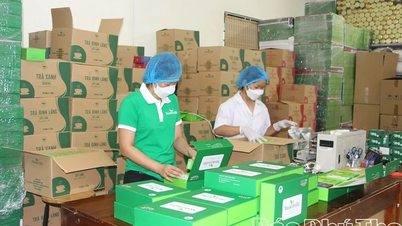
The early harvest of shallots not only brings profits to farmers but also creates vibrant livelihoods for thousands of local laborers, especially the elderly and women. At the purchasing and processing points of the Vinh Chau Shallot Cooperative, the atmosphere is always bustling with activities such as selecting shallots, bundling them, sorting, and packaging.

This activity provides a significant source of income for elderly workers who are no longer able to work in the fields. Ms. Ly Thi Tuyet (72 years old) shared that processing onions helps her earn more than 100,000 VND per day. Similarly, Ms. Thach Thi Lai (76 years old) and her daughter also earn 100,000 - 200,000 VND/day thanks to this light, cool, and flexible work.
For young workers, income from processing shallots is even higher. Workers involved in preliminary processing earn between 200,000 and 220,000 VND per day (women) and 250,000 to 270,000 VND per day (men). In addition, laborers hired to plant shallots in the fields also earn between 170,000 and 200,000 VND per day.
Mr. Thach Dil, Director of the Vinh Chau Onion Cooperative, said that the cooperative's activities are creating regular jobs for 30-40 local workers, helping many disadvantaged families with little land to earn extra income to cover their living expenses without having to leave their hometowns to work far away.
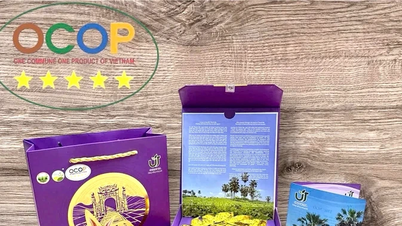
Blessed with the unique sandy soil of Vinh Chau, the purple onion has long established its position in the market thanks to its superior quality: beautiful, glossy bulbs, high crispness, a distinctive pungent aroma, and the ability to naturally preserve for a long time without the need for chemicals. This brand is not only certified by the Geographical Indication and the typical OCOP certification of Soc Trang province (formerly), but is also closely associated with the lives of the local people through three cultivation seasons each year, with the main crop area reaching up to 5,000 hectares.

However, to maintain that position in the face of climate change challenges, boldly switching to new, high-yielding varieties that are resistant to drought, salinity, and pests is key to unlocking modern farming practices and minimizing risks for growers.
Simultaneously, the model of production-consumption linkage along the value chain is truly becoming a solid foundation. The proactive role of cooperatives in guaranteeing output, bringing products into supermarket systems and modern distribution channels has helped farmers gradually escape the situation of bumper harvests leading to price drops, and stabilize their income. These synchronized efforts not only contribute to enhancing the value of agricultural products but also ensure sustainable livelihoods for thousands of ethnic minority workers, creating momentum for strong local economic development in the coming years.
Source: https://baotintuc.vn/kinh-te/thu-phu-hanh-tim-vinh-chau-dot-pha-tu-giong-moi-20260128072303009.htm


![[Photo] National Assembly Chairman Tran Thanh Man successfully concludes his participation in IPU-152](https://vphoto.vietnam.vn/thumb/1200x675/vietnam/resource/IMAGE/2026/04/18/1776502638199_vna-potal-chu-tich-quoc-hoi-ket-thuc-tot-dep-chuong-trinh-tham-du-ipu-152-8709975-jpg.webp)





















































































Comment (0)