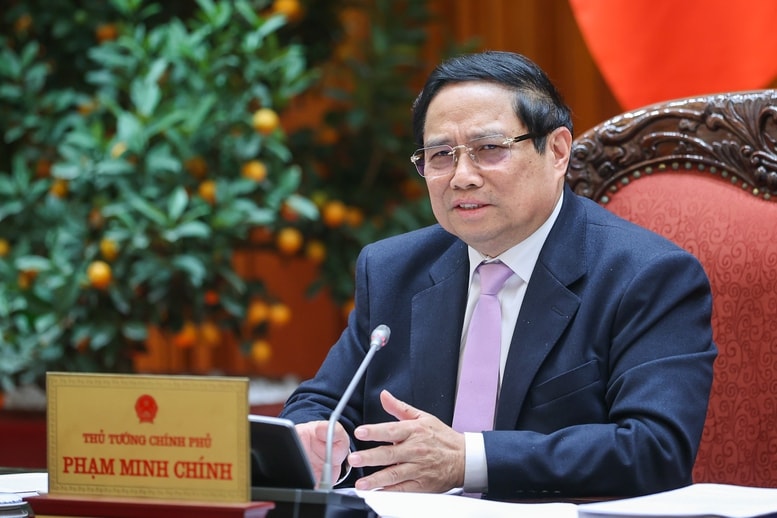
Prime Minister Pham Minh Chinh has just signed Directive No. 08/CT-TTg dated March 17, 2025, on strengthening the prevention and control of waste, unlocking resources, and promoting economic growth.
Accordingly, the Prime Minister requested that ministers, heads of ministerial-level agencies, government agencies, other central agencies, and chairpersons of People's Committees of provinces and centrally-administered cities focus on implementing the following tasks and solutions decisively and effectively.
Reaching a consensus on the role and importance of preventing and combating waste.
The Prime Minister requested that ministries, central and local agencies identify the prevention and combating of waste as a common task of the entire political system, requiring the responsible participation and contribution of all ministries, sectors, and localities.
Efforts to prevent and combat waste must be clearly demonstrated through commitments and plans with specific timelines and targets, focusing on thoroughly addressing the root causes of waste, and must be carried out regularly. The implementation plan must ensure five clear points (clear person, clear task, clear timeline, clear responsibility, clear results).
Linking the results of waste prevention and control efforts with the achievement of economic growth targets of 8% or more by 2025 and double-digit economic growth in the 2026-2030 period; identifying the results obtained from waste prevention and control efforts as an important resource, contributing to promoting growth drivers to achieve economic growth targets alongside other traditional growth drivers.
Focus on disseminating information about the Party's guidelines and policies, and the State's laws and regulations on preventing and combating waste. Actively promote exemplary individuals and good deeds; closely follow practical realities, and enhance information provision to contribute to stabilizing public opinion and creating a favorable environment for development.
Continue to review and urgently improve institutions, policies, and laws in the fields of socio-economic management and waste prevention and control.
The Prime Minister has assigned the Ministry of Finance to develop a draft Law on Savings and Combating Wastefulness to be submitted to the National Assembly for comments and approval at the 10th Session of the 15th National Assembly (October 2025). This aims to create a complete and synchronized legal basis for monitoring, inspecting, detecting, and strongly and deterrently handling wasteful acts, while not diminishing the motivation of officials who dare to innovate, think, act, and take responsibility for the common good, without self-interest.
At the same time, urgently gather opinions from ministries and agencies to finalize the National Strategy on Waste Prevention and Control, and report it to the Prime Minister for approval in March 2025.
The Ministry of Justice is urgently finalizing the decrees detailing the Law on the Promulgation of Legal Normative Documents of 2025 in a simplified form and submitting them to the Government before March 31, 2025, ensuring they take effect simultaneously with the law (April 1, 2025) to remove "bottlenecks" in the lawmaking process.


The Prime Minister instructed ministries and central agencies to urgently develop and finalize detailed regulations and guidelines for the laws and resolutions passed by the 15th National Assembly at its 9th extraordinary session and the 2024 Ordinance on Litigation Costs.
In addition, a review should be conducted to amend and supplement regulations on socio-economic management mechanisms and economic-technical norms that are no longer suitable for the country's development reality; focusing on areas prone to waste such as: state budget and public asset management; management and use of public investment capital; management of state capital invested in enterprises; construction; land, resources (including renewable resources), minerals, energy; credit, banking; organizational structure, human resource management…
Continue reviewing and improving the institutional framework for the application of information technology and digital transformation to minimize waste. Review and promptly amend outdated regulations to create a framework for new economic models such as the sharing economy, circular economy, and artificial intelligence.
Review wasteful and protracted projects and propose appropriate, timely, and effective mechanisms and policies for addressing them.
The Prime Minister has instructed ministries, central agencies, and localities to urgently update and supplement all contents and information required in the reports as stipulated in Official Dispatch No. 112/CĐ-TTg dated November 6, 2024, and Official Dispatch No. 13/CĐ-TTg dated February 8, 2024, of the Prime Minister on focusing on resolving outstanding and halted projects, and to urgently implement, complete, and put them into use to prevent waste and loss, as per Official Letter No. 2172/BKHĐT-PTHTĐT dated February 26, 2025. The reports should be submitted to the Ministry of Finance for compilation and reporting to the Prime Minister before March 25, 2025.
The Ministry of Finance, in coordination with the Government Office, will closely monitor and compile periodic reports, promptly proposing measures to address units and individuals that are slow or not seriously implementing regulations. For projects that remain stalled or have been suspended for extended periods, as reported by ministries and localities, the Ministry will urgently compile and clarify the causes, propose solutions, and assign competent authorities to resolve the issues definitively, ensuring the projects are put into operation and use as soon as possible, maximizing investment efficiency and preventing further waste of state and public resources.
The Prime Minister has instructed the Government Inspectorate to complete the inspection report on the investment project for the construction of the second facility of Bach Mai Hospital and the second facility of Viet Duc Friendship Hospital in Ha Nam province before March 31, 2025. At the same time, he directed the implementation of thematic inspections in several areas of management and use of the economy's resources, focusing on areas with the potential for significant losses and waste, in order to address violations and serve as a strong deterrent to other ministries, sectors, and localities regarding the effective management and use of public financial resources and assets.
Review and revise cumbersome administrative procedures that cause bottlenecks and waste resources; promote decentralization and delegation of power.
The Prime Minister requested that ministries, central and local agencies thoroughly implement the task of comprehensive reform, minimizing administrative procedures and compliance costs for citizens and businesses.
Promote decentralization and delegation of authority, coupled with enhanced supervision, inspection, and monitoring in the handling of administrative procedures to reduce intermediate layers and put an end to prolonged processing times across multiple agencies and units. Strictly implement the publication, transparency, and full disclosure of administrative procedures, and digitize records and results of administrative procedure processing as prescribed.
Accelerate the deployment of interconnected online public service groups, prioritizing the review and restructuring of integrated processes and provision on the National Public Service Portal; strictly implement the timely, complete, and accurate publication and disclosure of administrative procedures as prescribed; 100% of administrative procedure dossiers must be received and processed on the Ministry-level and Provincial-level Administrative Procedure Information System and synchronized with the National Public Service Portal. Promote the implementation of Project 06 at all levels, sectors, and localities.
Implement smart governance and digital transformation at all levels and in all sectors.



The directive states: Implementing smart governance and digital transformation is a breakthrough solution to improve the efficiency of state management, help to increase transparency of information, reduce losses and waste in the management and use of state resources, and is also an effective tool in preventing and combating waste at all levels and in all sectors.
Central and local ministries and agencies need to accelerate the application of digital technology, artificial intelligence (AI), and big data in management and supervision; at the same time, synchronize digital infrastructure and interconnect data systems between agencies to avoid the situation where each unit operates a separate system, leading to data fragmentation and difficulties in managing and exploiting information.
Strengthening coordination among ministries, sectors, and localities in the fight against waste.
The Prime Minister requested that coordination mechanisms be strengthened, data sharing be improved, and interconnected processing procedures be established among ministries, agencies, and localities to ensure that cases of waste and corruption are detected and handled promptly. At the same time, a strict monitoring mechanism is needed at all levels of government to prevent vested interests and cover-ups of wrongdoings, which could negatively impact the effectiveness of state management.
Inspection, auditing, and investigative agencies must coordinate closely and proactively intervene as soon as signs of violations are detected, avoiding delays that cause waste and public resentment.
TBSource: https://baohaiduong.vn/thu-tuong-chi-thi-day-manh-phong-chong-lang-phi-407493.html