

 |
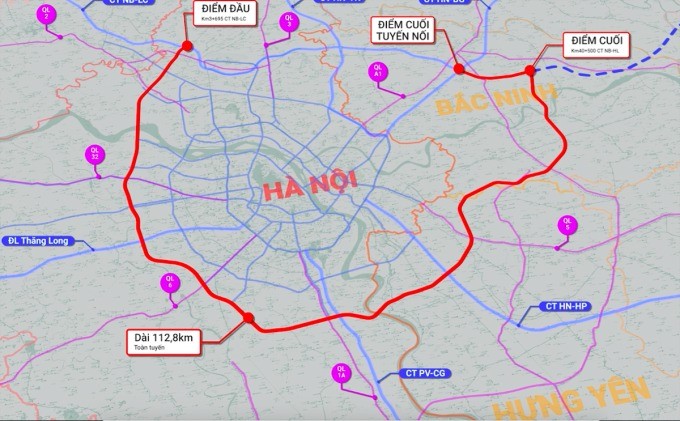
| Ring Road 4 Project - Capital Region. (Source: Hanoi People's Committee) |
"Leverage" for the development of the Capital Region
The Ring Road 4 - Capital Region construction project is a nationally important project, approved for investment by the National Assembly in Resolution No. 56/2022/QH15 dated June 16, 2022, and implemented by the Government in Resolution No. 106/NQ-CP dated August 18, 2022.
The current planning area of the Hanoi Capital Region encompasses Hanoi City and nine provinces: Hai Duong, Hung Yen, Vinh Phuc, Bac Ninh, Ha Nam, Hoa Binh, Phu Tho, Bac Giang, and Thai Nguyen. This is one of the key economic, social, and political regions of the country. However, the inter-regional transportation infrastructure has not yet met actual needs. Due to these infrastructure limitations, Resolution No. 56/2022/QH15 of the National Assembly sets the goal of investing in the construction of the Hanoi Capital Region's Ring Road 4, a key inter-regional economic ring road connecting the capital with Hung Yen, Bac Ninh, and other localities in the region.
According to the leaders of the Hanoi Department of Transport, the framework of the Capital Region's transport infrastructure, with Hanoi as the central core, is designed with a main framework consisting of 7 expressways: Hanoi-Lao Cai; Hoa Lac-Hoa Binh; Hanoi-Thai Nguyen; Hanoi-Hai Phong; Cau Gie-Ninh Binh; Thang Long Boulevard; and Noi Bai-Bac Ninh. Notably, all 7 of these main arteries are seamlessly connected by Ring Road 4.
"The new Ring Road 4 is the main backbone of the Capital Region's transportation network. In the context of not yet being invested in and constructed, all the pressure falls on Ring Road 3 – a road that was originally just a ring road within the central urban area, and is reluctantly having to shoulder this special role," a leader of the Hanoi Department of Transportation shared.
According to Vice Chairman of the Hanoi People's Committee Ha Minh Hai, the city has been focusing on implementing the investment project to build Ring Road 4 - Hanoi Capital Region; the project commenced on June 25, 2023, and aims to be basically completed in 2026 and put into operation in 2027.
Vice Chairman Ha Minh Hai added: "Hanoi City identifies this as a concrete step in focusing on one of the three strategic breakthroughs (developing synchronous infrastructure, prioritizing the development of connecting transportation infrastructure in the short term)."
At the same time, Mr. Ha Minh Hai also shared three lessons learned from the implementation of the National Assembly's Resolution on investment in the construction of Ring Road 4 - Hanoi Capital Region. The city has delegated the task of land clearance, compensation, and resettlement support to the districts and communes.
Vice Chairman of the Hanoi People's Committee, Ha Minh Hai, stated that the Politburo issued Resolution No. 15-NQ/TƯ dated May 5, 2022, on the direction and tasks for the development of Hanoi Capital City until 2030, with a vision to 2045. This resolution identifies the goal of building and developing the capital city into a center and driving force for the development of the Red River Delta region, the Northern key economic region, the Capital region, and the entire country. The objective is to become a highly competitive city in the region and the world by 2030, striving to develop to the level of capital cities in developed countries in the region.
Expanding the scope of development
According to experts, investing in the construction of Ring Road 4 will help expand development space, distribute urban pressure in Hanoi, and contribute to the formation of a chain of new, highly potential urban areas. Approximately 6,500 hectares of land west of Ring Road 4 are currently being studied for planning adjustments. Satellite cities in the districts of Me Linh, Dan Phuong, and Hoai Duc, as well as many urban and industrial zones along the route in the provinces of Hung Yen and Bac Ninh, will develop rapidly when the Ring Road 4 project is implemented. Simultaneously, it will resolve numerous traffic congestion points such as the southern gateway, Thanh Tri Bridge, National Highway 2, and National Highway 5…
Notably, Noi Bai Airport – the international air gateway of the entire Capital Region – will be directly connected to neighboring provinces and cities, minimizing logistics costs for transportation businesses, reducing traffic pressure at Hanoi's gateways, and contributing to improving the competitiveness not only of Hanoi but also of related provinces and cities in the Capital Region and the country as a whole.
Expressing his views, Mr. Dao Huy Hoang from the Institute of Transport Science and Technology stated that Ring Road 4 is essentially a circular road with the main function of connecting different regions. At the same time, it is also a road located on the outer ring of the city.
Therefore, according to Mr. Dao Huy Hoang, it is necessary to focus on systematically developing the main, radial arterial roads. If these axes are properly planned, with wide cross-sections and appropriate spacing, they will be a core factor in attracting residents away from the inner city, developing the urban area, and simultaneously resolving the current traffic congestion.
Addressing this issue, architect Tran Huy Anh, a Standing Committee member of the Hanoi Architects Association, commented that after the completion of Ring Road 4, it will attract residents, helping to alleviate overcrowding in the inner city. According to Mr. Anh, this is an opportunity, but also a challenge, as it faces the risk of spontaneous urban development and illegal construction spreading like an "oil slick." Mr. Huy Anh also emphasized that the city needs to quickly develop a specific plan and strictly manage the land around the road.
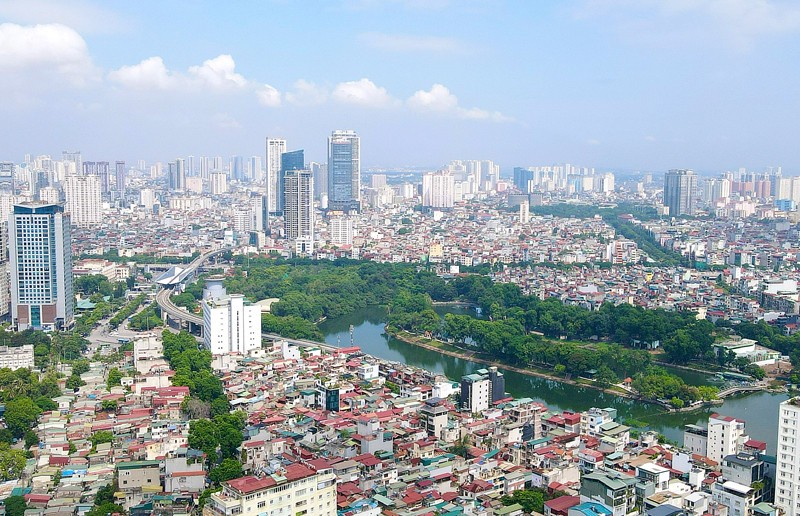 |
| Hanoi city is maximizing the intellectual resources of its team of experts and scientists to improve the quality of urban planning. (Source: Hanoimoi) |
"Constructing the Capital's Ring Road 4 is absolutely necessary."
To ensure the project is completed on schedule, with guaranteed quality and efficiency, experts believe that all related issues need to be carefully considered. These include financial efficiency, socio-economic efficiency, investor rights, connectivity and traffic organization plans, land clearance, residents, environment, landscape, and spatial planning.
Expressing his views, Dr. Nguyen Van Hau from the University of Transport assessed that the construction of the Hanoi Capital Region's Ring Road 4 is extremely necessary and urgent. Currently, Hanoi's Ring Road 3, despite having 4 elevated expressway lanes and 6 to 10 lanes on the parallel road below, still experiences serious traffic congestion due to the extremely high volume of traffic. With such a large volume of traffic, applying the public-private partnership (PPP) model is quite suitable for the Ring Road 4 project, but it is difficult to offset the investment costs for the expressway section.
Dr. Nguyen Van Hau emphasized: "Based on my personal experience, for BOT (Build-Operate-Transfer) projects in Vietnam, if the total investment is below 12,000 billion VND, the financial plan is feasible at the present time. Projects with financial plans exceeding 20,000 billion VND are not feasible, regardless of traffic volume, because the interest costs are too high."
According to Mr. Hau, the BOT investment model can only be implemented when there is coordination between the State and investors to jointly participate in the project. Currently, the Ring Road 4 expressway project mainly runs on elevated sections, with the land under the bridges reserved for future traffic. It is possible to study the construction of an underground expressway, using barriers, and only building overpasses at points where obstacles, intersections, and rivers need to be overcome, instead of mostly using elevated viaducts as currently done. This solution would ensure maximum reduction in investment costs and guarantee the financial viability of the BOT investment model.
Meanwhile, Dr. Pham Van Khanh, from the Vietnam Construction Association, stated that assessing the impact of construction projects is a crucial task, especially for large projects, due to the significant capital investment, large quantities of materials, labor, and construction machinery used, and their major impact on economic and social development, employment, and the environment.
Presiding over a working session with the Steering Committee for the implementation of the Ring Road 4 - Hanoi Capital Region investment project in Hanoi on March 14th, Mr. Dinh Tien Dung, Member of the Political Bureau, Secretary of the Hanoi Party Committee, and Head of the Steering Committee for the implementation of the Ring Road 4 - Hanoi Capital Region investment project, requested that members of the Steering Committee for the project in Hanoi; and leaders at all levels and sectors continue to participate with the highest determination and sense of responsibility.
Hanoi Party Secretary Dinh Tien Dung emphasized: “I want to emphasize that once construction begins, it must be carried out immediately and continuously. The investor must require the contractor to prepare all necessary machinery and materials to organize the construction. All levels, sectors, agencies, units, and individuals must consider the project's implementation as progressing according to the National Assembly's resolution and Resolution No. 15-NQ/TW dated May 5, 2022, of the Politburo, which aims for basic completion by 2026 and commissioning from 2027; consider this a political task; having already made the commitment, we must be even more determined to achieve it.”
The Hanoi Capital Region Ring Road 4 project has a total length of 112.8km. The starting point of Ring Road 4 connects to the Hanoi-Lao Cai Expressway, and the end point connects to the Noi Bai-Ha Long Expressway. The project passes through Hanoi City (58.2km), Hung Yen (19.3km), Bac Ninh (25.6km), and a connecting route (9.7km). The project is being invested in using public capital combined with a public-private partnership (PPP) model; it is divided into 3 project groups with 7 component projects and has a total investment of VND 85,813 billion. The project's investment preparation and implementation began in 2022, with basic completion expected in 2026 and operation commencing in 2027. |
Source












































































Comment (0)