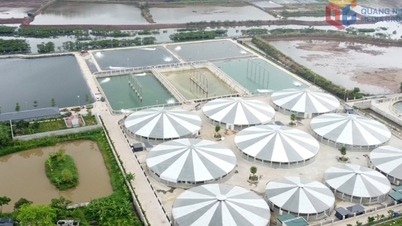
Walking along the internal road leading to the agricultural production area, one can easily sense the appearance of a well-planned, clean, and beautiful production zone. Rows of greenhouses, livestock pens, fish ponds, and a centralized processing station are arranged scientifically , forming a synchronized and modern system. The effectiveness of Project QN-21 is evident in the yield, in every lush green vegetable patch, in every scientifically operated livestock area, and especially in the quality of the soldiers' daily meals.
In implementing the Project, Regiment 102 regularly briefed its officers and soldiers on the role and significance of agricultural production in the new situation. Lieutenant Colonel Dang Sy Ngoc, Commander of Regiment 102, said: “The Party Committee and the Regiment's command have developed a specialized resolution, assigned specific tasks to each agency and unit; and organized the implementation synchronously from planning the agricultural production area, deploying forces to managing and operating production.”
To ensure effective implementation, the Regiment established a specialized Production and Processing Team consisting of 13 members. Livestock farming, fish farming, and centralized processing were directly managed by the Logistics and Technical Department; the main units were responsible for crop cultivation under the technical guidance of the specialized department.
 |
Officers and soldiers of Regiment 102 (Division 308, Corps 12) are tending to their thriving vegetable garden. |
The regiment has invested in a comprehensive infrastructure to support production, including: two broiler chicken coops with an area of 700m² and a capacity of 7,000 chickens; a greenhouse for growing vegetables with an area of 1,024m²; a net house for growing vegetables with an area of 4,140m²; and an automatic irrigation and drip irrigation system for over 21,000m² of gardens and trellises. The unit has also built a centralized processing station with an area of 260m² along with a synchronized system of yards, roads, and wastewater treatment tanks, meeting the requirements of production in the direction of circular and modern agriculture .


To date, the total area of the agricultural production zone has reached over 76,000 m², including 23,000 m² of fish ponds and over 42,000 m² of vegetable gardens and climbing plants. The scale of livestock farming remains stable with 250 breeding sows, 1,280 fattening pigs, 50,000 egg-laying poultry, and 7,000 meat poultry; in addition, the unit is also experimenting with ostrich farming.
The greenhouse and netting systems, along with automated irrigation, have proven remarkably effective, helping to increase productivity, reduce labor costs, and mitigate the impact of weather conditions. In the greenhouse area, the unit grows high-quality, off-season crops such as cantaloupe, watermelon, and cucumber; the netting houses focus on short-term vegetables; and the trellis area cultivates zucchini, loofah, and long beans according to the seasons.
 |
| Harvesting chicken eggs in the concentrated poultry farming area of Regiment 102 (Division 308, Corps 12). |
Since the introduction of the greenhouse and automatic irrigation system, vegetable cultivation has become much easier, resulting in uniform growth, fewer pests and diseases, and stable yields. Seeing the lush green vegetable beds supplying the unit's mess hall, everyone is delighted. Thanks to this, for many years, Regiment 102 has consistently ensured 100% of its vegetable needs for the troops, and at times has even provided assistance to other units in the area.
In livestock farming, Regiment 102 strictly maintains disease prevention and control measures; closely coordinating with veterinary forces and specialized agencies to control the disease situation. Livestock farms are organized into batches, ensuring they operate at the designed capacity, maintain environmental hygiene, and ensure disease safety.
Alongside production, the centralized processing station is effectively utilized for slaughtering, preliminary processing, and processing of food products such as sausages, meatballs, fish cakes, tofu, bean sprouts, pickled vegetables, etc. The mess halls maintain a unified menu, ensuring absolute food safety and hygiene. The actual food rations for the soldiers consistently exceed the standards set by the Ministry of National Defense .



Captain Vuong Duc Giang, Assistant Quartermaster of Regiment 102, said: “At the centralized processing station, we strictly implement a closed-loop process from receiving raw materials to processing food. The prices of products supplied to the mess hall are always tightly controlled, 10% to 20% lower than market prices, contributing to maintaining the stable quality of troop nutrition.”
Thanks to the synchronized implementation of Project QN-21, the production and processing work at Regiment 102 has achieved many positive results. The production of green vegetables, meat, eggs, and basic processed products adequately meets the regular food needs of the troops; the quality of meals has improved significantly, and the material and spiritual lives of the troops have been increasingly enhanced. Through the decisive involvement of the Party committee and commanders, and the self-reliance and self-improvement spirit of the troops, the Regiment has successfully built a modern, closed-loop centralized production and processing system. This is an important foundation for the unit to continue promoting the emulation movement "Building a unit that excels in troop feeding and good troop supply management," maintaining a high percentage of healthy troops, and being ready to receive and successfully complete all assigned tasks.
Source: https://www.qdnd.vn/quoc-phong-an-ninh/xay-dung-quan-doi/thuc-tuc-binh-cuong-o-trung-doan-102-1045655