


 |
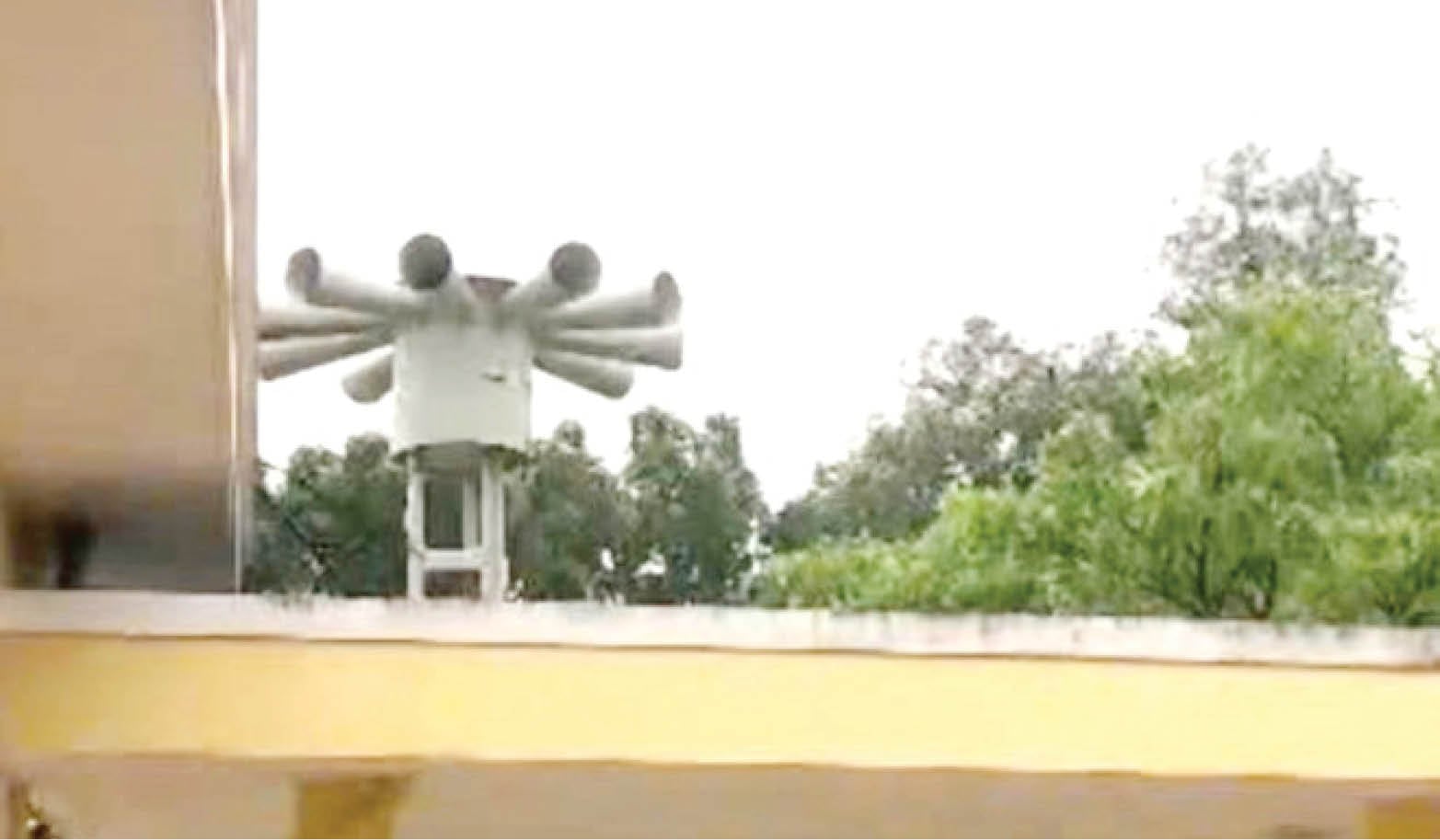
| A siren warning of heavy rain and flooding has been placed at the Hue City administrative building. Photo: nhandan.vn |
Warning sound
For the first time in 2025, at 6 PM on October 26th, Hue city activated four sirens to signal a major flood warning, helping people in downstream areas respond in time. And in just one month, there were four such instances – a record number – of the terrifying sirens heard by Hue residents. While called "terrifying," in reality, the sirens are absolutely essential for a place like Hue, which frequently experiences annual floods (lyrics from the song "The Sound of the Perfume River" by composer Pham Dinh Chuong).
Installed at the city's administrative building, the Hue Water Resources Management and Exploitation Company Limited, Huong Tra, Quang Dien, operates the flood warning siren system in two ways: Firstly, automatically remotely via Wi-Fi network controlled by the Smart City Monitoring and Operation Center. Secondly, manually on-site in case of communication loss. This is considered a smart solution for adapting to floods.
The wailing sirens reminded me of the historic flood exactly 26 years ago. Back then, information about the devastating floods wasn't readily available, so even on the afternoon of November 1st, 1999, when the floodwaters were already high, I still tried to finish my information technology class. Then, around 7 PM, on my way home to Thuy Phuong (Thanh Thuy ward), I fearfully felt the impact of the flood as the water on National Highway 1A surged, at times threatening to sweep away both my motorbike and me. By the time I got home, the floodwaters had reached my yard… In the following days, the flood raged, there were power outages, and information was completely cut off. Everyone relied mainly on their old, easily rechargeable mobile phones.
Living together
I still believe that November 13, 1995, was a strategic moment when, at an emergency meeting in Dong Thap following the historic floods in the Mekong Delta, Prime Minister Vo Van Kiet stated: "We can no longer fight floods like we're fighting an enemy. We must learn to live with floods." Then, in 2000, after directly overseeing flood and storm prevention and control in Central Vietnam, especially in Hue, at the Mekong Delta Flood and Storm Prevention and Control Conference ( Can Tho , August 2000), Prime Minister Phan Van Khai officially affirmed: "Our strategy from now on is to live with floods."
For over a quarter of a century, the whole country in general and Hue in particular have gradually strived to "live with floods." For example, in Hue, high-rise buildings for housing and public facilities (housing, health centers, etc.) are becoming increasingly common. Programs to build "Flood-Resistant Houses" or models of "Communities Living with Floods" are being implemented in low-lying areas. Flood control structures such as dikes, embankments, and reservoirs have been constructed. Hue also focuses on building and reinforcing embankments, dikes, regulating reservoirs, and temporary flood reservoirs within the city; dredging, clearing, and upgrading the flood drainage system.
Aiming for long-term coexistence with floods and storms, Hue is implementing economic restructuring in frequently flooded areas, shifting from rice cultivation to aquaculture, ecotourism, and mangrove reforestation; removing structures that obstruct natural water flow; and replanting upstream forests. In particular, the city center of Hue is being re-planned according to the principle of "living with floods"; new urban areas are developing towards the south and west, in higher, drier areas.
Intelligent adaptation
Developments in 2025 show that floods and storms are becoming increasingly "fierce," with greater frequency, intensity, and scope of impact, causing serious damage. The concept of "living with floods," from the 1990s and 2000s, remains valid, but is now being upgraded to "smart adaptation to floods."
The Hue-S platform, developed and operated by the Smart City Monitoring and Management Center, is a prime example. This is a super app integrating monitoring of river and hydroelectric reservoir water levels and online cameras. Citizens can receive alerts via phone, track real-time flood situations, and even make emergency payments. By 2025, Hue-S aims to become a platform connecting the digital ecosystem, facilitating rapid coordination between the government, the community, and rescue forces.
Hue has also integrated AI into disaster forecasting and warning, resulting in higher accuracy compared to traditional methods. More recently, the ZCRA (Zero Carbon Resilient Adaptation) project, in collaboration with ISET and Plan International, has improved early flood warnings in Hue using sensor technology and big data analytics software, focusing on vulnerable communities. It has improved forecasting capabilities in heavily flooded communes and reduced response times.
In Hue, "smart adaptation to floods" is understood in its oldest sense, not only as a warning system but also as proactive measures such as stockpiling food and medicine, developing survival skills in the event of floods, and mobilizing forces for evacuation (selecting suitable locations) and rescue. Importantly, "smart adaptation to floods" doesn't forget the ancient wisdom about the unity and cooperation of the entire community: "When floods engulf the whole village, to avoid them, husband and wife must work together."
Clearly, only when every citizen, every agency, every generation works together, protects the headwater forests, raises house foundations, opens up river channels for water flow, and shares a warning message on Hue-S… will Hue truly adapt – not just to coexist, but to live safely and sustainably amidst unpredictable storms and floods. The sirens will sound many more times. But as long as we continue to work together like husband and wife did before, no matter how severe the flood, the village will not be submerged.
Source: https://huengaynay.vn/chinh-polit-xa-hoi/tieng-coi-hu-bao-con-lu-du-160626.html


![[Photo] Prime Minister Pham Minh Chinh receives the Director General of TASS News Agency (Russian Federation)](https://vphoto.vietnam.vn/thumb/1200x675/vietnam/resource/IMAGE/2026/02/25/1772024599891_dsc-8041-jpg.webp)

![[Photo] Prime Minister Pham Minh Chinh presides over the meeting of the Steering Committee for the Development of Science, Technology, Innovation, Digital Transformation and Project 06.](https://vphoto.vietnam.vn/thumb/1200x675/vietnam/resource/IMAGE/2026/02/25/1772024613089_1772024091685-jpg.webp)











































































Comment (0)