

In South Africa , in experiments, recordings of human voices frightened wild animals more than the roar of lions or gunshots.
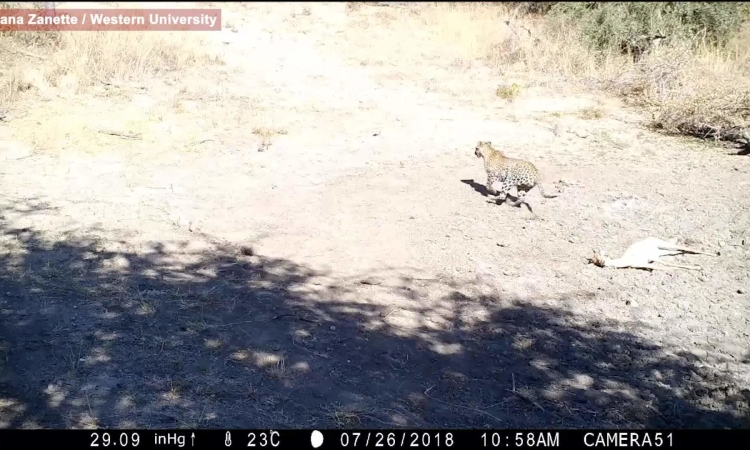
Many animals quickly flee upon hearing human voices. Video : IFL Science
Giraffes, elephants, antelopes, rhinos, leopards, and more than 10 other animal species in Greater Kruger National Park, South Africa, flee at twice the rate of hearing human voices from loudspeakers compared to lions, according to research by expert Michael Clinchy at Western Ontario University, Canada, and his colleagues. The study was published in the journal Current Biology on October 5th.
"Theoretically, this is a protected area, so these animals shouldn't be afraid of people. But new research shows that whether you're a wildlife visitor, a poacher, or anyone else, everyone is treated the same. The presence of a human is threatening, regardless of who you are," Clinchy said.
Previously, he and his colleagues discovered that fear of predators can cause animal populations to decline. To find out which predator was the most fearsome, the research team decided to experiment with humans and lions – animals often considered the most fearsome land predators.
The team installed speakers and cameras on trees about 10 meters from the animals' paths, near 21 lakes in Greater Kruger National Park, home to one of the world's largest lion populations. When the animals approach a lake, the speakers automatically play one of four recordings at the same volume. The recordings include calm conversations between men and women in the local dialect, lion growls, gunshots (possibly accompanied by dog barking), and calls from local birds such as woodpeckers and forest owls.
The research team recorded the reactions of 19 carnivorous and herbivorous species to audio recordings, totaling approximately 15,000 videos. They found that animals panicked more than any other sound. Upon hearing human voices, they fled 40% faster than at the sounds of lions or hunting, abandoning waterholes even during the dry season. The only species that did not flee upon hearing human voices was the lion. "Lions don't run away from anything," he said.
The new findings build upon previous research on the strong fear responses of animals to humans in North America, Europe, Asia, and Australia, highlighting the negative impact that human presence has on wildlife habitats. "The fear of humans alone can lead to serious ecological consequences," Clinchy observed.
However, this new discovery also has the potential to yield positive results. Recordings of human voices could help deter wildlife from encroaching on fields or livestock farms, and even protect rhinos, preventing them from foraging in areas prone to poaching.
Thu Thao (According to New Scientist )
Source link
![[Image] Close-up view of the interchange connecting the two expressways and Long Thanh Airport.](https://vphoto.vietnam.vn/thumb/1200x675/vietnam/resource/IMAGE/2026/05/25/1779703378210_ndo_br_z7863716673926-224453a31600126cce10622af6290afd-4549-jpg.webp)
![[Image] Hanoi's urban life under the challenge of a "scorching hot" environment](https://vphoto.vietnam.vn/thumb/1200x675/vietnam/resource/IMAGE/2026/05/25/1779706979265_nang-nong-t5-2026-minh-duy-7-4636-jpg.webp)






































































































Comment (0)