|
| Michael performs traditional West African music. |
In that special encounter, the Djembe drums of West Africa blended with the Hue folk music, creating a fascinating dialogue between two seemingly distant cultures. Beyond performing traditional African rhythms, Michael also shared his journey in pursuing world folk music , as well as his special affection for Hue and its folk music.
Journey from West Africa
Michael Schmidt Kanté's connection with music began with volunteer work. At the age of 18, he joined a French organization that went to Senegal to help find water sources for the local people. That five-week trip became a significant milestone in his life.
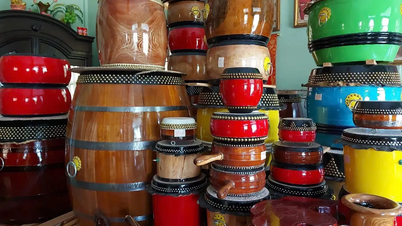
“I met Africans in Senegal and then fell in love with African music,” Michael shared. From there, he spent many years studying West African culture, especially the art of Djembe drumming, a traditional percussion instrument popular in countries like Mali, Guinea, Burkina Faso, and Niger.
Michael said he has spent about 20 years traveling, interacting, and performing music in many countries in Africa and Asia. Of these, West Africa is where he has spent the most time. "For Djembe, West Africa is the most interesting place," he said.
Five years ago, when instability in Mali made living and working as a musician in the region difficult, Michael turned his attention to Asia. While searching for a community of Djembe enthusiasts, he coincidentally connected with a Vietnamese man in Da Nang who specialized in importing and distributing Djembe drums from Africa.


From then on, Michael began participating in community activities related to the Djembe in Vietnam. He regularly teaches people who love this instrument in Da Nang.
Choose Hue as your destination.
Interested in traditional music, his curiosity and love for indigenous musical forms led him to the Hue Folk Song Club. There, the French artist listened to melodies deeply rooted in the identity of the ancient capital and was introduced to traditional West African rhythms through the Djembe drums.
Despite differences in origin, language, and cultural context, the encounter between Djembe and Hue folk music creates a harmonious blend. On one side are the powerful, communal rhythms of West Africa; on the other are the profound, refined melodies of the Perfume River and Ngu Mountain region. This very difference opens up an opportunity for music lovers to better understand each other's cultural values.
Artist Michael has a special affection for Hue. Over the past five years, he has returned to Vietnam many times and often chooses Hue as his place of extended stay. Each time, he stays for about six months before moving on to other locations or to Laos. "Hue is my favorite city," Michael said.
According to him, the most appealing thing about Hue is its tranquility. Unlike the bustling pace of life in Hanoi or Ho Chi Minh City, Hue offers a sense of relaxation and closeness to nature. "I enjoy cycling. It only takes about 15 minutes to get out of the city center and to the rice fields," he shared.
At 65, Michael still maintains his habit of cycling dozens of kilometers every day. Some days he cycles 50km, even 100km, to explore the local landscape. On the day he attended the Hue folk music performance, he had just cycled to the beach to admire Hue's new bridge, the Thuan An estuary bridge. For this French artist, Hue is not just a tourist destination but also a place to slow down, connect with nature, and meet new friends.



Michael plans to stay in Hue for another month and a half before returning to Paris to explore life there, meet friends, and experience the culture.
The encounter between the Djembe drums and Hue folk songs is therefore more than just a simple musical exchange. It is also a testament to the connecting power of art, where people from different cultures can still find common ground through traditional music.
Source: https://huengaynay.vn/van-hoa-nghe-thuat/tieng-trong-djembe-o-hue-167078.html
![[Photo] A phone-free summer afternoon at the village library](https://vphoto.vietnam.vn/thumb/1200x675/vietnam/resource/IMAGE/2026/06/27/1782551770949_anh-1-jpg.webp)

![[Photo] Thousands of people participate in a run to show their support for the campaign "Sharing a common determination to build drug-free communes, wards, and special zones".](https://vphoto.vietnam.vn/thumb/1200x675/vietnam/resource/IMAGE/2026/06/27/1782554475933_0673e2a3df7b5e25076a-8283-jpg.webp)