



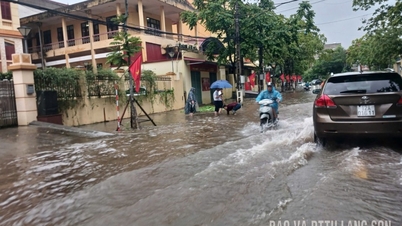
That year, Diep was three years old. One stormy night, a tempest raged like the wrath of nature. The wind toppled clumps of bamboo and banana trees, and the thunder roared deafeningly. Diep was too young to understand what was happening, she only knew to cling tightly to her mother. Her father stood at the door, locking the bolts, trying to keep the small house from being swept away by nature's fury. Although the wind continued to howl, he couldn't stay awake forever and had to go to sleep as dawn was approaching. That night, all four members of Diep's family slept on one bed.
In the night, a flash of lightning ripped across the sky, thunder roared at the gable of the house, followed by a long, terrifying silence. That horrific night claimed both her parents, leaving the two siblings, one five and the other three, orphaned and alone in the world.
The next morning, when the sky cleared and the clouds dispersed, the cicadas began to sing again in the rain-soaked trees. The village children ran out into the yard to play as if nothing had happened. Only Diep sat huddled on the porch, her big eyes wide with bewilderment, constantly muttering, "Mommy… Mommy…!"
Day after day, Diep grew up in the loving care of her grandparents. The old house was still there, but without the laughter of her parents, everything felt empty and cold. Her grandparents loved her dearly, pouring all their affection into making up for it, but there are voids that even the greatest love can never fill.
At the edge of the village, people still spoke of Diep's father as a kind and gentle man. They also mentioned his childhood friend – the one who grew up with him, sharing the hardships of poverty. After Diep's parents' funeral, that friend and his family left the village. Apparently, he followed his older brother to the border region of Lang Son to start a new life. Since then, news from him has been infrequent, and gradually became less and less.
Years passed, and that name faded into oblivion. Only Diep was unaware that her life was still silently connected to a thread of destiny from that bygone era.
When Diep got into university, the whole village was celebrating. She was the pride of her grandparents, a testament to the tireless efforts of a child who had lacked everything. The city where Diep studied opened up a completely different world before her eyes. There were bustling streets, towering buildings, and strangers. Among them was Son.
Sơn and Diệp attended the same school and department, but Sơn was one year ahead of Sơn. If it weren't for an impromptu inter-year group meeting, they probably would never have noticed each other. Sơn wasn't the outgoing type. He was quiet, reserved, always appearing at the right time and disappearing when the task was finished. Diệp, on the other hand, was introverted and rarely socialized, partly due to her circumstances and partly because she carried a sadness that wasn't easily shared.
Their first conversation was just a brief exchange about shared activities and studies, nothing special. Subsequent conversations were similar; they were like two parallel lines, occasionally intersecting due to academic matters, then continuing on their separate paths.
It wasn't until their third year, when they both attended a major departmental conference, that things began to change. Long meetings, debates, evenings spent refining every small detail… The distance between them gradually narrowed. Sơn realized Diệp wasn't as cold as she appeared. She was just trying to hide her inner wounds. Diệp, in turn, realized that behind Sơn's quiet demeanor was a warm, patient, and trustworthy person.
Their feelings developed quietly, without any dramatic declarations of love. One day, when Diep was tired after her part-time job, Son silently gave her a bottle of water and said, "You don't have to be strong alone." Those words were like a drop of water falling into the barren land in Diep's heart. From then on, they naturally entered each other's lives. Diep studied and worked simultaneously, attending lectures during the day and working at a restaurant at night, sometimes even on weekends. She didn't have much time for Son, but he never complained. He waited for her after each shift, took her home, sometimes just to walk a short distance together.
One summer afternoon, the cicadas chirped loudly throughout the schoolyard, and Diep suddenly fell silent. "You don't like the sound of cicadas?" Son asked.
Diep shook her head slightly. After a long pause, she said, "I lost my parents on a day when cicadas were chirping like this."
Son didn't ask any more questions; he just stood silently beside her. There are pains that don't need to be fully expressed, as long as someone understands.
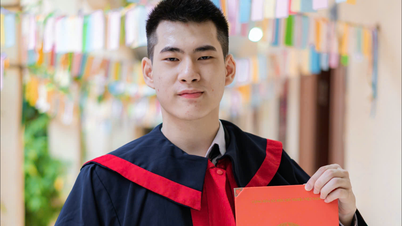
Then the day of Son's graduation arrived, and he received an offer to work in Lang Son – where his family lived. A border region with towering mountains, where his childhood was intertwined with winding roads and bitterly cold winters. He wanted to return not only for work, but also because he wanted to build a stable life, and in that life, he wanted to have Diep.
One early summer afternoon, as the sound of children's voices rang out in unison, Son took Diep's hand and said, "Will you come to Lang Son with me?"
Diep remained silent for a long time, then spoke, "And what about my grandparents...?"
"We'll figure it out. But I want you in my future," Sơn said.
It wasn't a flowery proposal, but it was enough for Diep to understand.
She nodded.
The bus ride to Lang Son carried both hope and anxiety.
Sơn's family welcomed them politely, but something felt incomplete. Sơn's mother looked at Diệp with a scrutinizing gaze. His father was taciturn, only asking a few polite questions.
After the meal, the atmosphere became heavy.
"Given her circumstances, would she be suitable?" – Sơn's mother said when Diệp wasn't around.
"Our family isn't exactly well-off either..." – Sơn's father mused.
Son stood silently. He didn't blame his parents, but he also didn't want to give up.
The following days were a series of waiting. Diep maintained a calm demeanor, but inwardly she was filled with unease. She was accustomed to being rejected because of her circumstances. She didn't blame anyone, she just felt sad.
Everything changed one evening when Sơn's father casually asked, "What did your parents do for a living?"
Diep softly replied, "Yes, my father is a carpenter... my mother sells goods at the market. My father's name is..."
As soon as she finished saying the name, Mr. Son suddenly froze.
"What did you say… your father’s name is?"
Diep repeated.
The teacup in his hand suddenly fell to the ground.
"Was there... once upon a time in the village... a close friend named...?"
Diep nodded.
The atmosphere froze. After a long while, Son's father suddenly stood up, his voice trembling: "Oh my God... you are... his child..."
Son's mother was astonished.
Sơn was also speechless.
The stories of the past are retold. Two men who were once childhood friends, who had promised their children would be together, but their lives took different paths after the events of that year.
"For so many years… I haven't dared to come back… because of the haunting pain…" – Sơn's father choked up.
He looked at Diep, his eyes red with tears: "You... have suffered so much already..."
The next day, the atmosphere in Son's family changed noticeably. But what changed most… wasn't their attitude, but the way they viewed life.
That evening, after a late dinner, Son's father called Diep over and gave her an old, worn-out wooden box. "I've kept this... for over twenty years."
When the leaf opened, inside was a wooden comb, weathered by time, crudely but carefully carved.
"A long time ago… my father made this for you. He said that when your daughter grows up, he'll give it to her as a gift when she comes to visit."
His voice choked up.
"But then… I no longer had the chance to do that with your father."
Diep's hands trembled. For the first time, she felt that the past was not just about loss… but also about an unfulfilled promise.
That night, Diep couldn't sleep.
She suddenly realized something: Pain is not something to run away from, but something to go through so that we can become a person with enough depth and breadth to love.
After getting married, Diep went to work during the day, and in the evenings she volunteered to teach at a small class for children with special needs.
Son once asked, "You've had a hard childhood, why not choose an easier life?!"
Diep just smiled and said, "Because I know what it feels like to have no one to hold your hand through the hardest days."
One summer day, as the cicadas chirped, a little girl in the class asked Diep: "Teacher... if I didn't have parents, would anyone love me?"
Diep fell silent. That question… was exactly the same question she had asked her grandparents when she was six years old.
She sat down, holding the child's hand: "Yes. It's just that sometimes... the people who love you don't come right away. But they will come, the important thing is whether you're good enough to recognize them."
Sơn stood watching from the classroom window. For the first time, he understood that Diệp's love wasn't something that needed healing, but something that could heal others.
Some time later, Son received an opportunity for advancement in a big city. It was something anyone would dream of. His family advised him to go because "opportunities don't come twice." But Son hesitated. That night, amidst the sound of cicadas, he said to Diep: "If I go, life will be easier, but… I might not be the person I am now."
Diep didn't answer immediately. She only said, "There are some things that, if you sacrifice yourself for them… are no longer worth it."
The next day, Son declined the opportunity. He refused not because of a sacrifice, but because he understood that a truly meaningful life isn't necessarily one with the most opportunities for advancement, but rather one in which one has no regrets when looking back.
Years later, they returned to visit Diep's old hometown, but this time it wasn't just the two of them; the children from Diep's volunteer class were also there. The cicadas still chirped in the trees, and a little girl asked, "Teacher, why do the cicadas sound so sad?"
Diep looked at the little girl, then smiled gently and replied, "No, it's not that. It's because someone who was once sad thinks it's sad, but when you're happy... it's the sound of a vibrant summer, full of meaning."
She turned to Son. "I used to think the sound of cicadas represented pain. Now I think... it's a way for memories to remind us to live better."
Son gently took her hand.
In the distance, his parents stood watching, their eyes serene.
Two families, once torn apart by loss, are now reunited by their children and love. Some things in life seem like coincidences: a storm, a name, a meeting… But if we look deeply enough, we realize that nothing is entirely random. Every person we meet, every pain we experience… is a link in the journey that leads us to where we belong. The cicadas' song doesn't change, only the human heart grows, and when we are mature enough to forgive the past, we understand that destiny isn't predetermined, but rather created by sincerity, choice, and human kindness.
Source: https://baolangson.vn/tieng-ve-ky-uc-5090964.html



























































Comment (0)