

Personally, due to my profession and the deep-seated, layered memories associated with this image, I always hear many images, lines, colors, and even sounds emanating from it; like a vast army of warriors rumbling within each layer of stone. If you try to follow it closely, I believe you won't think that's an exaggeration!
Horses and their various meanings and connotations.
When discussing the familiar imagery in Champa culture, especially in sculpture, people often immediately think of Shiva, Hindu deities, Apsara dancers, and highly symbolic mythical creatures such as Garuda, Naga, Makara, and Ganesa...
These images appear frequently and occupy a central position in the architectural and decorative composition, clearly reflecting the divine world and cosmology of the ancient Champa people.
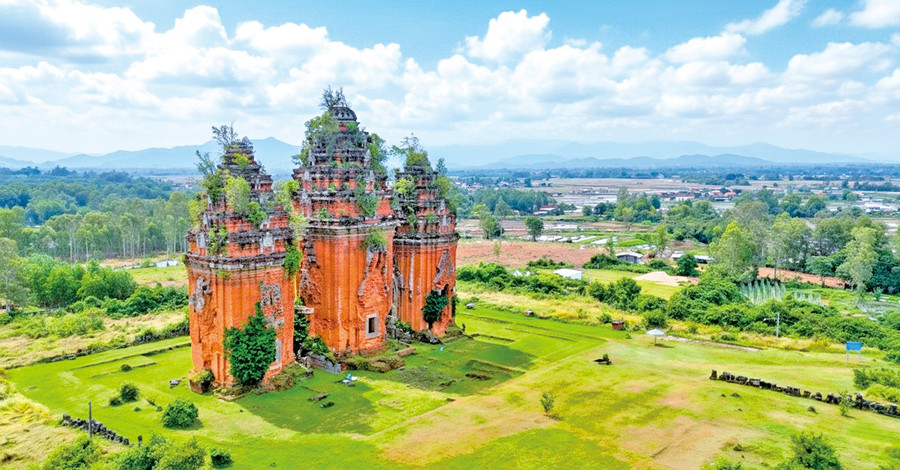
Within that system of imagery, the horse appears quite rarely. Not sanctified like the elephant, nor possessing the guardian function of Garuda or Naga, in Cham art, the image of the horse is usually not in a central position, but only appears on the pedestal of statues, the rim of altars, or in supporting narrative elements.
But precisely because of this, horses appear selectively and frequently, so that each appearance carries its own layers of meaning and connotations, linked to specific contexts that other imagery sometimes lacks, such as war, rituals, epics , or spiritual transformation.
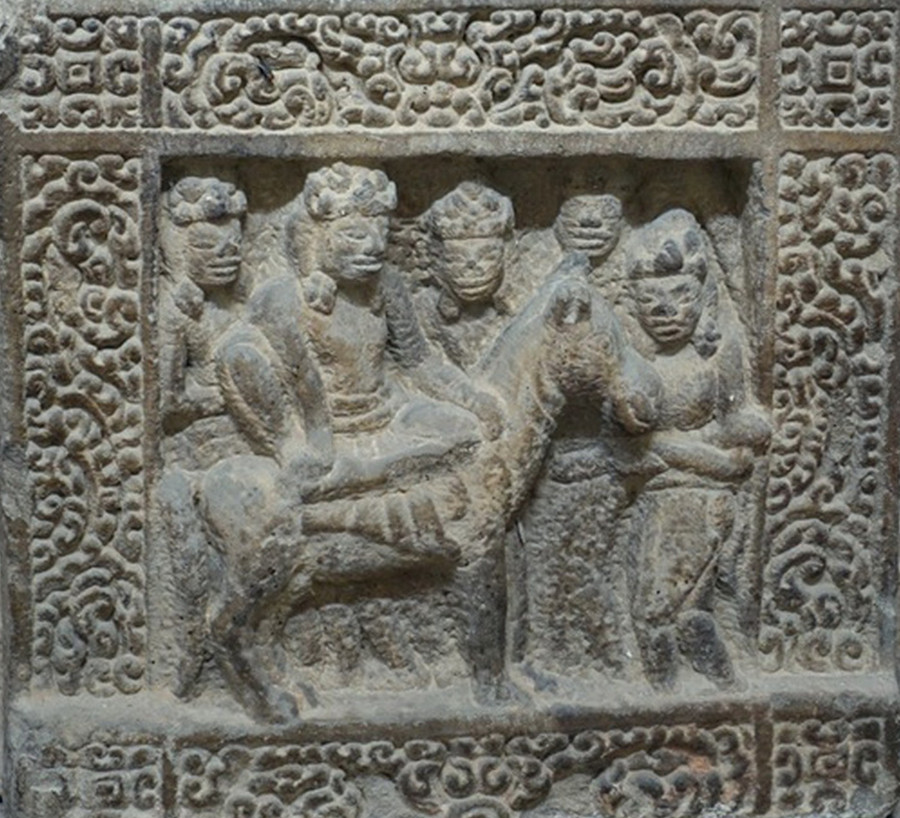
In Binh Dinh province, this rarity is even more pronounced. Compared to major centers like Tra Kieu, Dong Duong, or My Son, the image of the horse is almost absent in Binh Dinh Cham sculpture. Therefore, each artwork featuring a horse discovered here holds extremely special value, not only in terms of its form but also in terms of its underlying philosophy.
The imprint of Binh Dinh - War horses in the Mahabharata epic
Most notably, a sandstone carving dating from around the late 11th century, discovered in Binh Dinh and currently housed at the Da Nang Cham Sculpture Museum, depicts an excerpt from the Indian epic Mahabharata .
The artwork depicts three horse-drawn chariots chasing each other across a battlefield, creating one of the most dynamic and dramatic scenes in Cham art.
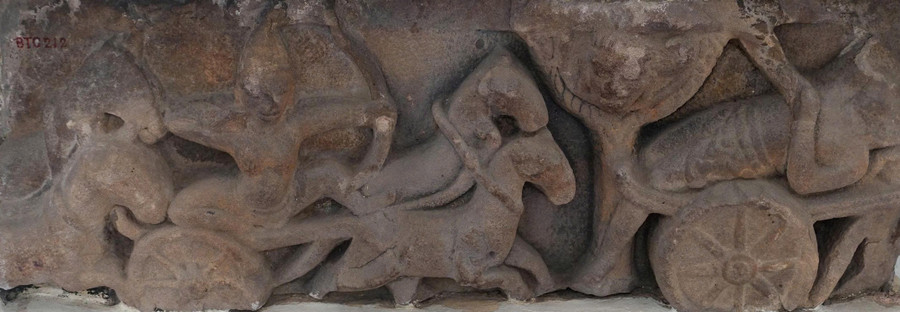
The horses in this carving have a very different appearance from many other Cham horse depictions. Their bodies are slender, their necks stretched out strongly, their legs long and powerful, and they are clearly shown in a galloping posture, pulling heavy chariots.
On the rear chariot, a warrior stands upright, drawing his bow and shooting forward. On the front chariot, a figure lies sprawled, their body limp, evoking a tragic moment of epic warfare.
Here, horses are no longer a supporting detail, but become the main driving force of the story. The rhythm of the horses' hooves guides the entire plot, leading to the climax of the chase, the arrow leaving the bowstring, and the fate of the characters.
This is one of the rare instances in Cham art where the horse figure plays a central role in terms of movement and drama – and I want to emphasize that.
Comparison with other Cham centers
When comparing the Mahabharata carvings from Binh Dinh with horse imagery from other Cham centers, the differences become apparent.
At Tra Kieu, in the Ramayana excerpt on the altar (second half of the 10th century), Prince Rama leads a procession to propose marriage to Princess Sita. Amidst the large crowd, only a single horse appears – short, stout, with a bell around its neck, walking slowly – bearing the appearance of a ceremonial horse, emphasizing its symbolic value rather than its fighting prowess.
Also at Tra Kieu, in the group of Apsara dancer statues (7th-8th centuries), the head of a war horse is placed between two graceful dancers, as a compressed symbol of mythological conflict.
In Dong Duong, a major Buddhist center of Champa (late 9th century), the horse Kanthaka in the scene of Prince Siddhartha's renunciation of worldly life symbolizes spiritual transformation; it does not gallop or fight.
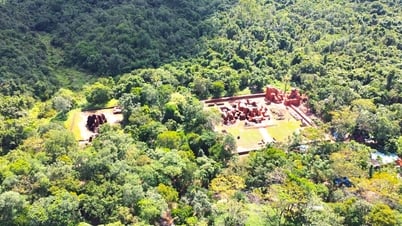
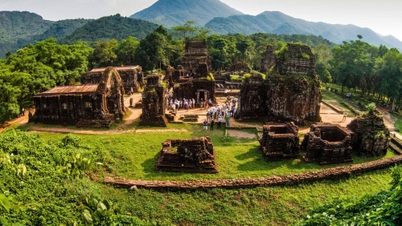
At Khuong My, horses are associated with the chariot of the sun god Surya, symbolizing the universe and time. At My Son, horses are the mounts of the wind god Vayu, the embodiment of natural forces.
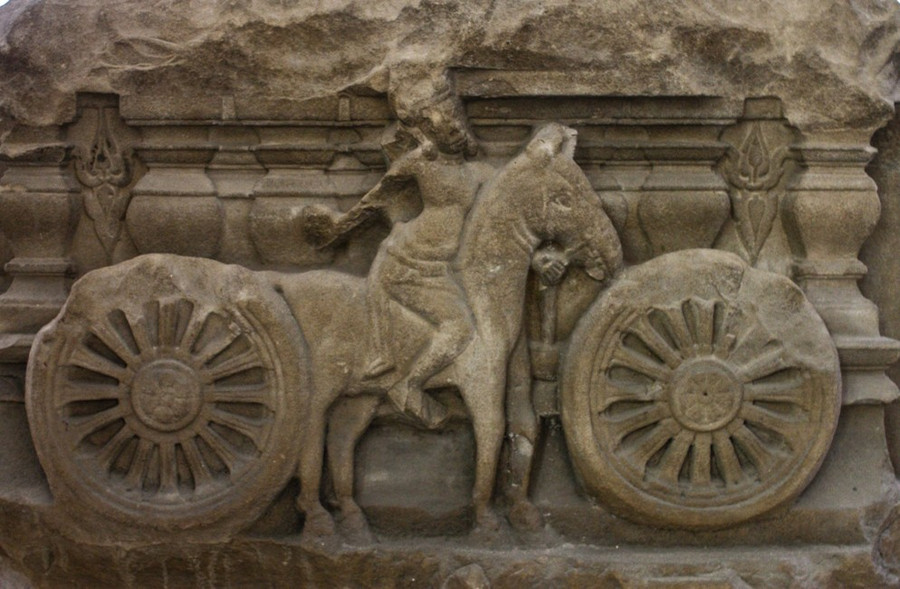
Looking at it from a broader perspective, the differences in horse imagery among Cham centers are not merely a matter of sculptural form, but also reflect the historical characteristics and cultural space of each region.
In early centers like Tra Kieu or Dong Duong, horses appeared in a restrained manner, primarily symbolic, serving rituals, religion, and storytelling. At My Son or Khuong My, horses were placed in relation to the universe and natural forces.
Meanwhile, the horses of Binh Dinh in the Mahabharata carvings are placed entirely within the space of war and epic heroism. The horses here are not ceremonial, not symbolic of the universe, not associated with spiritual transformation, but are true warhorses, pulling chariots, charging into pursuit and confrontation. It is this very choice that makes the Binh Dinh horses leave such a profound impression, like the sound of hooves compressed within each layer of stone.
Hoofprint sediment
The prominent presence of the Mahabharata theme and the image of war horses in Binh Dinh is no coincidence. From the 11th century, this region was an important political and military center of Champa.
In this context, epics, with their stories of war, honor, and destiny, become a suitable visual language. Throughout history, from the warhorses in ancient epics to the martial spirit of Binh Dinh in later times, there seems to be a continuous undercurrent within the cultural sediments quietly accumulated over centuries.
It is precisely in this rarity that the image of the horse in Binh Dinh emerges with the most powerful and direct role in Cham art. This shows that an image doesn't need to appear frequently to be important.
When placed in the right context, the horse—though not holding a central position in the symbolic system—can still carry a special weight, enough to represent the spirit of war, epic heroism, and the identity of an entire region.
***
In the midst of spring, as people reflect on their cultural identity, the sound of horse hooves echoing in the Cham sandstone of Binh Dinh still resonates – quietly but persistently – as a reminder that, before becoming the land of martial arts of today, a thousand years ago Binh Dinh was once the land of fierce and magnificent epics.
Source: https://baogialai.com.vn/tieng-vo-ngua-trong-tung-tho-da-post580050.html





































































Comment (0)