

NDO - On the afternoon of December 2nd, in Ba Ria-Vung Tau, Prime Minister Pham Minh Chinh, Chairman of the Southeast Region Coordination Council, chaired the fifth meeting of the Council with the theme "Double-digit Economic Growth in the Southeast Region by 2025: Challenges, Opportunities, and Solutions". Also attending was Comrade Nguyen Van Nen, Member of the Political Bureau and Secretary of the Ho Chi Minh City Party Committee.
In his opening remarks at the Conference, Prime Minister Pham Minh Chinh emphasized that this Conference would review and evaluate the work implemented after the fourth Conference; what lessons learned in leadership and guidance can be drawn to do better in the future? Obstacles must be resolved, and difficulties must be overcome. To successfully implement the Resolution of the 10th Central Committee Conference, 13th term, to promote the comprehensive, sustainable, and high-quality development of the Southeast region in the coming period, achieving a growth rate of 8-9% by 2025 is a huge challenge, but the opportunities are not few. Therefore, the Prime Minister stressed that the Southeast region is a key region making a significant contribution to the overall growth of the country; thus, this must be recognized as both a responsibility and a very heavy but extremely important obligation in development in 2025 and the 2026-2030 period.
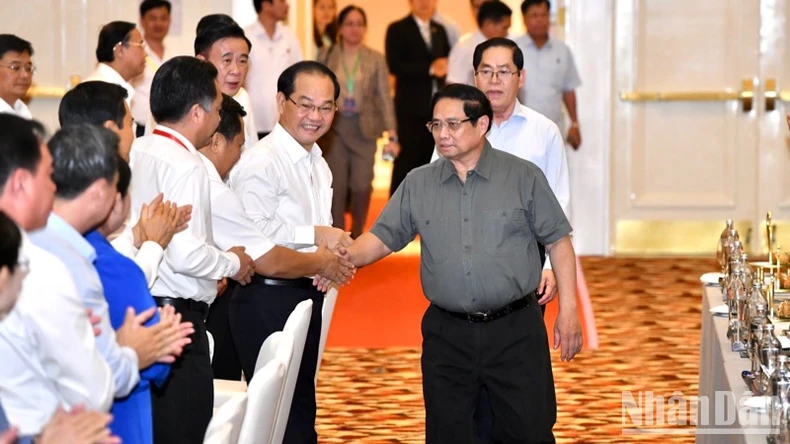 |
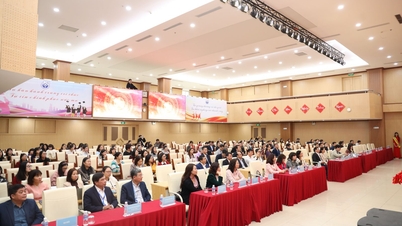
Prime Minister Pham Minh Chinh with representatives from the provinces and cities of the Southeast region attending the conference. (Photo: THANH GIANG) |
The Prime Minister stated that in 2025, the Southeast region must both accelerate and make breakthroughs, striving for an 8% economic growth rate, while simultaneously streamlining and reorganizing the administrative apparatus to ensure efficient and effective operation; and organizing Party congresses at all levels, leading up to the 14th National Party Congress. Therefore, the Prime Minister urged clear thinking, high determination, great effort, focused and targeted work, and ensuring each task is completed thoroughly. The Prime Minister requested delegates to find solutions to accelerate and make breakthroughs, review the targets for the 2021-2025 period; and to promote a spirit of daring to think, daring to act, and daring to innovate for the common good. He emphasized that what is said must be done, commitments must be fulfilled, and actions must yield concrete results. The Party has directed, the Government has agreed, the National Assembly has consented, and the people have supported; therefore, "we should only discuss action, not retreat."
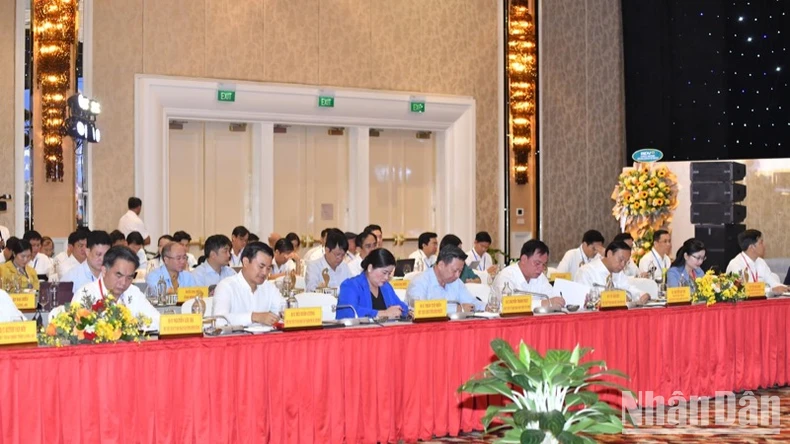 |
Representatives from the provinces and cities of the Southeast region attended the conference. (Photo: THANH GIANG) |
Regarding Long Thanh International Airport, the Prime Minister stated that the development of the Long Thanh airport ecosystem is related to the entire region, therefore a breakthrough is needed here. The Prime Minister has directed that a plan for building an airport city be developed, and the airport be operated efficiently. To achieve this, Long Thanh airport must have transportation connections with Ho Chi Minh City and surrounding areas.
The Prime Minister requested that the Secretaries and Chairmen of the People's Committees of provinces and cities, members of the Council, and representatives of ministries and sectors attending the conference discuss and clarify the situation regarding the implementation of tasks and solutions for the development of the Southeast region, identifying difficulties and challenges in implementing the Politburo's Resolution. They should clearly state what has been achieved and what has not, the reasons why, and the difficulties and challenges that need to be overcome. Regarding institutions, mechanisms, policies, resources, human resources, and finance, what issues arise in coordination work? What is the coordination within the region, inter-regionally, and between ministries, sectors, and localities? They should propose and recommend key directions, solutions, and specific tasks to be assigned to ministries, sectors, and localities. In particular, they must strive to achieve double-digit growth targets in the 2025-2030 period. What breakthrough solutions are there?
The Southeast region has many advantages, and logistics is also a solution that contributes to higher growth, reduces input costs, increases the proportion of logistics in the economy, and participates in the global logistics value chain; issues related to the Can Gio international container transshipment port; the implementation of the Ho Chi Minh City International Finance Center, and how to connect it with the Ho Chi Minh City Ring Road 4 Project?
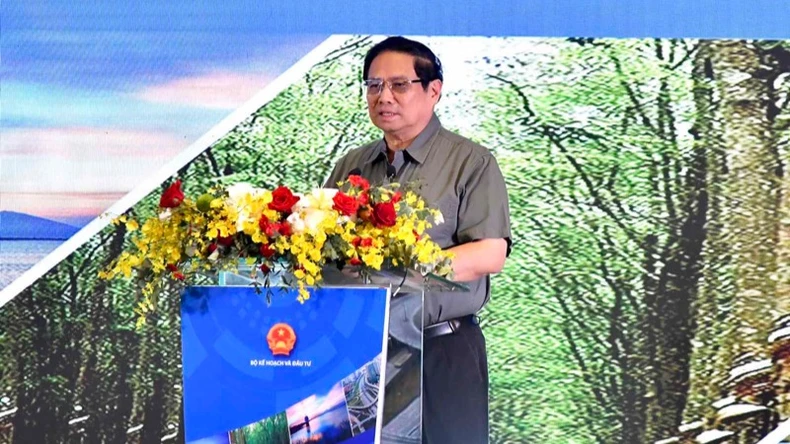 |
Prime Minister Pham Minh Chinh delivers a speech at the conference. (Photo: THANH GIANG) |
Regarding soft infrastructure, which is the institutional framework for the entire region, the Prime Minister requested that localities select a number of areas for breakthroughs and propose solutions; the issue of human resources is crucial for achieving double-digit growth. Each ministry, sector, and locality must strive and make efforts; we must choose major projects for breakthroughs, for example, the Ring Road 4, which will facilitate connectivity for the entire region; and then the roads connecting with Cambodia, Con Dao airport, etc.
The Prime Minister also emphasized that the Government, ministries, and agencies, together with Ho Chi Minh City, are striving to complete the flood control project for the city by December 2024.
* According to the Ministry of Planning and Investment, the GRDP growth rate of the Southeast region in 2024 is estimated at 6.38%, lower than the national average (the national average is estimated at 6.8%-7%); ranking 4th among the 6 economic regions. The region's GRDP in 2024 is estimated at VND 3,565.94 trillion; per capita income is estimated at VND 187.38 million/year, ranking first among economic regions and higher than the national average.
The service sector accounts for approximately 41-42% of the GRDP; the industrial and construction sector 45-46% (with manufacturing accounting for about 33%); and the agriculture, forestry, and fisheries sector 2-3%. Total state budget revenue in 2024 is estimated at VND 733.1 trillion, accounting for approximately 42.2% of the total national state budget revenue; an increase of 3.6% compared to the target set by the Prime Minister.
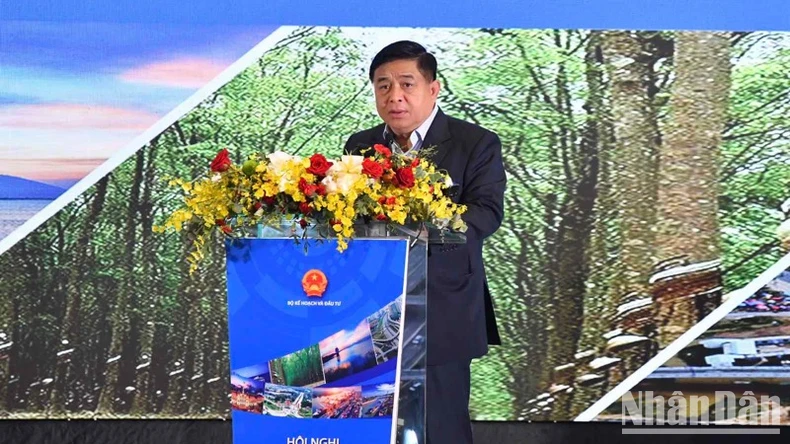 |
Minister of Planning and Investment Nguyen Chi Dung delivers a speech at the conference. (Photo: THANH GIANG) |
Regarding import and export in 2024: the region's export activities recovered positively, with an estimated export value of US$115.7 billion, accounting for 31% of the country's total export value; import turnover of the provinces also recovered, all increasing compared to the same period, with the entire region increasing by 11%. The Southeast region continues to lead the country in both the number of projects and the total amount of foreign direct investment implemented as of October 31, 2024, corresponding to 21,174 projects and US$189.011 billion, of which Ho Chi Minh City ranks first nationwide with the number of projects accounting for nearly 32.2% of the total projects and nearly 12% of the total registered capital.
In 2024, the Southeast region had the highest number of newly registered and reactivated businesses among the six economic regions, projected to increase by 9.8% compared to the same period. Regarding public investment disbursement: as of November 30, 2024, the region's disbursement reached VND 54,060 billion out of VND 147,650 billion as planned by the Prime Minister, achieving 36.61%, lower than the national average (54.79%).
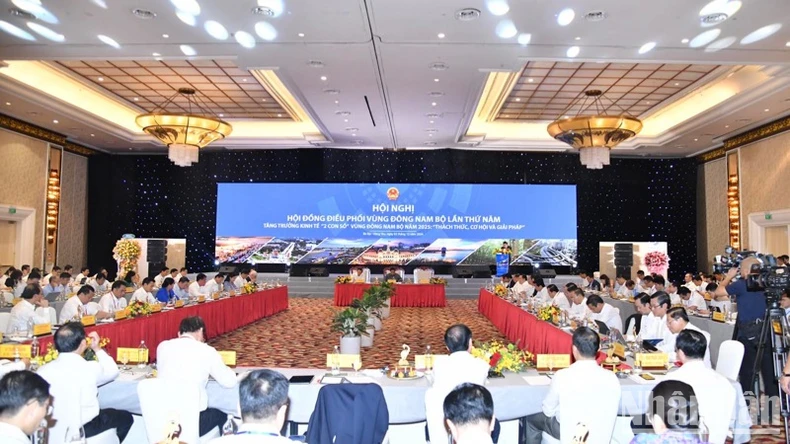 |
The conference scene. (Photo: THANH GIANG) |
Currently, the average GRDP growth rate of the region is trending downwards, lower than the national average growth rate; in order to fulfill its mission as a driving force and a growth pole for the whole country, it is necessary to promptly assess the causes and implement timely corrective solutions.
The Southeast region of Vietnam currently faces numerous difficulties and challenges such as traffic congestion, infrastructure shortages, flooding, and climate change adaptation, while its potential and advantages remain largely untapped. Transportation infrastructure has not kept pace with economic development; connectivity between localities and Ho Chi Minh City is incomplete and lacks synchronization; public investment disbursement has not met expectations, and obstacles to disbursement are slow to be resolved.
Industry is one of the three important pillars of the region, but its development is unsustainable, with low added value, irrational allocation, and heavy reliance on foreign-invested enterprises. Infrastructure connecting ports is a bottleneck; a diverse logistics service ecosystem has not yet been formed in the Southeast region to meet the needs of goods movement across the entire region, including: distribution centers, depots for trucks and empty containers, inland ports, etc.; customs services, specialized inspections, technical infrastructure, information technology, human resources, etc.
After listening to the opinions expressed by leaders of ministries, sectors, and localities, concluding the conference, Prime Minister Pham Minh Chinh assessed that the socio-economic situation in the Southeast region continues its positive recovery trend, achieving many important results in various fields, higher than the same period in 2023.
On behalf of the Government, the Prime Minister acknowledged, highly appreciated, and commended the efforts and significant achievements of the Party Committee, government, and people of the Southeast region and its localities in recent times, making important contributions to the overall achievements of the country. Alongside these positive results, the Prime Minister frankly acknowledged that the Southeast region still has limitations, shortcomings, and continues to face many difficulties and challenges.
The Prime Minister emphasized that in 2025, the whole country will still prioritize growth, striving for double-digit growth, while simultaneously ensuring macroeconomic stability, controlling inflation, and maintaining major balances. Regarding solutions, it is necessary to continue improving institutions; localities are urged to continue reviewing and identifying obstacles to propose amendments. To achieve growth, it is still necessary to renew traditional growth drivers such as investment, consumption, and exports, with a focus on disbursing public investment capital; concentrate on new growth drivers such as digital transformation, green transformation, circular economy, knowledge economy, and sharing economy; focus on and actively contribute to training high-quality human resources for the fields of artificial intelligence (AI) and semiconductors; change governance methods; propose mechanisms and policies to overcome difficulties, and build a common mechanism and policy to address difficulties for the entire region.
Regarding specific issues related to the Ho Chi Minh City Ring Road 4 Project, the Prime Minister assigned Ho Chi Minh City as the managing agency for investment, separating it into component projects, and assigning the component project of Binh Duong province to the province to handle first. Simultaneously, several mechanisms and policies for the project must be approved and submitted to the National Assembly in the first quarter of 2025, including specific mechanisms and policies such as direct contracting, capital mobilization, and bond issuance, ensuring that all procedures are completed by the first quarter of 2025 for implementation.
Regarding the Can Gio international container transshipment port, the Prime Minister instructed the Ministry of Transport and the Ministry of Planning and Investment to review the project and complete all procedures definitively by December 2024.
Regarding the construction of the Ba Ria-Vung Tau Free Trade Zone and the offshore wind power center, the Prime Minister requested the province to proactively work with the Ministry of Planning and Investment, the Ministry of Industry and Trade, and other relevant ministries to promote the project; review regional transportation projects, and ensure the completion of transportation projects connecting to Long Thanh Airport by 2025.
For Long Thanh International Airport, efforts must be made to essentially complete all items by 2025.
Regarding the project to build the Ho Chi Minh City International Finance Center, the Ministry of Planning and Investment and Ho Chi Minh City are striving to implement the necessary procedures this December, aiming to finalize the mechanisms and policies, and complete the Center in the first quarter of 2025.
Regarding the Binh Phuoc-Dak Nong and Ho Chi Minh City-Tay Ninh expressways, the localities assigned as investors should urgently implement the projects. If any obstacles arise, they should report back to the Government, and all procedures must be completed in the first quarter of this year.
The transportation routes connecting Long Thanh Airport with Tan Son Nhat Airport need to be reviewed to propose additional mechanisms and policies to accelerate the project.
Regarding breakthrough solutions, ministries and agencies need to specify them according to their functions, tasks, and powers, and not shirk responsibility. Accordingly, regarding land issues, the Ministry of Natural Resources and Environment must conduct research and consideration; regarding high-tech zones, the Ministry of Science and Technology must consider and resolve them definitively in the first quarter of 2025.
Regarding construction materials such as sand, the Prime Minister instructed the Ministry of Natural Resources and Environment and Deputy Prime Minister Tran Hong Ha to handle the matter, while the Ministry of Transport provided specific guidance on the use of sea sand as leveling material depending on each project.
Regarding the Loc Ninh-Ho Chi Minh City-Bien Hoa railway project, which connects Thi Vai-Cai Mep port and potentially Can Gio port, its effectiveness should be considered.
Regarding the disbursement of public investment capital, provinces are reviewing obstacles and bottlenecks and submitting written reports to the Government before December 10, 2024…; specifically for the flood control project in Ho Chi Minh City, the Government is determined to resolve the issue and issue a policy in 2024, striving to complete it in the first and second quarters of 2025.
Source: https://nhandan.vn/tim-giai-phap-tang-toc-but-pha-de-vung-dong-nam-bo-dat-muc-tang-truong-2-con-so-post848112.html
![[Photo] Closing Ceremony of the 15th Conference of the Central Committee of the 13th Party Congress](/_next/image?url=https%3A%2F%2Fvphoto.vietnam.vn%2Fthumb%2F1200x675%2Fvietnam%2Fresource%2FIMAGE%2F2025%2F12%2F23%2F1766462841764_a1-bnd-3731-1647-jpg.webp&w=3840&q=75)












![[Photo] Closing Ceremony of the 15th Conference of the Central Committee of the 13th Party Congress](https://vphoto.vietnam.vn/thumb/402x226/vietnam/resource/IMAGE/2025/12/23/1766462841764_a1-bnd-3731-1647-jpg.webp)













































Comment (0)