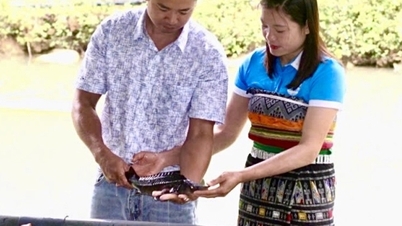
Join us as we head to the first stop on our journey: the home of Mr. Tan Mui Chinh, a Red Dao embroidery artisan, in Ta Ngao village, Ban Qua commune, Bat Xat district. There, we had an interesting interview with him, through which we learned a lot about the traditional embroidery craft of the Red Dao people.
Here's what we'd like to share:

Dao women are responsible, passionate, and proud of their work in creating patterns and decorations for their clothing. The value of a garment is determined by the system of patterns printed on it. The patterns express aesthetic concepts. They contain information about psychology, society, beliefs, historical development, and the process of cultural transformation.
The embroidery and decorative styles on Dao people's clothing include: cross-stitch, straight-line (stick) embroidery, patchwork, and silk (wool) appliqué. With stick embroidery, the embroiderer combines seemingly simple and rigid stick shapes to create concrete images with parallel and contrasting forms, while retaining the basic characteristics of the real figures. The stick shapes are essentially straight lines that the embroiderer shortens or lengthens to suit each detail. For example, the human figure – a demon… The women have omitted cumbersome and difficult-to-embroider details, simplifying the figures as much as possible, but this does not mean the motifs lose their original appearance. It is precisely these straight lines that easily create varying lengths and symmetrical balance when the Dao people use reverse embroidery techniques.

Cross-stitch embroidery involves constructing two lines in opposite directions at right angles to each other, forming a right angle. It represents a significant development in straight-line embroidery techniques. From using a single line to create specific shapes and patterns, it evolved to using two intersecting lines to create the desired design. While straight lines often give a sense of delicate form, cross-stitch creates a feeling of solid, continuous movement and distinct shapes.

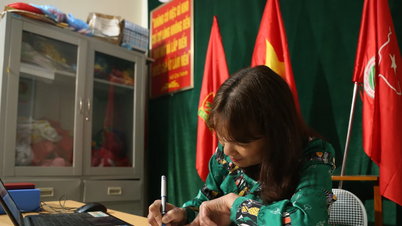
We also got to experience embroidering the Dao people's patterns. The Dao people's embroidery technique is quite unique. Unlike the Kinh people who use embroidery thread wrapped around the fabric threads, embroidering on the right side so the design is visible, the Dao people thread the embroidery thread through the gaps between the fabric threads on the wrong side so the design is visible on the right side. The embroidery patterns aren't pre-drawn but memorized and then embroidered from memory. Girls learning embroidery usually need a lot of patience to remember how to embroider the patterns.

Women often embroider whenever they have free time—at noon, in the evening, on rainy or cold days when they're not working; they hardly ever have time to rest. Girls are usually taught basic embroidery techniques by their grandmothers or mothers, and then gradually learn on their own through friends.

Finally, we also got to hear the elders in the village tell stories about the origins of the Dao people, about the entire life of a Dao woman intertwined with every stitch as she embroidered and sewed clothes for herself, her husband, and her children.




We truly appreciate those interesting stories and are grateful for the warm and enthusiastic welcome from your family and neighbors in the village. We hope to have the opportunity to return to this place!
The second leg of our field trip was to visit the family of artisan Sung Thi Xoa in Muong Hum commune, Bat Xat district, to learn about the traditional embroidery art of the H'mong people.
According to her, she has dedicated her entire life to embroidery. From the age of 9 or 10, she was taught embroidery by her grandmothers, mothers, and sisters, just as the Hmong proverb says:
Growing up, he followed his father to work in the fields.
Follow him into the forest to hunt animals.
Growing up, I learned embroidery from my mother.
According to her, the dress was dyed indigo and printed with floral patterns.
Upon reaching adulthood, she, like other Hmong girls, spared no time, working day and night to embroider her wedding dress. Hmong custom dictates that a woman's talent and beauty are judged by her embroidery skills and her wedding attire. A Hmong proverb says, " To know a good person, look at their kitchen; to know a beautiful woman, look at her clothes ." And weaving and embroidery were considered measures of a woman's worth:
A beautiful girl who doesn't know how to be clever is also ugly.
A pretty girl who doesn't know how to hold a needle is spoiled.
A beautiful girl is considered to be one who is as skilled at embroidery as a child's bottom.
A skilled embroiderer is highly regarded and respected by the entire community.




We also had the opportunity to observe many patterns on the traditional clothing of the Hmong people. It can be said that patterns and motifs are the most important elements that create the beauty of Hmong clothing. All the patterns here are extremely simple, originating from ancient stories, poems about the origins of the ethnic group, the natural landscapes where the Hmong people live, familiar plants, animals, and agricultural products. Common patterns include horizontal squares with borders in the shape of squares, crosses, nails, and spaced slanted lines, combined with rhombuses, triangles, circles, single and double swirls (hooks or S-shaped), sawtooth patterns, curves, and wavy lines... Inside are five-pointed, six-pointed, and eight-pointed stars, pumpkin flowers, garlic flowers, eggplant flowers, plum blossoms, peach blossoms, lotus flowers, spiderwebs, butterfly wings, fish scales, mugwort leaves, pine branches, bamboo buds, fishhooks, mountains and rivers, dragon tails, snails, snakes, goat horns...


At the end of our experience, we were still very impressed by the intricate patterns on the traditional H'mong and Dao ethnic costumes. These patterns not only enhance the aesthetic value of the clothing and showcase the uniqueness of their culture, but also reflect their way of life, traditional craftsmanship, and aesthetic sensibilities. It's truly a valuable treasure trove that we need to preserve, protect, and promote these traditional values.
Authors: Lu Thi Huong - Vang Minh Khoi
Source: http://laocai.edu.vn/chuyen-de-gddt/tim-hieu-van-hoa-theu-cua-dan-toc-h-mong-dao-280528